Linger – Open-source, local, personal agent
SimplexAI released Linger, an open-source personal agent that runs 125B MoE models on 12 GB consumer GPUs using the PolyStrata offloading engine.
By Dillip Chowdary • Nov 29, 2026 • Source: github.com
At a glance
- Product
- Linger
- Developer
- SimplexAI Labs
- Minimum VM memory
- 5 GiB RAM
- Target GPU memory
- 8 GB to 32 GB VRAM
- Availability
- macOS, Windows x64, Linux x64
- Pricing
- Open-source with zero token fees
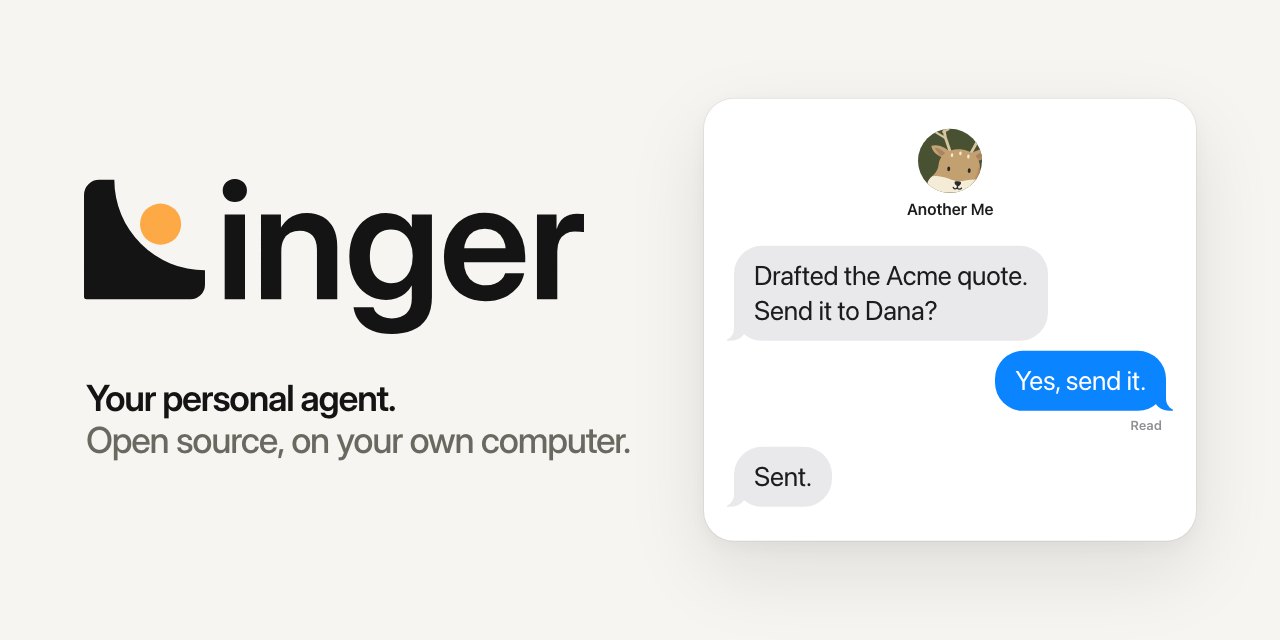
SimplexAI launched Linger, an open-source personal AI agent system engineered to run large language models locally on consumer hardware without remote token fees, according to github.com's report. The software runs local models directly on everyday desktop hardware, pairing an inference engine called PolyStrata with an autonomous personal assistant named Another Me.
This report examines Linger's offloading architecture, multi-model execution speeds, autonomous memory indexing, background task orchestration, and local deployment options. It is intended for software engineers, systems administrators, and privacy-conscious users seeking locally hosted automation without recurring cloud API fees.
01PolyStrata memory offloading and token speed
Linger employs the PolyStrata Mixture-of-Experts inference engine to partition model layers across system resources. The engine retains active expert parameters inside GPU memory while offloading inactive components to system RAM or solid-state storage. This co-design enables the 125-billion-parameter Qwen3.8-Flash-Next model to run on a 12 GB GPU paired with 64 GB of system RAM.
| Model | Laptop RTX 4070 8 GB | RTX 3060 12 GB | RTX 5090 32 GB |
|---|---|---|---|
| Qwen3.8-Flash-Next | — | 45.5 tok/s | 179 tok/s |
| LFM2.5-24B-A2B | 70–73 tok/s | 97.8 tok/s | 480–485 tok/s |
| Flint 40B-A2.5B | 61–63 tok/s | 65.5 tok/s | 251–252 tok/s |
| Qwen3.6-35B-A3B | 94–100 tok/s | 91.8 tok/s | 394–395 tok/s |
| Ornith 1.5 | 76–82 tok/s | 80–82 tok/s | 316–319 tok/s |
| Gemma 4 26B-A4B | 92–93 tok/s | 78.0 tok/s (Q4 file) | 353–356 tok/s |
| Tiel Coder 35B-A3B | 83 tok/s | 78.8 tok/s | 337–345 tok/s |
Writing speeds scale directly with memory bandwidth and compute headroom across consumer GPUs. The 32 GB RTX 5090 delivers peak throughput reaching 485 tokens per second on lighter MoE architectures.
02Model Autopilot hardware detection and tiering
Model Autopilot scans the host machine to profile available graphics cards, system memory, and interface bandwidth. SimplexAI evaluated 49 language models across two inference engines with quantizations ranging from 1-bit to 8-bit and context windows from 64K to 256K. Autopilot filters candidates requiring at least a 64K context window, selects the smartest viable model, optimizes for generation speed, and completes installation only after verifying a test query.
| Hardware | Recommended model | Writing speed | SimplexAI score | Compares with |
|---|---|---|---|---|
| Mac 16 GB | Spark-X2.6-4B Q4_K_M | 41 tok/s | 31.5 | ≈ Gemini 2.5 Pro |
| Mac 24 GB | Inkling 2 Mini UD-IQ3_XXS | 29.9 tok/s | 53.4 | ≈ Claude Sonnet 4.6 |
| Mac 32 GB | Inkling 2 Mini UD-Q4_K_M | 30 tok/s | 54.2 | ≈ Claude Sonnet 4.6 |
| Linux NVIDIA 8 GB + 32 GB | Inkling 2 Mini UD-Q3_K_XL | 50 tok/s | 53.9 | ≈ Claude Sonnet 4.6 |
| Linux NVIDIA 12 GB + 32 GB | Inkling 2 Mini UD-Q3_K_XL | 68 tok/s | 53.9 | ≈ Claude Sonnet 4.6 |
| Linux NVIDIA 24 GB + 64 GB | Qwen3.8-Flash-Next GSQ-RCO IQ2_XS† | 128.5 tok/s | 58.8 | ≈ Claude Opus 4.6 |
Recommended profiles balance quantization depth against execution speed across Apple silicon and x64 platforms. High-end Linux workstations achieve top reasoning tiers by pairing 24 GB video cards with 64 GB of host memory.
Advertisement
Tech Pulse Daily
Get tomorrow's pulse first
Join engineers who read Tech Pulse before stand-up. Free, weekday mornings.
03Another Me memory wiki and dreaming
The Another Me assistant processes historical inboxes, chats, and meetings into searchable markdown wiki entries. Every night, the system indexes new conversations into structured pages accessible across all local subagents. All personal data, contextual records, and operational decisions remain strictly on the local device rather than external vendor servers.
Another Me monitors email, calendars, and Slack to advance pending items without manual prompting. A nightly optimization process called Dreaming evaluates how earlier messages landed and modifies decision rules without model retraining. Two consecutive rejections establish a silence rule, while direct corrections alter operational timing in a single overnight cycle.
04Desktop orchestration and background agent delegation
Linger interacts with native desktop environments by clicking and typing across macOS, Windows, and Linux applications. On macOS and Windows, agents access standard Chrome profiles with existing session logins intact. Voice modules record meetings, build live transcripts, answer factual queries, and pass follow-up tasks to Another Me.
Complex objectives execute across multi-agent teams coordinated through a shared team.md configuration file. Primary agents hand intensive tasks to background workers while maintaining active chat sessions with the user. A central model scheduler prioritizes interactive conversational queries and defers background jobs until local compute resources idle.
05Desktop beta setup and Docker deployment
Single-user deployments use the standalone desktop application available across major operating systems. The software connects the workstation, configures local agents, and provides an optional local server installation.
Note: The desktop app is in beta under active development, and users may encounter Windows SmartScreen warnings because the installer is unsigned.
Shared environments and multi-machine setups deploy through Docker Compose on hosts with at least 5 GiB of dedicated memory.
- Clone repository run git clone https://github.com/simplexai-labs/linger.git and enter the directory.
- Configure environment copy .env.example to .env to set up local environment variables.
- Build containers execute docker compose up --build --detach --wait to launch services.
- Create owner pipe the initial password into teamhub-account create-owner to initialize credentials.
- Run model installer execute ./scripts/install/install.sh on Unix or install.ps1 on Windows.
Frequently asked questions
What hardware is required to run the 125B Qwen model locally?
The 125B Qwen3.8-Flash-Next model requires a 12 GB GPU paired with 64 GB of system RAM using the PolyStrata inference engine.
How does Linger adapt its autonomous behavior without model retraining?
The Dreaming process reviews message interactions each night and updates a concise list of behavioral rules based on user reactions.
Can Intel Macs run the native Linger desktop application?
No, the prebuilt desktop package supports Apple silicon Macs on macOS 14.0 or later, while Intel Macs must use Docker Compose.
What external agent runtimes can connect to Linger?
Users can bring Claude Code, Codex, or Pi runtimes to execute on local models or existing subscriptions.
Sources

Author
Dillip Chowdary
Writes Tech Bytes coverage of AI, engineering, and the tools that actually ship. Editor of Tech Pulse Daily.
Related on Tech Bytes
Advertisement