Long-Term Memory for a 32K Local Agent: Testing Mnemonic Proxy
Mnemonic Proxy 0.3.24 preserved full conversation history across nine benchmark turns within a 32K window, avoiding the context failure of a 128K model setup.
By Dillip Chowdary • Nov 29, 2026 • Source: sotaaz.com
At a glance
- Product
- Mnemonic Proxy
- Software version
- 0.3.24
- Base context limit
- 32,768 tokens
- Hardware allocation
- 6,568 to 6,580 MiB VRAM
- Task duration limit
- 30 minutes per turn
- Software status
- Experimental release
Developers released Mnemonic Proxy 0.3.24, a local mediation service that converts coding agent conversations into persistent long-term memory without expanding server token limits, according to sotaaz.com's report. The proxy sits directly between an autonomous coding assistant and a local inference backend, replacing verbose tool outputs with concise one-line receipts while preserving verbatim historical text in a dedicated local disk archive.
This technical breakdown evaluates multi-turn benchmark experiments comparing native long context windows, standard agent conversation compaction, and proxy-based archival storage using Qwen3.5-9B on an NVIDIA A100 graphics processing unit. The analysis examines GPU memory consumption, context window exhaustion, and file reading loops for machine learning practitioners building local agent systems.
01Context window constraints and memory allocation
Large language models retain no internal memory between distinct user queries and must re-read an entire interaction history with every incoming prompt. This architectural constraint turns conversation history into a growing token payload that eventually hits the model context boundary. When cumulative prompts and file contents exceed this limit, the underlying inference server rejects further requests.
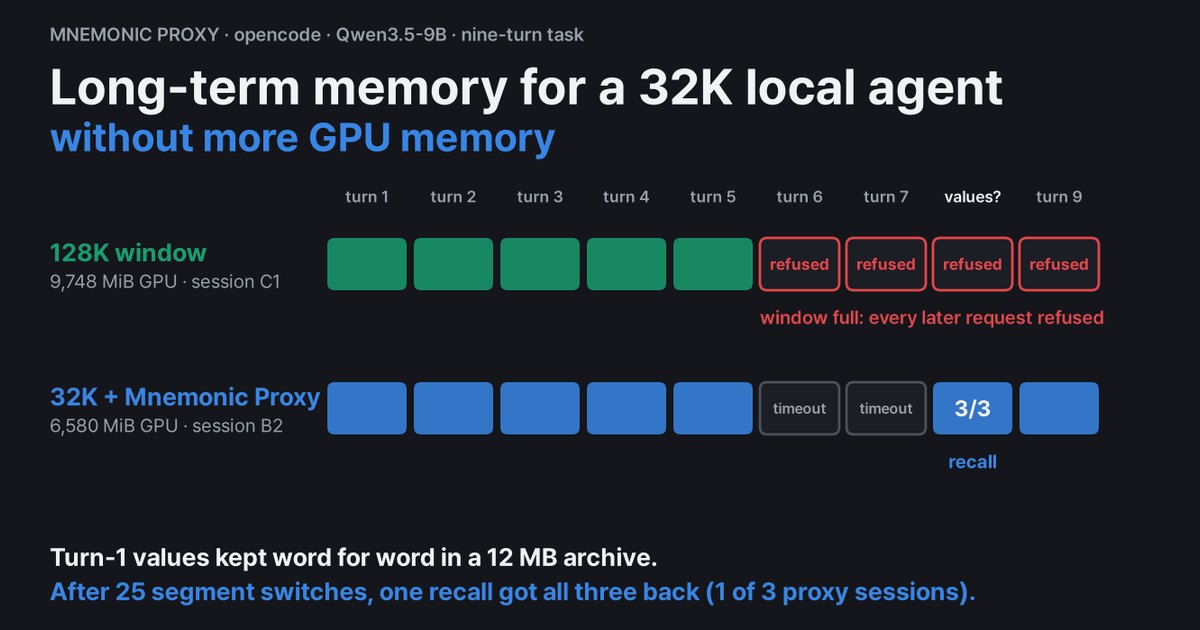
Expanding hardware capacity to accommodate longer conversations introduces significant hardware overhead. Testing a local server with a 32,768-token window consumed 6,580 MiB of graphics memory on an A100 system. Quadrupling the context boundary to 131,072 tokens increased graphics memory consumption to 9,748 MiB, yet full source files and command outputs still exhausted the expanded space rapidly.
Traditional memory systems address growth by compacting older conversation turns into brief summaries when context windows fill up. The opencode agent includes built-in compaction to shrink prior exchanges, but summarization permanently discards fine-grained technical data. Any specific compiler flags, configuration settings, or raw output omitted from the generated summary cannot be recovered later in the session.
02Single-line receipts and local archive retrieval
Mnemonic Proxy replaces destructive conversation pruning by moving historical content into an offline local text archive. Whenever a tool produces verbose console logs or file data, the proxy intercepts the response, writes the original text to disk, and presents the model with a one-line receipt. This receipt confirms the action while keeping active context usage minimal.
The model accesses historical records through an integrated recall tool that searches the archive and restores necessary passages on demand. As active tokens approach the 32,768 boundary, the agent compiles concise handoff notes before the proxy initiates a fresh conversation segment. The proxy maintains continuous dialogue within the fixed context footprint across dozens of consecutive segments.
For persistent workflows running on llama-server, the proxy synchronizes backend engine state directly to disk storage. This serialization ensures that a restarted inference process resumes immediately without recalculating prior context tokens from scratch. The agent retains full access to earlier interaction records through the archive while preserving predictable hardware resource boundaries throughout the session.
03Containerized nine-turn agent benchmark architecture
Advertisement
Tech Pulse Daily
Get tomorrow's pulse first
Join engineers who read Tech Pulse before stand-up. Free, weekday mornings.
The benchmark suite evaluated Mnemonic Proxy 0.3.24 against alternative memory strategies using opencode 2.0.32 and llama.cpp build 947. Every test executed the Qwen3.5-9B model with Q4_K_M quantization at temperature 0.6 and random seed 42. Testing took place inside an isolated software container with external network access disabled, passing only the local model server port through to the environment.
The experimental workload assigned the agent a nine-turn software engineering task based on the Click repository. Individual turns carried a 30-minute execution cap, with turns eight and nine restricted to 10 minutes and total session duration capped at 90 minutes. Independent evaluation relied on 18 hidden automated unit tests alongside exact string matching for target metric recovery.
| Setup | Context window | Proxy configuration | Agent compaction |
|---|---|---|---|
| Setup A: compaction | 32,768 tokens | None | Built-in compaction enabled |
| Setup B: proxy | 32,768 tokens | Mnemonic Proxy with state saving | Compaction disabled |
| Setup C: big window | 131,072 tokens | None | Compaction disabled |
04Retrieval accuracy and context window exhaustion
Testing revealed stark contrasts in stability and retrieval accuracy across the three configurations. Across three sessions using standard compaction, the agent failed to recover a single metric from turn one, returning unknown for all values. The expanded 131,072-token window in Setup C exhausted available memory around turn six, causing the model server to reject all subsequent prompts.
In contrast, all three sessions operating through Mnemonic Proxy completed the full nine-turn sequence while remaining within the baseline 6,568 to 6,580 MiB memory allocation. One proxy session initiated 25 distinct segment handoffs and successfully recovered all three target values using a single recall invocation. Across all proxy runs, the complete turn-one log persisted inside a 9 to 12 megabyte local archive.
Autonomous retrieval depended heavily on model prompting during final reporting turns. When asked to report initial metrics in turn eight, only one proxy session invoked the recall tool autonomously.
After receiving a turn-nine hint identifying the initial script, two proxy sessions retrieved and reported all three values accurately. No session hallucinated answers, writing unknown whenever data was missing.
05Compaction loops and experimental benchmark scores
Analysis of session transcripts uncovered severe execution loops caused by agent compaction during file inspection. In Setup A, the agent repeatedly called its read tool without offset parameters, receiving only the first 1,313 lines of click/core.py. The resulting summary recorded that the file had been examined but omitted its source code, prompting the agent to read the identical segment 507 times.
Similar repetitive behavior emerged during turn five, where an agent in the compaction group executed 311 redundant reads across three shorter files before exhausting its time allotment. Conversely, sessions equipped with Mnemonic Proxy or native context correctly tracked line offsets, requesting line 1,314 onward to complete module documentation. The proxy configuration matched or exceeded compaction setups on hidden unit tests, averaging 10.0 passes.
Note: Project maintainers noted that combining opencode with llama-server remains experimental because the configuration has not undergone long real-world development sessions. On the separate benchmark reported in the project repository, the proxy configuration scored 86 and 85 across runs, whereas conversation summarization scored 47 and 57.
Frequently asked questions
How does Mnemonic Proxy store conversation history?
It intercepts agent tool outputs and stores the complete raw text in a local disk archive. In active context, it replaces verbose output with a one-line receipt and provides a recall tool to retrieve the original data.
How much GPU memory did Mnemonic Proxy save in testing?
Running a 32K context window with Mnemonic Proxy used between 6,568 and 6,580 MiB of GPU memory. Running the same model with an expanded 128K context window required 9,748 MiB before failing due to context limits.
Why did built-in conversation compaction fail during file reading?
Compaction generated summaries stating a file had been read but omitted the actual file contents. Because the agent lacked the source code to perform analysis, it repeatedly read the same 1,313 lines hundreds of times.
Did the agent hallucinate missing setup values?
No session hallucinated any missing figures during testing. Whenever the model could not locate values using search or compaction, it wrote unknown as instructed.
Sources

Author
Dillip Chowdary
Writes Tech Bytes coverage of AI, engineering, and the tools that actually ship. Editor of Tech Pulse Daily.
Related on Tech Bytes
Advertisement