MCP servers are more than just tools news update
Under the 2026-07-28 Model Context Protocol specification, server instructions moved to discovery results and Claude Code truncates them at 2,048 characters.
By Dillip Chowdary • Oct 17, 2026 • Source: pournasserian.com
The Model Context Protocol specification update published on 2026-07-28 moved server instructions from initial connection handshakes into discovery responses. As detailed in pournasserian.com's report, instructions now operate as an optional plain-text field returned within server/discover responses and cached alongside ttlMs and cacheScope parameters. Under prior specifications from 2025-11-25 and earlier, instructions were bundled into the initialize handshake result, but client hosts now cache discovery metadata independently.
This technical analysis examines how agent hosts consume server instructions, how tool search alters routing decisions, and how developers configure instruction blocks across client runtimes. The report serves software engineers and system architects developing servers with official development kits. As hosts adopt on-demand schema loading, understanding how language models parse server summaries and coordinate instructions with tools, prompts, and skills is essential for building reliable agent architectures.
MCP servers vs just tools news update: what actually changed
The architectural adjustment in the 2026-07-28 specification centers on where server metadata resides and how client software fetches it across sessions. In the legacy 2025-11-25 protocol era, instructions formed an optional field inside the initialize handshake result that concluded host startup. Under the 2026-07-28 specification, instructions shifted to an optional field of the server/discover endpoint result. This repositioning allows client hosts to cache instruction text alongside discovery parameters using ttlMs and cacheScope settings, optimizing multi-session agent connections without requiring repeated connection handshakes.
Although instructions now have a standardized location in discovery responses, client consumption remains optional under the protocol. Calling server/discover is optional for clients, and nothing in the standard requires hosts to insert the received text into a model prompt. Host environments like Claude Code read instructions alongside tool names at session startup, while other runtimes bypass discovery text entirely. Developers must therefore treat the field as host-specific guidance rather than a guaranteed channel that every client environment delivers directly to its underlying language model.
MCP servers vs just tools news update: how it works
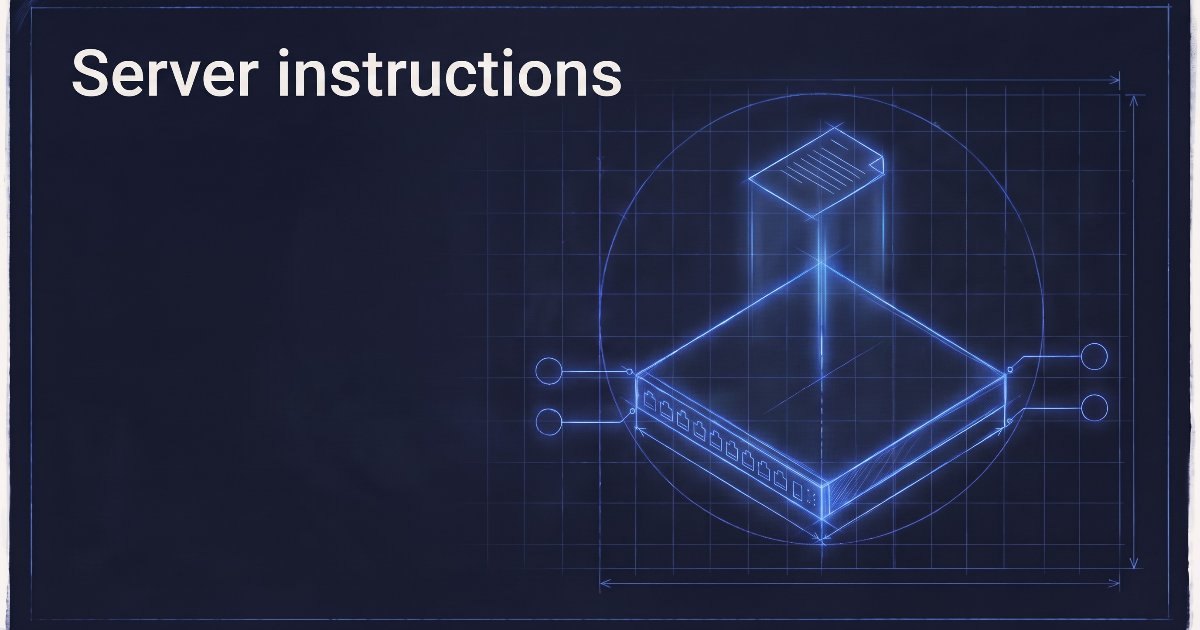
In modern agent hosts, server instructions serve as the primary routing mechanism for deferred tool discovery. Hosts managing multiple connected servers no longer load every tool schema into model context upfront. In October 2026 implementations of Claude Code, the runtime loads only tool names and server instructions into the system prompt at session start. When a user assigns a task, the model reads the instructions paragraph and tool names to determine whether the request matches the server before initiating tool search to fetch complete schemas.
If the model determines that a task does not match the server, the server stays dormant without adding tool schemas to context. When a task matches, tool search retrieves full schemas for matching functions before proceeding to tools/call. Official development kits handle protocol transitions automatically. Verification with the official Python SDK mcp 2.3.0 on 8 October 2026 showed that setting instructions on MCPServer delivers the string to 2026-07-28 discovery clients while maintaining identical text for legacy initialize clients connecting in backward-compatible mode.
Advertisement
Tech Pulse Daily
Get tomorrow's pulse first
Join engineers who read Tech Pulse before stand-up. Free, weekday mornings.
MCP servers vs just tools news update: why it matters now
Writing an effective instructions block determines whether an agent correctly routes user tasks to connected tools. Official guidance dictates that an instructions block should address four foundational questions: server purpose, boundary conditions regarding when to use or avoid it, workflow sequences across tools, and operational constraints. Defining clear boundaries avoids misrouting across overlapping servers. Detailing tool relationships, such as searching before fetching full records, provides execution structure. Stating constraints like rate limits and cache refresh cadences informs the model of system boundaries before invocation begins.
A reference implementation for an internal engineering documentation server called Acme Docs demonstrates this four-part structure across a 547-character paragraph. The opening sentences define the domain for runbooks, architecture decision records, and API references while restricting use on general programming tasks. The workflow specifies calling search_docs first and passing doc_id to fetch_doc, pointing to skill://incident-runbook/SKILL.md for runbook procedures. The constraints note that search_docs is inexpensive, fetch_doc caps output at 20,000 characters, document identifiers remain stable, and documentation content updates on a nightly schedule.
MCP servers vs just tools news update: who is affected
Developers deploying servers into agent environments must structure instruction text to fit runtime truncation limits. As of October 2026, Claude Code truncates server instructions and tool descriptions at a default threshold of 2,048 characters. Critical operational boundaries, sequence orders, and server capabilities must appear near the beginning of the text to prevent vital context from being dropped. Teams building servers using the Python SDK or C# SDK options must treat instruction blocks as version-controlled product copy, auditing text whenever tool interfaces change.
Engineering teams must distinguish server instructions from prompts and skills. Instructions load at session start to orient tool routing, prompts load user-selected message workflows, and skills load procedural directories containing SKILL.md files. Furthermore, developers cannot rely on instructions for security enforcement. Because robust hosts treat instruction strings as untrusted text, security controls and input validations must execute within server application logic rather than trusting the language model to follow plain-text operational limits or permissions outlined directly in the discovery payload.
MCP servers vs just tools news update: what to watch
Host platforms and registry reviewers are actively enforcing safeguards against instructions containing prompt injection. Phrasing that commands the model to prioritize a server over competitors or ignore previous directives is rejected by ecosystem reviewers and marketplace rulebooks. Promotional claims and aggressive hijacking phrases mimic tool-poisoning attacks that compromise agent execution paths. Developers must omit redundant tool descriptions from instructions since schemas load dynamically through tool search. Instructions should focus strictly on server domain, workflow ordering, and concrete operational limits.
Engineering teams should test custom servers in environments with tool search enabled to verify that models trigger schema retrieval for intended user tasks. Because calling server/discover remains optional under the specification and host handling varies across client software, testing ensures language models route queries accurately. Developers should evaluate whether the model reads instructions at session start, initiates tool search for appropriate requests, and executes subsequent tools/call operations without misrouting. Measuring these interactions under realistic tool loads remains the primary benchmark for evaluating MCP server discoverability under the 2026-07-28 protocol specification.
Developer Action Items
- ☐ Verify the claim on the official Claude / Python page (or HN AI Agents), not from this recap alone.
- ☐ Name the surface that moved — API, policy, model, hardware, or commercial terms — before you Slack the thread.
- ☐ Assign one owner a day to read the primary material and decide: this-sprint, this-quarter, or noise.
- ☐ Do not change production on day-one coverage. Watch the vendor changelog and one independent write-up first.
MCP servers vs just tools news update FAQ
Where do server instructions reside under the updated Model Context Protocol?
Under the 2026-07-28 specification, instructions reside as an optional plain-text field in the server/discover result, cached using ttlMs and cacheScope. In protocol versions from 2025-11-25 and earlier, instructions were part of the initialize handshake result.
How does Claude Code handle MCP server instructions during a session?
Claude Code loads tool names and server instructions into the system prompt at session start while deferring full tool definitions until needed. By default, it truncates server instructions and tool descriptions at 2,048 characters.
What key questions should an MCP server instructions block answer?
An effective instructions block answers what the server is for, when to use it and when not, how tools fit together in sequence, and operational constraints such as rate limits and data freshness.
How do server instructions differ from prompts and skills?
Instructions load at connection time to orient tool routing, prompts are user-selected message workflows, and skills are selectable procedural directories containing a SKILL.md file.
Sources

Author
Dillip Chowdary
Writes Tech Bytes coverage of AI, engineering, and the tools that actually ship. Editor of Tech Pulse Daily.
Related on Tech Bytes
Advertisement