Microsoft’s new AI chip makes it less reliant on Nvidia’s GPUs
Microsoft announced its Maia 300 custom AI chip, built on TSMC's N2P node to deliver 40 percent more tokens per megawatt ahead of a 2027 production rollout.
By Dillip Chowdary • Oct 12, 2026 • Source: The Verge
Microsoft announced its third-generation in-house artificial intelligence processor, Maia 300, positioning custom silicon as the central operational backbone for its consumer and commercial cloud ecosystem. Detailed in The Verge's report, the accelerator is engineered specifically to serve as the primary inference system across Azure and first-party software suites. By shifting intensive model serving away from third-party merchant suppliers toward proprietary hardware designs, Microsoft aims to drastically alter the cost curve and thermal economics of operating generative models at planet scale.
This breakdown examines the technical architecture, throughput claims, rollout schedule, and production targets behind Microsoft’s third-generation custom silicon effort. Enterprise software teams deploying large-scale inference endpoints, platform architects tracking Azure capacity developments, and engineering organizations measuring compute infrastructure overhead will find an analysis of how this platform transition reshapes cloud capacity. The transition reflects an escalating effort across hyperscalers to mitigate reliance on external component suppliers while controlling power distribution budgets across centralized data center campuses.
Microsoft’s new AI chip makes it less reliant: the announcement
Microsoft formally unveiled Maia 300 on October 12, 2026, marking the latest iteration of its custom accelerator roadmap aimed directly at reducing systemic dependence on hardware from Nvidia and AMD. The silicon will function as the primary artificial intelligence inference platform across the entire software portfolio, operating production workloads directly within Azure data centers. Cloud group executive vice president Scott Guthrie confirmed that Microsoft intends to expand the Azure Maia family to multi-gigawatt server deployments beginning in 2027, establishing an operational foundation designed to ingest high-volume corporate inference demands internally rather than renting external accelerator pools.
The engineering timeline represents a fast execution cadence following the Maia 200, which was announced in January 2026. The prior-generation Maia 200 already handles live production traffic for flagship products, including Microsoft Copilot, GitHub Copilot, Microsoft Foundry, and first-party internal foundation models. Guthrie characterized Maia 200 as the best-performing infrastructure component inside the current fleet when assessed by live operational telemetry, establishing the operational baseline that the upcoming hardware revision will expand across global server clusters.
What actually changed with Microsoft’s new AI chip makes it less reliant
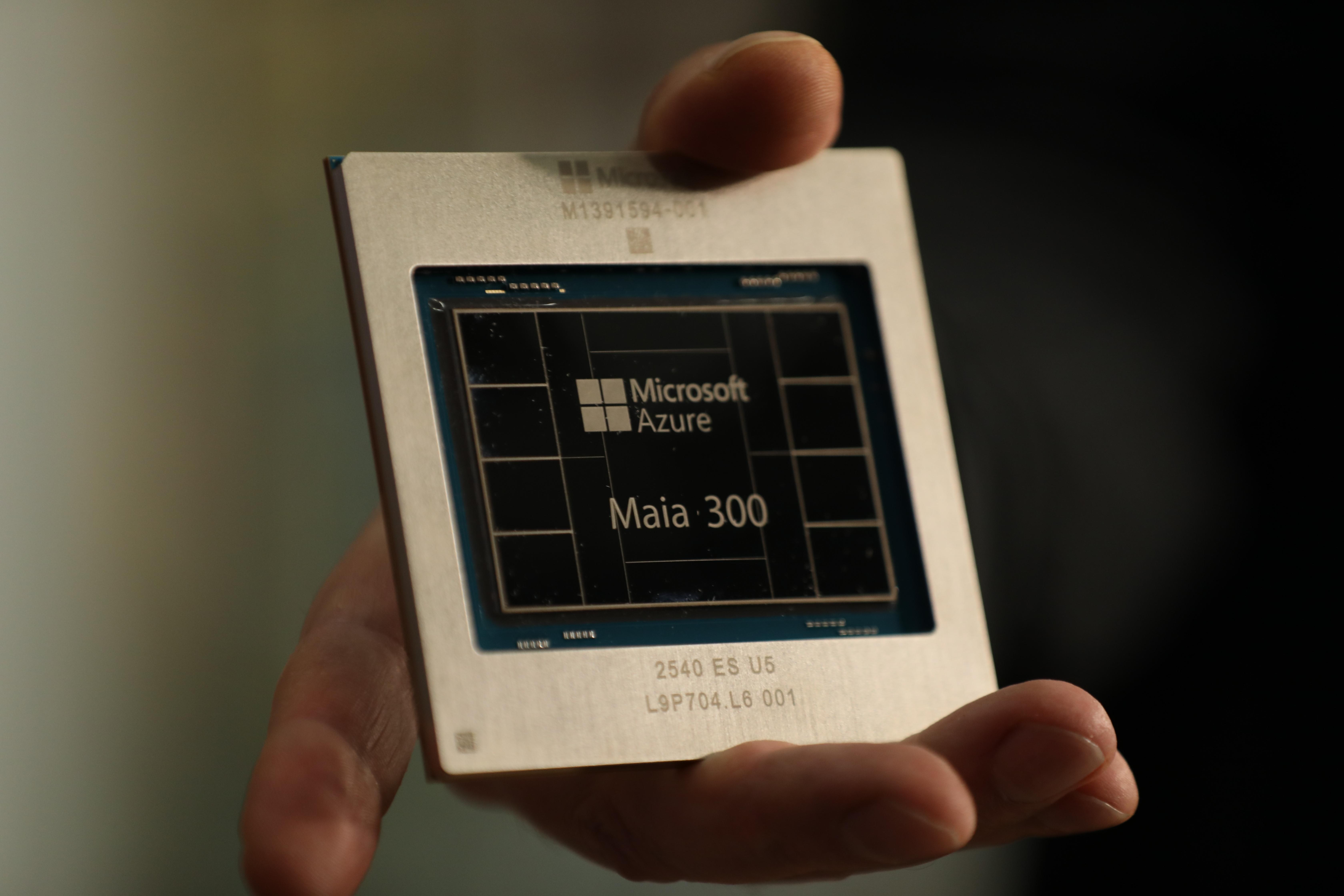
Under the hood, Maia 300 transitions to TSMC’s advanced N2P process node and adopts a dedicated modular chiplet packaging architecture. This structural configuration isolates raw compute units, memory controllers, and input/output pathways onto dedicated silicon dice instead of relying on a single monolithic slab. The Azure hardware and infrastructure engineering team explained that physically splitting these functions expands the total die surface area reserved exclusively for computational logic, while allowing auxiliary subsystems to run on packaging processes optimized specifically for their respective tasks.
The architectural overhaul translates directly into measured power and throughput advantages at scale. Microsoft projects that Maia 300 will achieve forty percent greater token processing efficiency per megawatt than leading comparative graphics processor clusters operating in equivalent environments. Furthermore, when deployed within standard ninety-six accelerator rack chassis, the configuration delivers up to a sevenfold increase in rack-scale token throughput over Maia 200 hardware, providing the sustained capacity necessary to serve memory-intensive conversational platforms and multi-step agentic workflows without tripping power thresholds.
Advertisement
Tech Pulse Daily
Get tomorrow's pulse first
Join engineers who read Tech Pulse before stand-up. Free, weekday mornings.
Who should care about Microsoft’s new AI chip makes it less reliant
Organizations building on top of Microsoft Copilot and Azure OpenAI developer endpoints represent the primary constituency affected by this hardware migration. Because inference serving costs scale linearly with user adoption and interaction depth, shifting high-frequency workloads to custom silicon directly curbs operational compute overhead. Mustafa Suleyman, chief executive officer of Microsoft AI, emphasized that model development requires vertically integrated alignment down to raw silicon, arguing that proprietary platforms co-designed with internal models are essential for closing operational gaps with competitors like Google DeepMind, Anthropic, and OpenAI.
Software engineers designing agentic pipelines that run iterative reasoning chains will also see the direct impact of the tailored hardware profiles. Microsoft intentionally targeted Maia 300 at complex computational profiles characterized by sustained multi-step autonomous execution, long-context window evaluation, and latency-sensitive dialogue systems. Rather than optimizing exclusively for traditional batch inference processing or generalized dense matrix training operations, the underlying layout accelerates complex logic patterns where intermittent memory stalls and context lookups traditionally introduce latency spikes during active client interactions.
How to try Microsoft’s new AI chip makes it less reliant
Individual developers and enterprise customers cannot purchase individual Maia 300 physical boards or reserve immediate virtual machine instances today, as the hardware is slated to begin rolling out to live production clusters in 2027. Because Microsoft treats the Maia family as a foundational infrastructure tier rather than a standalone merchant component, access will come indirectly through standard application programming interfaces that connect to Azure AI services, Microsoft Foundry, and Copilot tools as capacity comes online across regional server zones.
Teams seeking to utilize Microsoft's custom silicon pipeline immediately can evaluate Maia 200 capacity currently serving production tasks within Microsoft Foundry, Microsoft Copilot, and GitHub Copilot environments. By running live production workloads on these services today, engineering groups interact directly with the existing generation of the custom silicon stack. As Microsoft provisions multi-gigawatt Maia 300 data center capacity over the course of 2027, production traffic routing across existing endpoints will progressively migrate to the newer chiplet architecture transparently behind supported service layers.
What to watch after Microsoft’s new AI chip makes it less reliant
The primary benchmark to monitor over the coming months is the physical rollout cadence across Azure data centers as deployments ramp up to the planned multi-gigawatt threshold in 2027. Given the aggressive timeline following the Maia 200 launch in January 2026, the rate at which server installations transition away from third-party vendor platforms will signal how quickly custom silicon can replace commercial graphics processor capacity. Production telemetry demonstrating whether the chiplet layout achieves its projected forty percent power efficiency advantage under sustained real-world load will be an essential indicator of success.
Additionally, observers should track how tightly Microsoft binds its forthcoming proprietary frontier models to the Maia hardware environment. With Suleyman's engineering unit actively co-designing internal foundation models alongside custom silicon revisions, technical benchmarks will eventually show whether vertically integrated development enables Microsoft to outpace rivals that depend entirely on standardized commercial accelerator platforms. The deployment scale across Azure Foundry will ultimately reveal whether custom silicon can fully insulate the company's financial model from external hardware supply cycles.
Developer Action Items
- ☐ Verify the claim on the official Microsoft / Nvidia / GitHub page (or The Verge), not from this recap alone.
- ☐ Name the surface that moved — API, policy, model, hardware, or commercial terms — before you Slack the thread.
- ☐ Assign one owner a day to read the primary material and decide: this-sprint, this-quarter, or noise.
- ☐ Do not change production on day-one coverage. Watch the vendor changelog and one independent write-up first.
Microsoft’s new AI chip makes it less reliant FAQ
When will Microsoft Maia 300 be available in production?
Microsoft plans to begin rolling out Maia 300 to live production AI workloads across its Azure cloud data centers in 2027.
How does Maia 300 compare to Maia 200 and traditional GPUs in performance?
Maia 300 is projected to deliver forty percent more tokens per megawatt than leading GPU systems and up to seven times the rack-scale token throughput of Maia 200 in a full ninety-six accelerator configuration.
What manufacturing process and architectural design does Maia 300 use?
Maia 300 is manufactured on TSMC's N2P process node and utilizes a chiplet architecture that isolates compute, memory controller, and I/O functions onto distinct silicon areas.
Which services currently run on Microsoft's custom Maia chips?
Maia 200 currently runs live production workloads across Microsoft Copilot, GitHub Copilot, Microsoft Foundry, and Microsoft's proprietary internal artificial intelligence models.
Sources

Author
Dillip Chowdary
Writes Tech Bytes coverage of AI, engineering, and the tools that actually ship. Editor of Tech Pulse Daily.
Related on Tech Bytes
Meta has some Wonder Full new AI models
Read →
Meta releases its first frontier model, Muse Wonder
Read →
Accessing OpenAI GPT models on Amazon Bedrock with global cross-Region inference in…
Read →
Anthropic takes risky AI tests offline after models breach govt sites
Read →
Today's Tech Pulse briefing
Full briefing →
Advertisement