Monkey Island: all 13 versions side by side
The Paninos off-line launched an interactive preservation archive comparing 13 versions of Monkey Island at 1600x1200 across WebGL2 CRT monitor shaders.
By Dillip Chowdary • Nov 15, 2026 • Source: monkeyisland.pages.dev
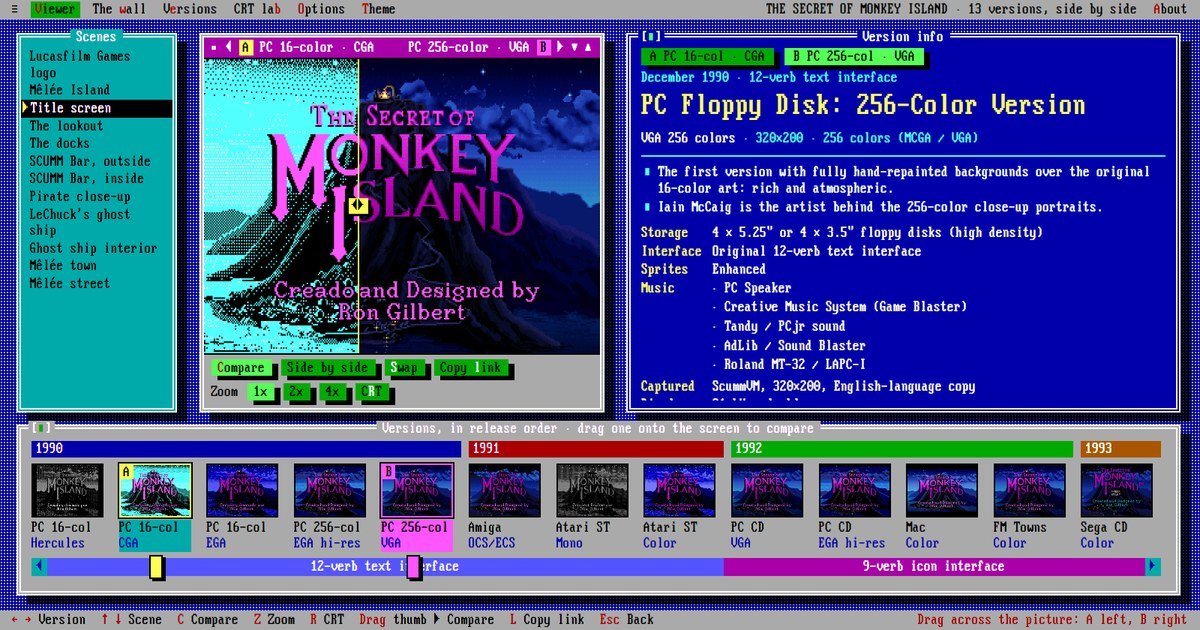
Independent development duo The Paninos off-line built and launched a web-based interactive visual archive documenting thirteen historical releases of LucasArts classic adventure title The Secret of Monkey Island, according to monkeyisland.pages.dev's report. Built as a side-by-side comparative tool, the project provides a technical look at how different vintage microcomputers and consoles handled art assets, color palettes, display resolutions, and display aspect ratios.
The project is designed for retrocomputing enthusiasts, digital preservationists, and adventure game fans who want to examine pixel-level differences across historical platforms without configuring separate emulators. The interactive interface gathers identical game moments across versions, allowing users to compare specific scenes under native resolutions, aspect ratio corrections, and tailored CRT simulation shaders.
01Emulation capture pipeline and scaling parameters
The developers captured every version using ScummVM, with the single exception of the Atari ST monochrome version, which was recorded using the Hatari emulator. Each image capture is scaled up to an output resolution of 1600x1200 pixels using nearest-neighbour interpolation to preserve sharp, unblurred pixels.
The capture process enforces 4:3 aspect ratio correction across every system so that original artwork retains the exact geometric proportions intended for period CRT monitors. Across all thirteen platforms, the team recorded the exact same twelve in-game moments using identical scene framing, ensuring that switching between systems highlights hardware display differences rather than differing camera setups.
Language variations exist within the source files due to regional disk releases. The PC 16-color release was recorded from a Spanish retail copy, while the Atari ST monochrome version relies on a French disk release, with all other eleven captured releases running English-language assets.
02Platform aspect handling and resolution adjustments
Hardware architectures handled graphical coordinate spaces differently during the early 1990s, forcing custom layout behaviors across platforms. On the Macintosh, the game renders a 640x400 active picture inside a native 640x480 desktop display resolution, which introduces visible black letterbox bars at the top and bottom of the frame.
The Hercules graphics card implementation renders its display across the center 640 columns of its 720 horizontal pixels, accommodating the non-standard video timings of monochrome PC monitors. Because base games ran at 200 vertical scanlines, standard display configurations scaled lines differently across microcomputers.
The interactive online viewer provides split-screen and side-by-side panels where users can drag and drop specific hardware releases into slots labeled A and B. Users can adjust view options through manual magnification steps of 1x, 2x, and 4x zoom levels to inspect dithering algorithms, pixel shading, and typography.
Advertisement
Tech Pulse Daily
Get tomorrow's pulse first
Join engineers who read Tech Pulse before stand-up. Free, weekday mornings.
03Hardware monitor profiles and WebGL2 shaders
The web presentation includes a full CRT simulation engine based on DOSBox Staging shaders ported directly to WebGL2. The shader system selects custom monitor presets based on the underlying display hardware of each target system, drawing native pixels with integer screen pixels per scanline wherever window dimensions allow.
Standard PC VGA and FM Towns versions map to a 31 kHz VGA monitor profile where each of the original 200 scanlines is drawn twice, creating 400 fine scanlines. Macintosh captures run through an equivalent 31 kHz monitor profile configured directly for 480 vertical scanlines.
Older PC standards like EGA and CGA switch to a 15.7 kHz profile displaying 200 scanlines, with an interface toggle allowing users to swap between 15 kHz and 31 kHz. Amiga, Atari ST color, and Sega CD releases run through 15 kHz monitor and television presets featuring dark line gaps, while Hercules and Atari ST mono disable phosphor masks.
04Shader attribution and typography heritage
The visual presentation relies on multiple open-source emulation and retrocomputing components. The core scanline logic uses Hyllian's CRT shader and DOSBox Staging VGA 1080p shaders, combined with curvature, corner geometry, and vignette effects derived from the guest-advanced-hd shader by guest(r) and Dr. Venom.
The web viewer interface displays text using the PxPlus IBM VGA 9x16 bitmap font designed by VileR from int10h.org under a Creative Commons CC BY-SA 4.0 license. The font is stretched horizontally by a factor of 1.35 to match standard 4:3 cathode-ray tube geometry.
Additional engine credits cited by the project include ScummVM SCUMM palette code, Sega CD shadow mode routines, Linkuei's 2022 Sega CD video fix, Eric Johnston's MacTech fast blit strategies, Aaron Giles's LucasArts Mac and Windows ports, and Amiga audio engineering credits for Chris Hülsbeck and Rudolf Stember.
05Development team and preservation scope
The entire comparison tool was created by The Paninos off-line, an independent team consisting of two brothers who developed the application with the assistance of artificial intelligence tools. The project operates strictly as an independent fan reference, without commercial affiliation or endorsement from Lucasfilm Games, LucasArts, or Disney.
In addition to publishing the comparison gallery, the duo is actively developing an unofficial, non-commercial remake of Sierra On-Line's 1986 fantasy title The Black Cauldron using Adventure Game Studio. The team announced plans to launch a dedicated project website for that remake in the near future.
The web viewer allows retro enthusiasts to explore hardware trade-offs ranging from monochrome dithering to 256-color palettes directly in modern browsers. By aligning frames across systems, the project serves as a permanent reference archive for early graphic adventure engine engineering.
Monkey Island FAQ
Which emulators were used to capture the game screens?
The project captured twelve versions using ScummVM and used the Hatari emulator specifically for the Atari ST monochrome screens.
How are different video cards and CRT monitors simulated?
The site uses WebGL2 ports of DOSBox Staging and Hyllian CRT shaders, applying 31 kHz profiles for PC VGA and Mac, 15 kHz profiles for Amiga and Sega CD, and phosphor tints for Hercules.
What upcoming game project is the development team building?
The two-brother team is developing a free, non-commercial remake of Sierra's 1986 adventure title The Black Cauldron using Adventure Game Studio.
Sources

Author
Dillip Chowdary
Writes Tech Bytes coverage of AI, engineering, and the tools that actually ship. Editor of Tech Pulse Daily.
Related on Tech Bytes
Advertisement