Native Model Authoring for Edge with LiteRT Tensor API
Google launched the LiteRT Tensor API to give developers native C++ control over edge model graphs, outperforming Apple MLX by 1.5x on a MacBook Pro.
By Dillip Chowdary • Oct 19, 2026 • Source: Google Developers Blog
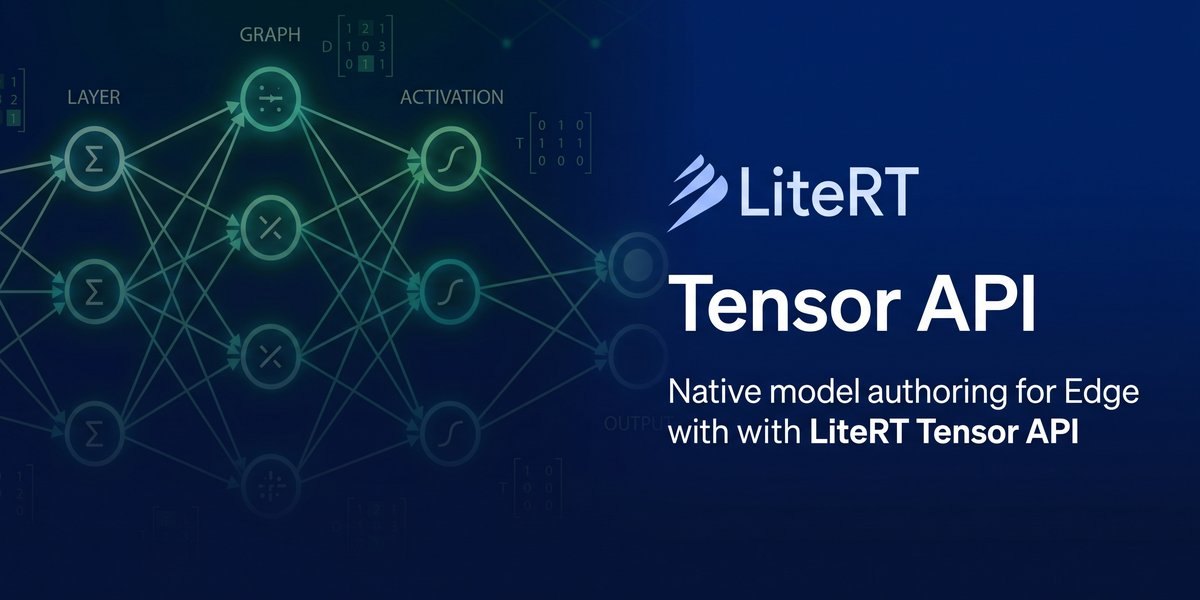
Google launched the LiteRT Tensor API, a lightweight C++ model authoring layer within the LiteRT stack built to give developers direct, code-first control over model computation graphs across edge hardware. Announced by Google engineers Ping Yu, Quentin Khan, Lu Wang, and product manager Chintan Parikh on October 19, 2026, the framework unifies manual operator construction with cross-hardware execution on CPUs, NPUs, and GPUs powered by open-source ML Drift. While converting existing models via tools like LiteRT Torch remains the recommended default for standard production pipelines, the new API addresses edge-deployment bottlenecks where developers traditionally hand-coded routines in platform-specific shader languages or tailored runtimes. Detailed in Google Developers Blog's report, the API lets engineers assemble custom architectures and fuse end-to-end processing pipelines without waiting for upstream machine learning framework updates or rewriting code for every hardware target.
This analysis examines how the LiteRT Tensor API operates under the hood, how it manages zero-copy memory transfers between inference steps, and how it performs across consumer mobile and desktop silicon. The breakdown is targeted at on-device machine learning engineers, mobile system architects, and developers building high-throughput edge computer vision or language applications. By bridging low-level C++ graph definition with multi-backend execution, the system establishes a portable middle ground between rigid model conversion pipelines and fragmented native implementations. It also introduces structured primitives designed specifically for autonomous AI coding agents to synthesize, benchmark, and optimize custom computational subgraphs directly against reference implementations.
Native Model Authoring for Edge with LiteRT: what actually changed
The release introduces a unified C++ authoring interface that replaces the fragmented practice of writing separate native compute kernels for Metal, OpenCL, or Vulkan. Developers build graphs op by op, defining every mathematical connection from standard elementwise math to specialized composite operations such as scaled dot-product attention, RMSNorm, and key-value cache updates. Weights load directly from standard model checkpoints, including Hugging Face .safetensors files, completely bypassing external offline conversion scripts. This architecture enables developers to prototype custom lowerings or experimental network topologies inside native C++ without maintaining disconnected codebases for every individual accelerator target.
Beyond graph definition, the interface alters backend targeting through C++ template mixin tags on tensor types. Tagging a graph with TfLiteMixinTag allows ModelFactory to export a .tflite binary that LiteRT executes across CPUs, NPUs, and GPUs, while XnnpackMixinTag enables the exact same graph to execute immediately on the CPU via XNNPACK without generating a serialized model file. Developers can tag tensors with both mixins simultaneously, allowing rapid local iteration and debugging through direct XNNPACK execution before generating a production deployment artifact. This dual-path design removes the compilation latency historically associated with modifying and testing low-level on-device graphs.
Native Model Authoring for Edge with LiteRT: how it works
At the code level, individual neural network layers are structured as native C++ functions operating over Tensor values and WeightMap references. For an attention block, functions such as FullyConnected, Reshape, Transpose, BatchMatMul, and Softmax manipulate dimensions programmatically to compute multi-head projections and scaled scores. To show the workflow in production, Google authored Meta's Segment Anything Model 2 (SAM 2) entirely in C++ using the Tensor API. Functions named BuildEncoder and BuildDecoder construct the image feature extractor and mask decoder graphs, which ModelFactory then packages as two distinct executable signatures within a single sam2_image.tflite container file.
A core operational mechanism is tensor-centric buffer interoperability across heterogeneous hardware. In a typical on-device pipeline, preprocessing camera frames, executing model partitions, and post-processing masks require repeated CPU-GPU memory copies that stall hardware accelerators. The LiteRT Tensor API expresses the entire sequence—including image resizing through small subgraphs generated via CreateLambdaRunner—as connected graphs running entirely on the accelerator. Buffers are bound and shared at startup, ensuring that high-resolution intermediate tensors pass directly between pipeline stages with zero CPU round-trips.
Advertisement
Tech Pulse Daily
Get tomorrow's pulse first
Join engineers who read Tech Pulse before stand-up. Free, weekday mornings.
Native Model Authoring for Edge with LiteRT: why it matters now
Achieving low-latency execution for modern multimodal and generative architectures on mobile devices requires maximizing accelerator residency. Tailored C++ runtimes like llama.cpp and Apple's MLX proved that code-first implementations unlock significant efficiency on local silicon, but those setups often demand backend rewrites when porting across operating systems. In benchmark tests conducted on a MacBook Pro running fp16 precision across the SAM 2 image encoder and mask decoder, the LiteRT Tensor API implementation ran approximately 1.5 times faster than Apple MLX while output masks matched Meta's reference PyTorch implementation pixel for pixel.
The architecture also matters because it turns model authoring into a deterministic target for automated software tools. Plain C++ operator graphs provide clean programmatic boundaries that allow AI coding agents to construct candidate networks, verify numeric outputs against reference weights, and iteratively tune operator schedules on physical hardware. In the open-source WebGPU showcase application, an AI coding agent evolved the SAM 2 graph from under 10 frames per second to over 30 frames per second at 512x512 resolution, demonstrating that automated graph rewriting can yield dramatic throughput gains without human kernel tuning.
Native Model Authoring for Edge with LiteRT: who is affected
The primary impact falls on edge machine learning teams and mobile application developers who deploy complex multi-stage vision and language models. Teams deploying web applications benefit directly through LiteRT.js and WebGPU, as demonstrated by the interactive browser-based SAM 2 demo that pairs vision segmentation with natural language prompts driven by Gemma 4 E2B. Instead of orchestrating complex canvas manipulations on the main browser thread, engineers can execute complete end-to-end vision pipelines inside shared WebGPU buffers, avoiding browser memory bottlenecks.
Cross-platform software engineers targeting heterogeneous fleets of Android, iOS, and macOS devices also gain substantial maintenance relief. Google validated the exact same C++ codebase for the SAM 2 model across three distinct environments: a macOS laptop utilizing Metal, an iOS smartphone utilizing Metal, and an Android device utilizing OpenCL. Teams maintaining on-device inference engines no longer need to staff separate shader development efforts across disparate operating systems to maintain competitive frame rates, as pre- and post-processing stages introduce merely 0.34 milliseconds of overhead when executed within shared memory.
Native Model Authoring for Edge with LiteRT: what to watch
As the LiteRT ecosystem matures, adoption will depend on how teams balance standard conversion pipelines against direct C++ authoring. Google explicitly maintains that LiteRT Torch and standard model conversion remain the fastest, most reliable default route for conventional model deployments. The Tensor API serves as a specialized path when developers require low-level graph rewiring, instant weight ingestion from safetensors checkpoints, or full accelerator residency for complex chained workflows. Watching how the community integrates these primitives will reveal whether code-first graph authoring becomes standard for high-performance edge computing.
The interplay between direct CPU execution and multi-accelerator deployment also warrants close observation. The Gemma 4 implementation utilizes the direct XNNPACK execution path for prefill and decode stages on the CPU, illustrating that the lightest execution model requires no intermediate file serialization at all. Moving forward, developers should track additions to the open-source LiteRT Samples repository and monitoring how the ML Drift GPU backend expands compatibility across diverse mobile GPUs and web standards, particularly as automated coding agents take over routine operator optimization.
Developer Action Items
- ☐ Diff the official changelog for Google / Meta / Framework before you bump — APIs, defaults, and removed flags only.
- ☐ Install through the vendor's documented channel in staging; keep a one-command rollback and time-box the canary.
- ☐ Grep your repo for old flag names, lockfile pins, and plugin versions that the notes mark as breaking.
- ☐ Prefer the first patch cut over the day-zero tag unless you have a reason to be on the leading edge.
- ☐ If Google Developers Blog did not name a region, plan, or SKU, screenshot the official availability line before you promise it to users.
Native Model Authoring for Edge with LiteRT FAQ
What is the LiteRT Tensor API?
It is a C++ authoring layer in Google's LiteRT stack that lets developers construct machine learning computation graphs op by op with native control across CPUs, GPUs, and NPUs.
How does the Tensor API achieve zero-copy data execution?
It chains preprocessing, inference models, and post-processing subgraphs through shared accelerator buffers established at startup, preventing intermediate tensor copies between the accelerator and CPU.
How does the LiteRT Tensor API perform compared to Apple MLX?
In benchmark tests running the SAM 2 image encoder and mask decoder on a MacBook Pro in fp16, the Tensor API ran approximately 1.5 times faster than Apple MLX while matching PyTorch output masks pixel for pixel.
Can the Tensor API run models without generating a .tflite file?
Yes, graphs tagged with XnnpackMixinTag run directly on the CPU through XNNPACK without requiring a serialized model file or external runtime.
Sources

Author
Dillip Chowdary
Writes Tech Bytes coverage of AI, engineering, and the tools that actually ship. Editor of Tech Pulse Daily.
Related on Tech Bytes
Advertisement