Netflix Builds Quasar to Measure the Blast Radius of Library API Changes
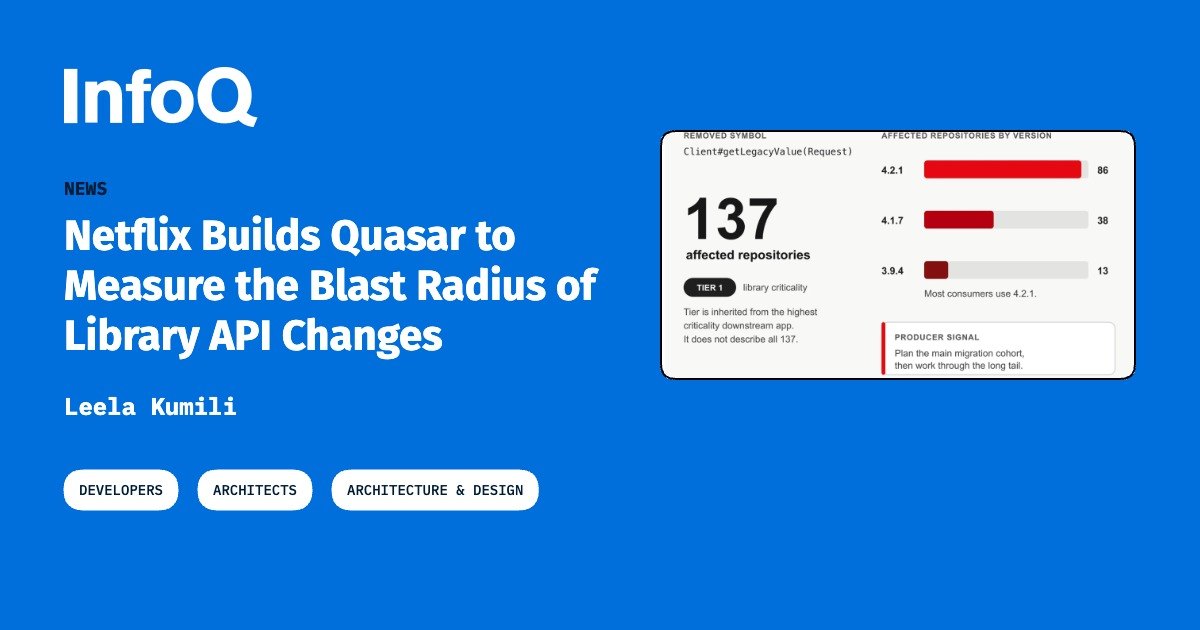
Netflix built Quasar to trace API changes across 137 repositories, pairing SCIP code indexing with Amazon Athena queries to catch breaking library releases.
In short
Library maintainers and platform engineers · 137 repositories across three library versions · Internal Netflix tool via REST, GraphQL, and MCP · Trace API call sites before merging breaking changes
By Dillip Chowdary • Nov 28, 2026 • Source: InfoQ
At a glance
- Who it is for
- Library maintainers and platform engineers
- The number
- 137 repositories across three library versions
- Available
- Internal Netflix tool via REST, GraphQL, and MCP
- What to do
- Trace API call sites before merging breaking changes
- Supported languages
- Java, Go, Python, JavaScript, TypeScript, Rust
- Key limitation
- Reflection and dynamic loading are unindexed
Netflix has developed Quasar, an internal code intelligence platform that identified 137 repositories across three library versions affected by a single deprecated method removal, according to InfoQ's report.
The platform is designed for library maintainers and platform engineers who need to measure downstream blast radius before shipping updates. Teams can inspect exact call sites across dependent repositories and coordinate migrations before merging breaking changes.
01Downstream consumer tracking beyond compatibility checks
Traditional compatibility checkers flag removed methods and altered signatures, but they fail to show which downstream microservices actually execute those interfaces. Dependency graphs highlight declared relationships instead of active invocations, while standard text searches regularly miss calls masked by inheritance, method overloads, and generated code. Compiling and running test suites across every downstream consumer repository to validate a single library update creates prohibitive build costs at enterprise scale.
Platform engineers require precise visibility into consumer call sites before modifying or retiring shared interfaces. Without reliable usage data, library maintainers often postpone necessary refactoring or inadvertently introduce breaking changes that disrupt downstream production systems during rollouts. Quasar bridges this architectural gap by indexing exact symbol references across independent project repositories.
| Detection Method | Visibility Provided | Operational Limitation | | Compatibility tools | Flags signature changes | Omits calling applications | | Dependency graphs | Shows declared relationships | Fails to show invocation | | Text search | Scans literal string tokens | Misses overloads and inheritance | | Downstream test builds | Validates compiled artifacts | High compute expense at scale |
02Code indexing with SCIP and Athena
Quasar indexes symbol definitions and references across distributed repositories using the SCIP Code Intelligence Protocol. SCIP provides an open, standardized schema for capturing structured code relationships and compiler-derived symbols across varied development environments. Language-specific indexers run directly inside continuous integration pipelines to submit fresh code intelligence data whenever repositories build their artifacts.
The submitted metadata is serialized into Parquet files and stored within Amazon S3 object storage for long-term retention. Centralizing graph relationships in columnar Parquet formats allows Netflix to maintain compact storage footprints while organizing symbols by organization, repository, and commit hash. This storage layer decouples static code extraction from subsequent analysis tasks.
Engineering services query the accumulated index using Amazon Athena to execute serverless SQL lookups across the Parquet datasets. Athena scans the partitioned code intelligence records to retrieve matching symbol occurrences and references within seconds. This serverless query pipeline enables downstream dependency discovery without requiring continuous management of dedicated database clusters.
03Pull request analysis across library versions
Advertisement
Tech Pulse Daily
Get tomorrow's pulse first
Join engineers who read Tech Pulse before stand-up. Free, weekday mornings.
Quasar evaluates proposed code modifications during pull request analysis by comparing API definitions between Git commits. The engine identifies all added, modified, and removed symbols introduced in the pending pull request branch. Once symbol differences are isolated, Quasar queries indexed references to map every affected repository, pinned dependency version, and source code location across the company.
In one documented scenario at Netflix, maintainers evaluated the impact of removing a deprecated library method. Quasar pinpointed 137 separate repositories consuming the deprecated symbol across three active library versions. Having granular call site coordinates allowed the library authors to quantify the exact engineering effort needed to deprecate the method before publishing the breaking release.
Impact reports generated during automated pull request checks present structured summaries directly to developers. Maintainers can view which downstream systems lag on outdated dependencies and pinpoint the exact source files requiring code adjustments. This direct visibility eliminates speculative deprecation warnings and prevents unforeseen breakages across downstream service fleets.
04Static analysis limits and runtime telemetry
Static code indexing cannot guarantee that an absence of indexed references equates to an unused API. Antonio J. del Águila, founder of Knaisoma, emphasized in an analysis of the technique that observed usage has a blind spot for reflection and for code on rare paths, like a quarterly batch job, since those calls may never show up in the window that was sampled. Dynamic class loading, outdated indexes, and incomplete repository coverage introduce further observation limits.
Note: Roberto Pérez Alcolea of the Netflix Java Platform Team acknowledged that reflection and incomplete indexing remain blind spots. He explained that Netflix is investing in runtime analysis to complement static evidence so that both signals inform removal decisions without guaranteeing that an API is safe to delete.
Pairing static CI telemetry with runtime production execution traces provides a more comprehensive safety profile for library authors. When static indexers fail to capture dynamic invocations, production monitoring highlights low-frequency traffic hitting deprecated endpoints. Together, these complementary mechanisms reduce the risk of breaking internal consumers while enabling teams to clean up deprecated interfaces.
05Multi-language protocol servers and agent migrations
Quasar works alongside Revapi for API compatibility checking and Kythe for semantic code navigation by linking theoretical API changes directly to verified consumer usage. SCIP powers cross-repository usage queries across Java, Go, Python, JavaScript, TypeScript, and Rust codebases. For compatibility validation, the system inspects JVM application interfaces and tracks Protobuf schema changes through generated Java source files.
Netflix exposes Quasar impact intelligence through REST, GraphQL, and a Model Context Protocol server for engineering teams and automated tools. Integrating Model Context Protocol endpoints allows AI coding agents to consume blast radius data directly inside interactive developer environments. Agents can query downstream dependencies and inspect affected call sites without navigating disparate continuous integration dashboards.
Netflix plans to shift impact analysis earlier in the development lifecycle so coding agents can detect public API shifts before pull requests open. Under this architecture, AI agents will identify consumer repositories and prepare automated migration patches in advance. This workflow accelerates downstream upgrades across microservice fleets while ensuring final release and versioning decisions remain strictly with human library authors.
Frequently asked questions
What is Netflix Quasar?
Quasar is an internal code intelligence tool developed by Netflix to determine the blast radius of library changes. It combines semantic code indexing with API comparisons to identify which downstream repositories and source lines use specific library symbols.
How does Quasar store and query code references across repositories?
Language-specific indexers extract symbols during continuous integration builds using the SCIP Code Intelligence Protocol. Quasar stores this data as Parquet files in Amazon S3 and queries references via Amazon Athena.
Which programming languages does Quasar support?
Quasar supports usage queries across Java, Go, Python, JavaScript, TypeScript, and Rust using SCIP. Compatibility analysis covers JVM APIs and Protobuf changes traced through generated Java code.
What are the primary blind spots of static impact analysis?
Static analysis cannot reliably detect reflection, dynamic class loading, or code executed on rare schedules, such as quarterly batch jobs. Netflix is developing runtime analysis systems to complement static evidence and inform deletion decisions.
How can automated AI coding agents interact with Quasar?
Netflix provides access through REST, GraphQL, and a Model Context Protocol server. This allows coding agents to evaluate public API modifications and prepare consumer migrations before pull requests are submitted.
Sources

Author
Dillip Chowdary
Writes Tech Bytes coverage of AI, engineering, and the tools that actually ship. Editor of Tech Pulse Daily.
Related on Tech Bytes
Advertisement