New PRL Miner – Codex is great news update
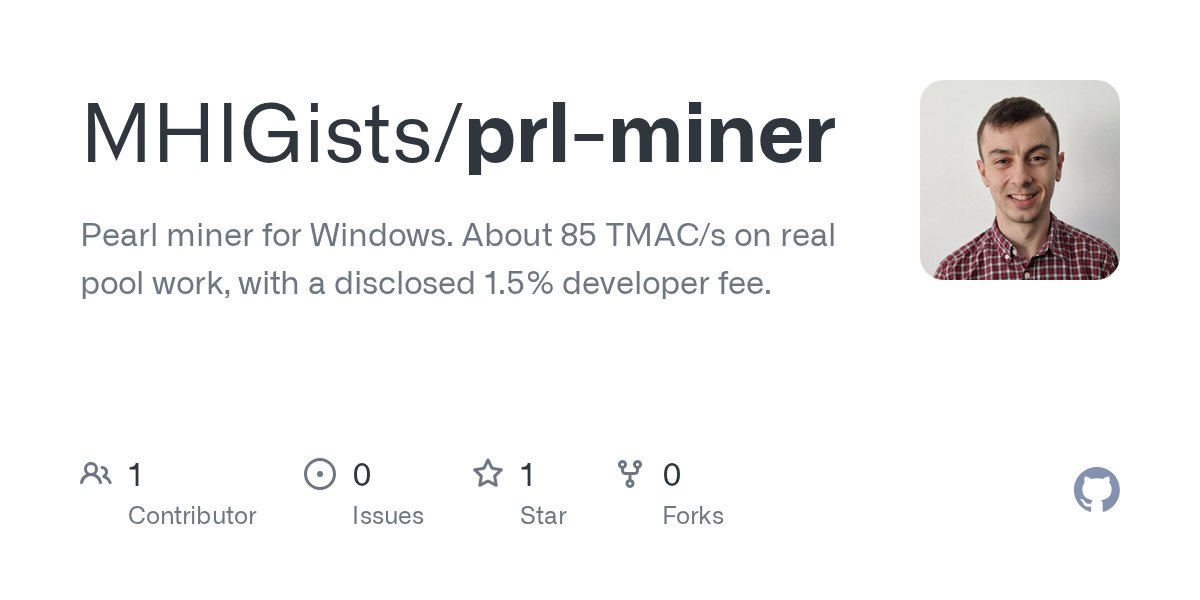
MHIGists released PRL Miner for Windows, reaching 85 TMAC/s on the RTX 5060 Ti with compute capability 12.0 while restricting older graphics cards.
By Dillip Chowdary • Nov 29, 2026 • Source: github.com
At a glance
- Product
- PRL Miner
- Target GPU
- NVIDIA GeForce RTX 5060 Ti
- Architecture
- Compute capability 12.0 (sm_120)
- Hashrate
- ~85 TMAC/s
- Developer fee
- 1.5% of Pearl mining work
- Platform
- Windows x64
MHIGists released PRL Miner as a specialized Windows utility engineered for mining Pearl cryptocurrency across graphics processors and central processing units. According to github.com's report, this release integrates an optimized CUDA pipeline alongside a dedicated CPU backend. When processing real pool work and submitting cryptographic shares, the software sustains roughly 85 TMAC/s on the targeted NVIDIA GeForce RTX 5060 Ti graphics card.
This technical report examines hardware requirements, architectural restrictions, mining fee distributions, and pool configurations governing the new software release. Cryptocurrency operators, system builders, and mining administrators can use these verified operational parameters to establish operational Pearl mining environments. Readers will find every essential technical specification and launch procedure detailed below without needing additional configuration references.
01Kernel tuning and Blackwell hardware targets
The core executable contains a dedicated CUDA kernel specifically compiled and tuned for the NVIDIA GeForce RTX 5060 Ti graphics card. In live production environments submitting valid cryptographic shares against mining pools, the hardware achieves a steady hash rate of approximately 85 TMAC/s. Developers built this acceleration path to maximize mathematical efficiency on this specific mid-range Blackwell graphics processor.
Other graphics cards reporting compute capability 12.0 within the RTX 50-series can load the compiled kernel without driver errors. However, project maintainers emphasize that this broader hardware compatibility path remains unverified in production. The established 85 TMAC/s benchmark belongs strictly to the tested 5060 Ti configuration and cannot be assumed for other models.
02Compute capability limits across graphics generations
Hardware support for GPU acceleration requires compute capability 12.0, corresponding to the sm_120 compilation target. Because the precompiled executable carries binary images exclusively for this architecture, host NVIDIA display drivers immediately reject the kernel on earlier card generations. The flagship GeForce RTX 4090 reports compute capability 8.9, which prevents the driver from loading the provided GPU code.
Note: The compiled binary contains no compatible machine image for older architectures, preventing the CUDA kernel from loading on GeForce RTX 40-series, RTX 30-series, and RTX 20-series cards. Host display drivers reject the kernel file immediately when initialized on those legacy platforms. Hardware running these earlier graphics generations cannot execute GPU mining passes under this build.
Operators working with older graphics hardware can still utilize the software through its embedded CPU execution backend. This central processing path operates entirely on host system processors without touching installed graphics hardware or requiring display adapter acceleration. The CPU fallback ensures basic functional capability on legacy desktop environments excluded from the modern CUDA execution kernel.
03Project wallet fee structure and runtime exemptions
Advertisement
Tech Pulse Daily
Get tomorrow's pulse first
Join engineers who read Tech Pulse before stand-up. Free, weekday mornings.
The software embeds a mandatory 1.5 percent developer fee that directs a portion of Pearl mining calculations to project developers. The application prints this commission notice in the console window upon startup before routing funds to project wallet prl1panjyh7nxs8neq93dkjuegnxrytdr9z94tv969mzrch5zrc6td07qgz9zpa+2rnQqCToSE8HjMC6QfTia2CqAHwzkJiyGXPahtf5vYK8oAKkLWE67DM. The remaining 98.5 percent of generated mining effort stays assigned to the pool and wallet address specified on the user command line.
Specific operational environments operate free from developer deductions to facilitate benchmarking and specialized deployments. Executing the miner with the mock evaluation parameter or utilizing Quantus bypasses the commission mechanism entirely. Under these designated modes, the client directs all submitted shares exclusively to the user-configured wallet address without transferring any cryptographic reward to the project creators.
04Pool difficulty tiers and share timing math
Default stratum pool connectivity targets the LuckyPool mining endpoint located at pearl-tr.luckypool.io over port 3360. This port represents the lowest entry tier available on the service, establishing a baseline starting difficulty of 2,000,000. Mining clients cannot connect to lower difficulty tiers, as the service architecture designates port 3360 as the absolute minimum threshold.
LuckyPool organizes client connections across three distinct difficulty tiers mapped to sequential network ports:
| Port | Starting difficulty |
|---|---|
| 3360 | 2,000,000 |
| 3361 | 4,000,000 |
| 3362 | 8,000,000 |
At approximately 85 TMAC/s against a 2,000,000 difficulty target, the hardware submits a share once every 100 seconds. The developer fee executes as a single short mining session of that duration roughly every two hours.
05Windows runtime setup and miner launch flags
Preparing a host computer requires installing an up-to-date NVIDIA display driver along with the Microsoft Visual C++ 2015–2022 x64 redistributable package. Without these core dependencies installed, the Windows operating system cannot load essential runtime libraries or initialize CUDA hardware interfaces. System administrators should verify both prerequisites before attempting to execute the mining binary from the command line.
Deploying the miner involves three sequential preparation and command-line execution steps:
- Driver installation Deploy a current NVIDIA display driver capable of managing compute capability 12.0 graphics cards.
- Runtime dependency Install the Microsoft Visual C++ 2015–2022 x64 redistributable package on the target Windows system.
- Execution command Launch cppminer.exe with the CUDA backend, device index zero, pool address stratum+tcp://pearl-tr.luckypool.io:3360, your destination PRL1 wallet string, and worker identifier rig01.
Frequently asked questions
Which graphics cards can run the PRL Miner CUDA kernel?
Only graphics cards reporting compute capability 12.0, such as the RTX 50-series, can load the CUDA kernel. Older models including the RTX 40-series, 30-series, and 20-series are rejected by the driver.
What performance does the miner deliver on tested hardware?
The software achieves approximately 85 TMAC/s on the RTX 5060 Ti graphics card when submitting shares on real pool work.
How does the developer fee function during mining?
The miner allocates 1.5 percent of Pearl work to the developer wallet, running a brief session of about 100 seconds roughly every two hours. Execution under --mock or Quantus remains on the user wallet with no developer fee.
Can systems without RTX 50-series cards run the software?
Yes, systems lacking compatible graphics hardware can execute the integrated CPU backend, which functions independently of the graphics card.
Sources

Author
Dillip Chowdary
Writes Tech Bytes coverage of AI, engineering, and the tools that actually ship. Editor of Tech Pulse Daily.
Related on Tech Bytes
Advertisement