New Species of Giant Fungus Discovered in China Grows up to 20 Inches Tall
Researchers in Yunnan discovered Dianjunus rex, a giant 20-inch fungus weighing five pounds that diverged 65 million years ago after the dinosaur extinction.
By Dillip Chowdary • Nov 15, 2026 • Source: Wired

Researchers at the Kunming Institute of Botany, a division of the Chinese Academy of Sciences, identified an entirely new family and species of giant fungus uncovered in the forests of southwestern China. Formally cataloged as Dianjunus rex, the organism produces massive structures reaching up to twenty inches in height and weighing nearly five pounds. As detailed in Wired's report, the specimen represents the largest fungal mass ever recorded among Ascomycetes.
This breakdown examines the taxonomic classification, evolutionary history, physical attributes, and unusual genetic profile of the newly discovered Yunnan fungus. Field biologists, mycologists, and evolutionary researchers tracking biodiversity across East Asian forests can evaluate how the organism emerged following prehistoric extinction events. The analysis details how laboratory testing, morphological surveys, and DNA reconstruction reveal an organism that diverged tens of millions of years ago while maintaining an energy-intensive growth cycle.
01Kunming Institute specimens and Ascomycete classification
The research team selected the name Dianjunus rex by combining the historical designation of Yunnan's ancient Dian Kingdom with the Chinese phonetic term for fungus. The specimen belongs to the Ascomycetes phylum, a group comprising more than 64,000 known species. Rather than developing conventional mushroom caps and stems, these fungi generate specialized fruiting bodies that release reproductive spores.
Taxonomic analysis placed Dianjunus rex into its own distinct biological family within the broader Ascomycetes group. This placement indicates that the organism possesses no known close living relatives across modern fungal records. The classification highlights the biological complexity of Yunnan Province, where mycologists have documented roughly 6,000 fungal species out of an estimated regional total that could reach 100,000.
Lead author and associate professor Indunil C. Senanayake emphasized that the discovery illustrates how much fungus biodiversity remains to be discovered in East Asian forests.
Uncovering an uncataloged family demonstrates that large fungal organisms can evade classification even across thoroughly traveled terrain. The findings establish a baseline reference for categorizing previously undocumented Ascomycete specimens in regional ecosystems.
02Nanban rainforest soil and branching morphology
Field investigators documented the giant specimens during biological surveys conducted throughout the Nanban tropical rainforest. Scientists observed large, whitish fruiting bodies growing directly from the forest soil adjacent to the root systems of dying trees. The fungi emerged in diverse configurations including cylinders, elongated spindles, and cupped palms that resembled hands reaching upward through the ground.
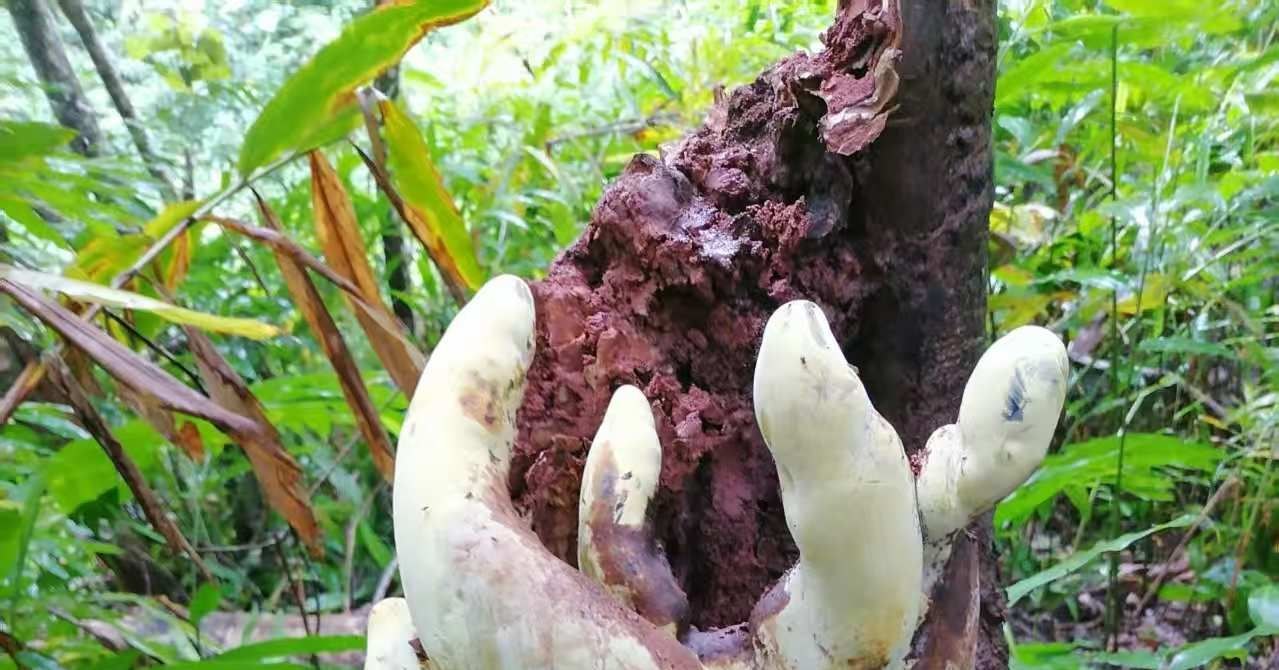
Upon reaching maturity, the fruiting bodies develop distinct finger-like branches across their exposed surfaces. The sections rising above the forest floor display dense coverings of white, powdery fibers that transition into a dark yellow shade over time. In contrast, the basal portions anchoring the fungus beneath the soil line remain completely black and smooth.
Laboratory transport revealed that the collected field samples dried out rapidly once removed from the humid forest floor environment. Cross-section inspections showed dense, sponge-like internal tissues with white or yellow coloration. The research team noted that the internal flesh possessed no strong odor or distinctive taste during laboratory evaluations.
Advertisement
Tech Pulse Daily
Get tomorrow's pulse first
Join engineers who read Tech Pulse before stand-up. Free, weekday mornings.
03Cretaceous extinction divergence and molecular timeline
Genetic sequencing allowed the research team to construct a molecular clock that traced the evolutionary timeline of Dianjunus rex. The data indicated that the fungal lineage diverged from other species approximately 65 million years ago. That window coincides with the boundary of the Cretaceous period, marking the catastrophic mass extinction event that wiped out three quarters of Earth's plant and animal species.
While the divergence timeline means Dianjunus rex never overlapped with living Tyrannosaurus rex populations, the aftermath of the die-off created ideal environmental conditions for emerging fungi. The sudden accumulation of decomposing plant material across forest floors supplied abundant ecological resources. Saprophytic organisms capable of processing organic debris found unprecedented opportunities to expand across altered landscapes.
The chronological alignment confirms that the lineage developed specialized structural adaptations shortly after the dinosaur extinction pulse. By exploiting vacant ecological niches, the ancestral fungus established physical dimensions that separated it from related Ascomycete lines. These historical conditions provided the foundation for the massive fruiting structures observed in contemporary specimens.
04Genomic sequencing and decomposition gene deficits
Subsequent genomic evaluations of Dianjunus rex revealed an unexpected metabolic contradiction inside the organism's DNA profile. Despite growing beside decomposing wood, the fungus contains only about half the decomposition-related genes found in closely related species that feast on plant matter. The missing genetic pathways puzzled investigators who expected an abundance of wood-decay enzymes.
Standard wood-decay fungi rely on heavy suites of decomposition genes to digest fallen plant biomass and sustain large masses. Dianjunus rex operates without the typical array of digestive enzymes seen across wood-rotting Ascomycetes. The genetic shortfall indicated that the fungus does not rely entirely on standard saprophytic decay to fuel its growth.
The data prompted researchers to reconsider how the organism acquires sufficient nutrition to construct five-pound structures. Without an extensive complement of decomposition genes, the fungus must employ alternative metabolic strategies during earlier stages of development. The genomic architecture suggests a symbiotic or endophytic relationship before the host tree begins to decline.
05Tree host energy investment and spore dispersal
Senanayake theorized that the fungus might lead a double life by dwelling inside healthy trees before feeding on decaying wood once hosts die. Such internal living could permit the organism to accumulate substantial nutritional reserves while the host plant remains vigorous. That accumulated reserve would explain how the fungus gathers enough energy to generate massive fruiting bodies later.
The physical stature of the fungus provides a distinct mechanical advantage across dense jungle canopies. Senanayake hypothesized that towering higher than surrounding foliage and fallen leaves improves wind-mediated spore dispersal across the forest floor. Elevating reproductive surfaces above ground clutter allows air currents to distribute spores across broader geographic areas.
Constructing such massive fungal tissue requires a significant energy investment from the organism's metabolic budget. Senanayake noted that this structural growth strategy likely evolved only in specific ecological contexts where reproductive benefits outweighed biological costs. The species demonstrates how resource allocation can favor physical size to overcome dispersal limitations in crowded rainforest habitats.
New Species of Giant Fungus Discovered FAQ
What is Dianjunus rex and where was it found?
Dianjunus rex is a newly discovered species and biological family of giant Ascomycete fungus found in China's Yunnan Province in the Nanban tropical rainforest. It produces fruiting bodies that grow up to 20 inches tall and weigh nearly five pounds.
How old is the Dianjunus rex lineage?
Molecular clock reconstructions indicate that Dianjunus rex diverged from other species approximately 65 million years ago at the end of the Cretaceous period. This divergence occurred immediately after the mass extinction that eliminated dinosaurs and three quarters of all plant and animal species.
Why does Dianjunus rex have fewer decomposition genes?
Genomic analysis revealed that Dianjunus rex carries roughly half the decomposition-related genes found in relatives that consume plant matter. Researchers theorize the fungus may lead a double life, residing within healthy trees before feeding on dead material after host plants die.
What do the fruiting bodies of Dianjunus rex look like?
The fruiting bodies resemble cupped palms, spindles, and cylinders that branch into finger-like shapes. The above-ground parts have white powdery fibers that turn dark yellow with age, while the subterranean portions are black and smooth.
Sources

Author
Dillip Chowdary
Writes Tech Bytes coverage of AI, engineering, and the tools that actually ship. Editor of Tech Pulse Daily.
Related on Tech Bytes
Advertisement