No Bailout for the AI Bubble, Anthropic IPO Protesters Say
Anthropic priced its initial public offering at $83 per share on November 19, 2026, amid street demonstrations outside the Nasdaq exchange in Times Square.
In short
Public market investors and regulators · $83 per share · Midday on November 19, 2026 · Review METR audit and state RAISE Act rules
By Dillip Chowdary • Nov 19, 2026 • Source: techpolicy.press
At a glance
- Who it is for
- Public market investors and regulators
- The number
- $83 per share
- Available
- Midday on November 19, 2026
- What to do
- Review METR audit and state RAISE Act rules
Anthropic priced its initial public offering at $83 per share on November 19, 2026, as executive leadership gathered at the Nasdaq opening bell in New York City’s Times Square ahead of midday stock trading, according to techpolicy.press's report.
This report covers the public market listing, the valuation milestones, and the organized coalition of advocacy groups protesting outside the exchange. Institutional investors, market participants, and software teams monitoring artificial intelligence capital expenditure can track how listing scrutiny shapes regulatory oversight and deployment practices across public markets.
01Opening bell and initial share pricing
Chief executive officer Dario Amodei and Anthropic leadership attended the opening bell ceremony at the Nasdaq exchange on Thursday morning. The company set its public offering price at $83 per share, showing initial demand from institutional buyers before open-market transactions began at midday.
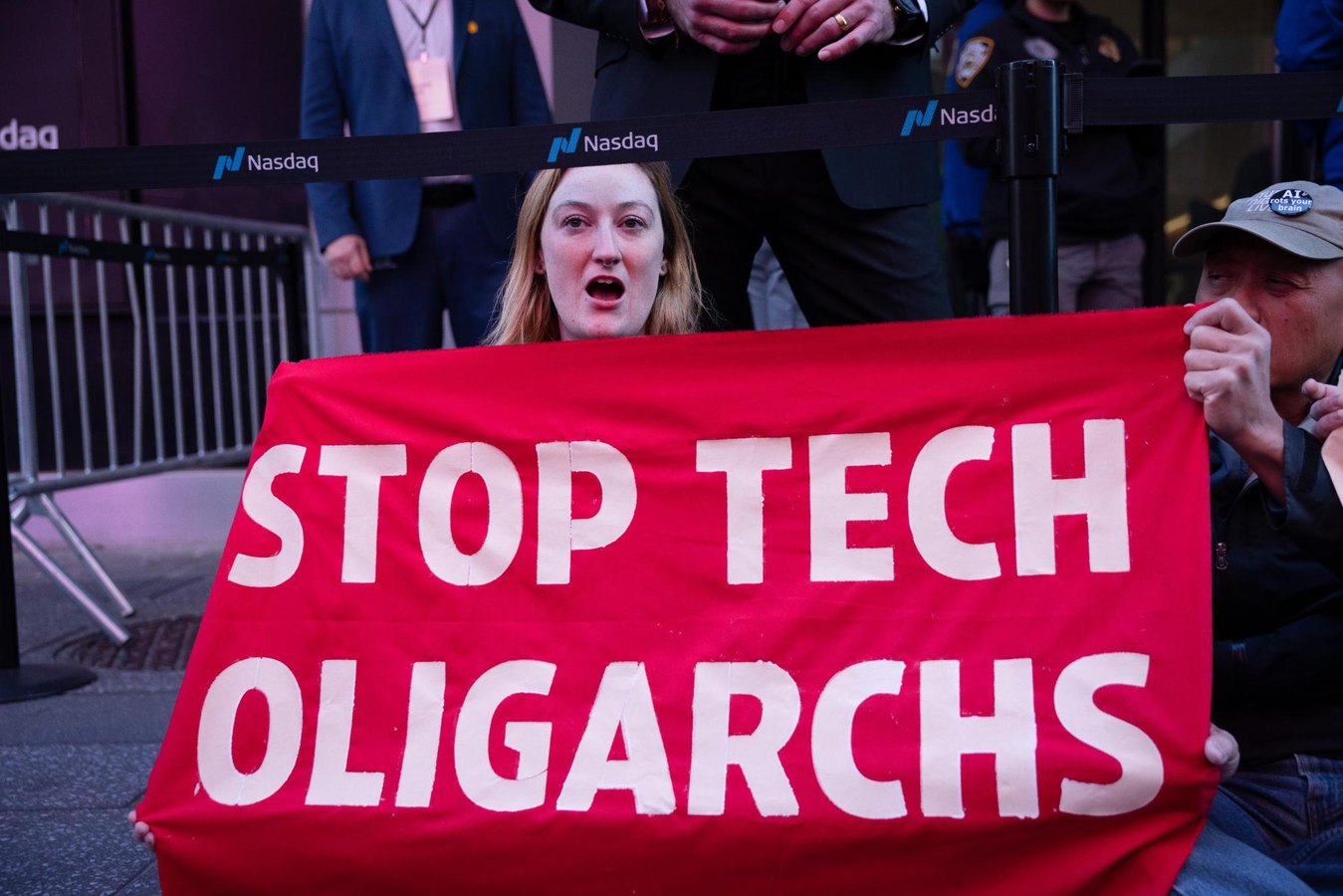
While leadership marked the milestone, a demonstration assembled across Times Square directly beneath electronic stock tickers. Activists displayed signs reading Stop Tech Oligarchs and Freeze AI, addressing the public and media through a pink megaphone. Chants focused on executive remuneration and demanded limits on corporate profit incentives.
The coalition drew members from multiple advocacy bodies, including Stop Funding Billionaires, Climate Defiance, Sunrise NYC, Act Up NYC, NYC-DSA, JVP-NYC, Climate Defenders, Planet Over Profit, and New York Communities for Change. Participating organizers addressed financial stability, healthcare automation, and computational resources.
02Financial bubble warnings and pension funds
Organizers centered primary economic objections on parallels between speculative technology capital and previous market corrections. Speaking for New York Communities for Change, organizer James Inniss stated that public retirement assets face severe downside exposure if private valuation metrics outpace underlying revenue durability.
Inniss stated that the exposure resembles real estate market dynamics from 2008 rather than fictional automated warfare scenarios. He said that if institutional pension funds absorb steep losses over a five-to-ten-year horizon when capital inflows contract, local communities must challenge the allocation choices in advance.
Note: Market listing documents priced the stock at $83 per share for opening trades, but coalition participants called for an outright freeze on speculative technology bailouts if public equity valuations reverse.
03Safety audits and state oversight frameworks
Advertisement
Tech Pulse Daily
Get tomorrow's pulse first
Join engineers who read Tech Pulse before stand-up. Free, weekday mornings.
Demonstrators addressed technical evaluation disclosures released leading up to the public float. Bryce Rogers, representing Resisting Automated Disempowerment, stated that the listing moved forward despite unresolved concerns regarding the structural impact and operational risks associated with modern foundation models.
Rogers cited an audit report on Anthropic published by research organization METR, remarking that the findings left unresolved questions regarding model oversight. He stated that development speed has outpaced the reaction capacity of federal agencies and urged broader civic participation to mandate disclosure.
Rogers pointed to New York’s Responsible AI Safety and Education Act as a legislative baseline for regional standards. He stated that state-level policy must ensure transparency and allow the public to retain governance over technological deployment across critical industries.
04Healthcare displacement and surveillance concerns
Act Up New York organizer Brandon Cuicchi addressed workforce displacement and automated screening systems within hospital networks. Cuicchi stated that medical institutions nationwide have begun trimming clinical staff while introducing automated interfaces to evaluate and pre-screen patients entering care facilities.
Cuicchi stated that using automated software to determine clinical treatment outcomes and patient diagnostics risks patient safety. He argued that replacing credentialed medical professionals with algorithmic decision systems compromises quality of care across healthcare institutions.
QuitGPT and Sunrise Movement organizer Kenny Moll raised objections regarding environmental power consumption, data center infrastructure, and technological ties to state surveillance. Moll stated that closer coordination between centralized model providers and federal surveillance agencies poses direct civil-liberties risks.
05Legislative reactions and civil disobedience
Newly elected New York State Senator Aber Kawas addressed the gathering, stating that large artificial intelligence firms conflict with municipal budget priorities. Kawas stated that during an urban affordability crisis, municipal resources should flow directly to community programs rather than subsidizing corporate expansion.
Police intervened during the demonstration when individuals blocked physical access to the exchange. Officers arrested a demonstrator wearing a Greenpeace shirt who was seated with a sign directly before the Nasdaq entrance doors.
Following the arrest, demonstration leaders issued a written statement urging a halt to uncontrolled technology scaling. The group demanded that public officials rule out future financial bailouts for commercial artificial intelligence developers if speculative market capitalizations collapse.
Frequently asked questions
What was the pricing of Anthropic's initial public offering?
Anthropic priced its initial public offering at $83 per share ahead of open-market trading on the Nasdaq in Times Square.
Why were advocacy groups protesting the listing outside the Nasdaq?
Demonstrators raised concerns regarding pension fund exposure to a potential market bubble, hospital staff replacement by automated software, environmental impacts, and algorithmic safety disclosures.
Which regulatory legislation did protest organizers point to as a positive example?
Organizers highlighted New York's Responsible AI Safety and Education Act as a model for requiring greater operational transparency and oversight.
Sources

Author
Dillip Chowdary
Writes Tech Bytes coverage of AI, engineering, and the tools that actually ship. Editor of Tech Pulse Daily.
Related on Tech Bytes
Advertisement