NVIDIA CUDA-X Libraries Give Agents the Tools to Accelerate Scientific
NVIDIA updated its CUDA-X library suite on November 16, 2026, delivering speedups up to 900x across astrophysics, fusion energy, and biopharma research.
In short
Computational scientists, biopharma, and AI agent developers · 900x speedup for cell polygon calculations over CPUs · November 16, 2026 across open source and CUDA-X suites · Integrate libraries or agent containers into GPU clusters
By Dillip Chowdary • Nov 17, 2026 • Source: NVIDIA Blog
At a glance
- Who it is for
- Computational scientists, biopharma, and AI agent developers
- The number
- 900x speedup for cell polygon calculations over CPUs
- Available
- November 16, 2026 across open source and CUDA-X suites
- What to do
- Integrate libraries or agent containers into GPU clusters
NVIDIA expanded its CUDA-X scientific computing libraries on November 16, 2026, introducing GPU-accelerated tools including cuPhoton, cuPotential, and cuSpa that speed up research workloads by up to 900x, according to NVIDIA Blog's report.
This piece covers the architecture additions, performance benchmarks, and partner deployments across astrophysics, plasma physics, drug discovery, materials science, and genomics. Computational researchers and scientific software engineers can integrate these specialized libraries into distributed GPU workflows and autonomous agent pipelines to accelerate petascale analysis.
01Event Horizon Telescope data correlation in minutes
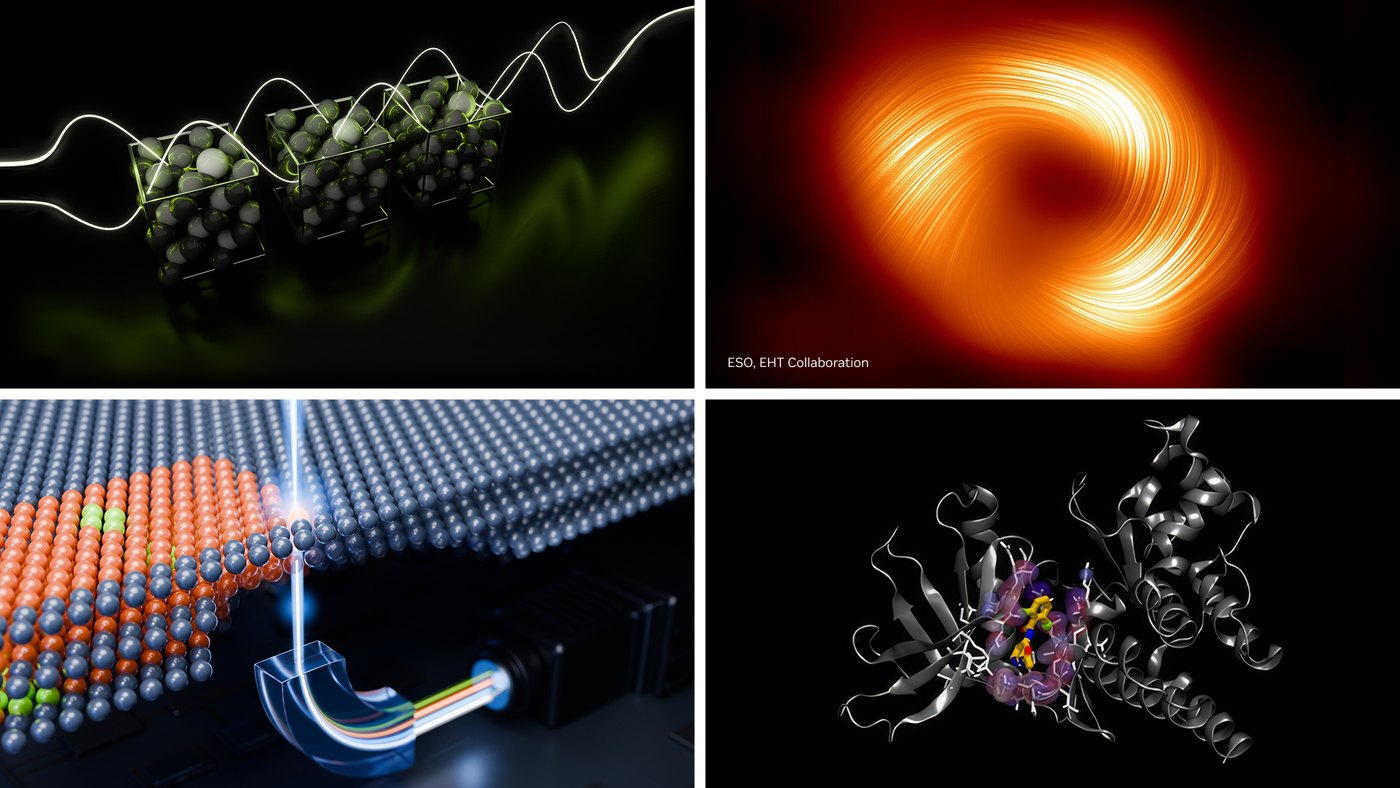
Processing black hole observations from the Event Horizon Telescope previously required over a month of computational effort because radio dish arrays distributed worldwide generate petabytes of raw signals. Using the cuPhoton.xBeam module inside the cuPhoton Toolkit, researchers reduced that correlation window to eight minutes. The software links radio data from global stations into an Earth-sized aperture to deliver high-resolution astronomical reconstructions.
The pipeline successfully correlated observations of the astronomical jets J1924 and 3C279. This speedup allows researchers to reconstruct the Messier 87* black hole galaxy in real time and analyze how matter spirals inward under intense gravitational attraction. The full workflow spans data ingestion, correlation, and visual rendering across distributed multi-GPU clusters or a compact NVIDIA DGX Spark system.
02Interactive plasma fusion steering with local agents
Sustaining continuous plasma at millions of degrees for fusion energy requires extensive numerical modeling, where a single time step on petascale supercomputers can take days and entire simulations run for weeks. Experimental fusion reactors generate telemetry faster than standard data pipelines can evaluate, forcing scientists to delay adjustments until whole runs conclude. Pacific Fusion deployed the cuPhoton.xLens module to extract physical metrics directly while plasma simulations execute.
Researchers paired cuPhoton.xLens with an NVIDIA Nemotron-driven agent operating locally on the same hardware environment. The local agent parses emergent simulation data on the fly, creating an interactive loop that guides simulation parameters in real time. This dynamic feedback helps engineering teams optimize target compression and chamber geometries for operational reactors.
03Molecular interaction speedups for drug discovery workflows
Advertisement
Tech Pulse Daily
Get tomorrow's pulse first
Join engineers who read Tech Pulse before stand-up. Free, weekday mornings.
E. Shaw Research, NVIDIA cuPotential accelerates molecular dynamics calculations by up to 3x while increasing stability and numerical precision. The library uncovers previously unidentified binding pockets and calculates interaction energy for generative AI training data.
E. Shaw Research, NVIDIA cuPotential accelerates molecular dynamics calculations by up to 3x while increasing stability and numerical precision. The library uncovers previously unidentified binding pockets and calculates interaction energy for generative AI training data.
NVIDIA is integrating cuPotential directly into established simulation codes, working alongside Schrödinger and the AMBER, NAMD, GROMACS, LAMMPS, and Open Molecular Software Foundation communities. Biotechnology companies and computational drug discovery teams, including Cadence, Fathom Therapeutics, Topos Bio, Genesis Molecular AI, and Terray Therapeutics, have adopted the engine to shorten molecular screening cycles.
04Quantum mechanical materials calculation using Daviator and DAQIRI
Materials simulations using the Vienna Ab initio Simulation Package often face bottlenecks when evaluating large numbers of atomic forces. NVIDIA ALCHEMI is adding Daviator, a collection of batched GPU kernels that runs quantum-mechanical calculations up to 22x faster at up to 75% lower compute cost. Daviator enables GPU acceleration across atomic systems of all sizes, including smaller atomic configurations that previously executed faster on CPUs.
At Lawrence Berkeley National Laboratory, engineers deployed the NVIDIA DAQIRI networking library to link high-speed electron microscopy detectors directly to GPU nodes. This arrangement moves data processing into the active physical instrument, allowing experimentalists to isolate target signals and change measurement trajectories during active scans. The pipeline supports element-level identification at atomic resolution.
05Open source cell polygon and sequence annotation libraries
Single-cell biology and spatial transcriptomics require intensive geometric calculations to map tissue architectures. The open source cuSpa library accelerates cell polygon computations, helping Memorial Sloan Kettering Cancer Center generate complex spatial tissue graphs for cancer modeling with a 900x speedup over CPU processing.
| Tool | Focus Area | Performance Gain | Partner or Adopter |
|---|---|---|---|
| cuPhoton.xBeam | Radio astronomy | >1 month reduced to 8 minutes | Event Horizon Telescope |
| cuPotential | Molecular dynamics | Up to 3x faster | Cadence, Terray Therapeutics |
| Daviator | Quantum chemistry | Up to 22x faster (75% lower cost) | VASP on NVIDIA ALCHEMI |
| cuSpa | Spatial biology | 900x faster than CPU | Memorial Sloan Kettering Cancer Center |
| rapids-singlecell | Single-cell analysis | 200x faster processing | Therna Biosciences, 10x Genomics |
| GPU HMMER | Sequence annotation | Up to 84x faster searches | Basecamp Research |
Codeveloped with scverse, the rapids-singlecell framework packages accelerated single-cell tools into an agent-ready container, allowing Therna Biosciences to run therapeutic design analysis 200x faster and supporting integration within 10x Genomics' Sentira platform. In addition, the open source GPU-accelerated HMMER library speeds up predicted protein sequence annotations, running benchmark searches up to 84x faster at Basecamp Research to prepare foundation model training datasets.
Frequently asked questions
What performance improvement does cuPhoton bring to radio astronomy?
cuPhoton.xBeam correlates petabytes of Event Horizon Telescope data in eight minutes, completing workloads that previously took over a month on traditional pipelines.
How does cuPotential fit into existing molecular dynamics software?
cuPotential accelerates simulation engines by up to 3x and is being integrated with Schrödinger, AMBER, NAMD, GROMACS, LAMMPS, and Open Molecular Software Foundation workflows.
Which of the announced CUDA-X libraries are available as open source?
cuSpa for spatial polygon calculations and the GPU-accelerated HMMER library for protein sequence annotation are available as open source software.
Sources

Author
Dillip Chowdary
Writes Tech Bytes coverage of AI, engineering, and the tools that actually ship. Editor of Tech Pulse Daily.
Related on Tech Bytes
Advertisement