Nvidia deliberately kept GPU prices high through circular financing deals
Disclosures show Nvidia funded customer purchases in 2026 to absorb TSMC wafer oversupply and prop up GPU prices, driving retail cards to 160% of MSRP.
By Dillip Chowdary • Nov 15, 2026 • Source: techspot.com

Nvidia financed its own artificial intelligence customers in an intentional effort to keep graphics processing unit prices elevated and absorb excess semiconductor supply, according to details disclosed in a recent Wall Street Journal profile highlighted by techspot.com's report. The disclosures follow the resignation of former chief executive officer Jensen Huang and describe how vendor capital was deployed across major AI firms and cloud providers throughout mid-to-late 2026 to prop up demand signals.
This report examines the internal dispute between Huang and interim chief executive Colette Kress, the operational scale of these circular financing arrangements, and the resulting supply squeeze across retail hardware. It is compiled for systems engineers, hardware procurement teams, and industry observers tracking how artificial intelligence infrastructure commitments have distorted the wider semiconductor and memory markets.
01Wall Street Journal profile and Kress warnings
Internal documents and executive profiles indicate that Nvidia expanded vendor-financing deals during mid-to-late 2026 to soak up an oversupply of Taiwan Semiconductor Manufacturing Company silicon wafers. Interim chief executive officer Colette Kress, who also serves as executive vice president and chief financial officer, raised direct concerns regarding the sheer volume of capital committed to customer balance sheets. Despite those internal warnings, executive leadership pushed forward with expanding the financing pipeline across major compute operators.
The scale of the commitments created growing tension within executive leadership as inventory obligations deepened. By the summer of 2026, Nvidia faced what insiders described as an avalanche of ordered semiconductors arriving from TSMC. During this period, Huang berated Kress as being a deer in headlights when evaluating the exposure generated by these arrangements.
02Scaled back commitments and the OpenAI backstop
Confronting an escalating wafer surplus and mounting risk, Nvidia began slowing down, downsizing, and pausing several of its customer-financing packages. Among the adjusted packages was an arrangement with OpenAI that had originally outlined a $250 billion backstop intended for the development of the world's largest data center. This pullback marked a sharp deceleration from the aggressive vendor financing that defined previous quarters.
The company had previously pushed back against public criticisms comparing its arrangements to the structure of Enron, which concealed debt through off-balance-sheet entities prior to collapsing in 2001. Huang and Kress defended the practice as necessary ecosystem development, yet the subsequent contract downsizing reflected deep operational exposure once semiconductor orders crested.
Advertisement
Tech Pulse Daily
Get tomorrow's pulse first
Join engineers who read Tech Pulse before stand-up. Free, weekday mornings.
03Silicon redirection and retail GeForce shortages
The concentration of manufacturing volume on enterprise accelerators drained critical component supplies away from personal computing hardware. Artificial intelligence data centers diverted substantial volumes of DRAM and NAND flash memory capacity away from consumer modules and solid-state storage. This widespread resource siphon triggered pricing spikes across desktop hardware ecosystems globally.
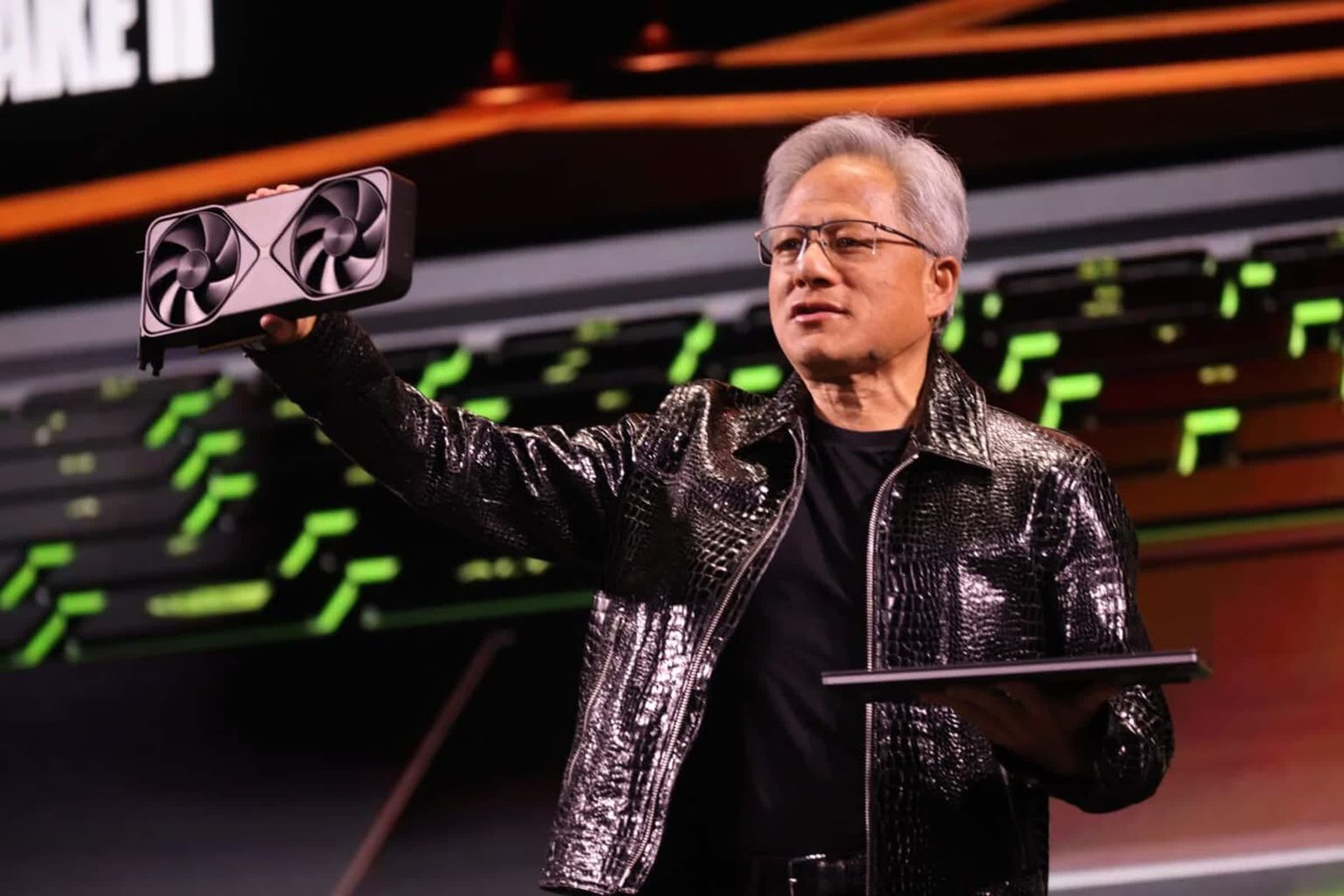
Consumer gaming hardware experienced immediate fallout as production priorities favored data center infrastructure. Nvidia GeForce retail cards saw shelf prices regularly surpass 160 percent of their baseline manufacturer suggested retail pricing. The flagship GeForce RTX 5090 became practically unobtainable for retail consumers after Nvidia allocated its VRAM quotas and raw semiconductor packages to enterprise accelerators.
04Stock market multiples and the Berlin conference
As financing programs contracted, Huang expressed severe concern regarding the company's valuation metrics on public markets. Nvidia saw its average monthly stock price multiple lag considerably behind the multiples commanded by comparable large-cap technology peers. The compression in valuation followed the reduction in subsidized compute purchases across primary cloud clients.
During an appearance before enterprise clients at a technology conference in Berlin, Huang addressed the commercial dynamics by sharing an anecdote regarding a Japanese soup vendor. The vendor refused to sell Huang a second bowl of soup despite a lengthy wait, explaining that demand far outstripped available supply. Huang cited the vendor story to justify strict customer diversification and high pricing thresholds, illustrating how controlled volume helped preserve the perception of intense scarcity.
05Resignation fallout and Megaspeed export inquiries
The disclosure of these financing practices arrived shortly after Huang resigned his executive post following revelations regarding multiple extramarital affairs. One relationship involved Alice Huang, the executive running Megaspeed, an enterprise identified by United States intelligence agencies as suspected of routing restricted Nvidia accelerators into China. Those shipments allegedly breached established export control frameworks restricting high-performance compute silicon.
While allegations surfaced claiming Alice Huang acted on behalf of intelligence authorities in Beijing, both President Donald Trump and the Department of Justice stated that no conclusive determination has been made. The operational and legal aftermath leaves Nvidia operating under Kress while managing the consequences of artificial demand generation and regulatory reviews.
Nvidia deliberately kept GPU prices high FAQ
Why did Nvidia finance its own customers?
Nvidia funded customers during mid-to-late 2026 to absorb an oversupply of TSMC wafers, inflate demand perceptions, and keep GPU prices elevated.
What happened to the OpenAI financing arrangement?
Nvidia downsized and paused the deal, which had initially proposed a $250 billion backstop to construct the world's largest data center.
Why did retail graphics card prices exceed MSRP?
AI data center demand siphoned off DRAM and NAND production, while Nvidia redirected VRAM and silicon from cards like the RTX 5090 into enterprise GPUs.
Why did Jensen Huang leave Nvidia?
Huang resigned following revelations of multiple extramarital affairs, including one with Megaspeed's Alice Huang, whose firm was suspected of diverting chips to China.
Sources

Author
Dillip Chowdary
Writes Tech Bytes coverage of AI, engineering, and the tools that actually ship. Editor of Tech Pulse Daily.
Related on Tech Bytes
Advertisement