Nvidia launches free tool that links idle computers into a personal AI
Nvidia is announcing its new Personal AI Router (PAIR), a free tool that syncs up your home computers for tackling local AI inference tasks with tools like.
By Dillip Chowdary • Sep 06, 2026 • Source: The Verge
What happened
Nvidia has announced Personal AI Router, known as PAIR, a free, open-source software tool designed to connect multiple home computers so they can work together on local AI inference tasks. Rather than sending requests to a cloud service, PAIR routes those requests across machines a user already owns, letting idle hardware contribute processing power to tools like Ollama and LM Studio.
This article breaks down exactly what PAIR does, how it differs from what came before, and what builders and hobbyists running local AI workloads should know before deciding whether to try it. If you run large language models at home across more than one machine, or have been looking for a way to put spare hardware to use, this announcement is directly relevant to you.
Nvidia announced Personal AI Router as a free tool targeting people who already run local AI inference at home. The product is open-source, meaning the code is publicly available for inspection and contribution. Nvidia positioned PAIR as a coordination layer, not a new piece of hardware, despite the name suggesting otherwise. The company was careful to clarify that point, likely because the word "router" carries strong connotations of physical networking equipment. What Nvidia is actually offering is software that sits between your AI applications and your hardware pool.
How it works
The announcement places PAIR alongside existing local inference tools rather than competing with them. Ollama and LM Studio were specifically named as compatible platforms, which signals that Nvidia is targeting the hobbyist and developer audience that has built up around those projects. That community has grown substantially as models capable of running on consumer hardware have become widely available, and PAIR appears designed to extend what that hardware can accomplish without requiring new purchases.
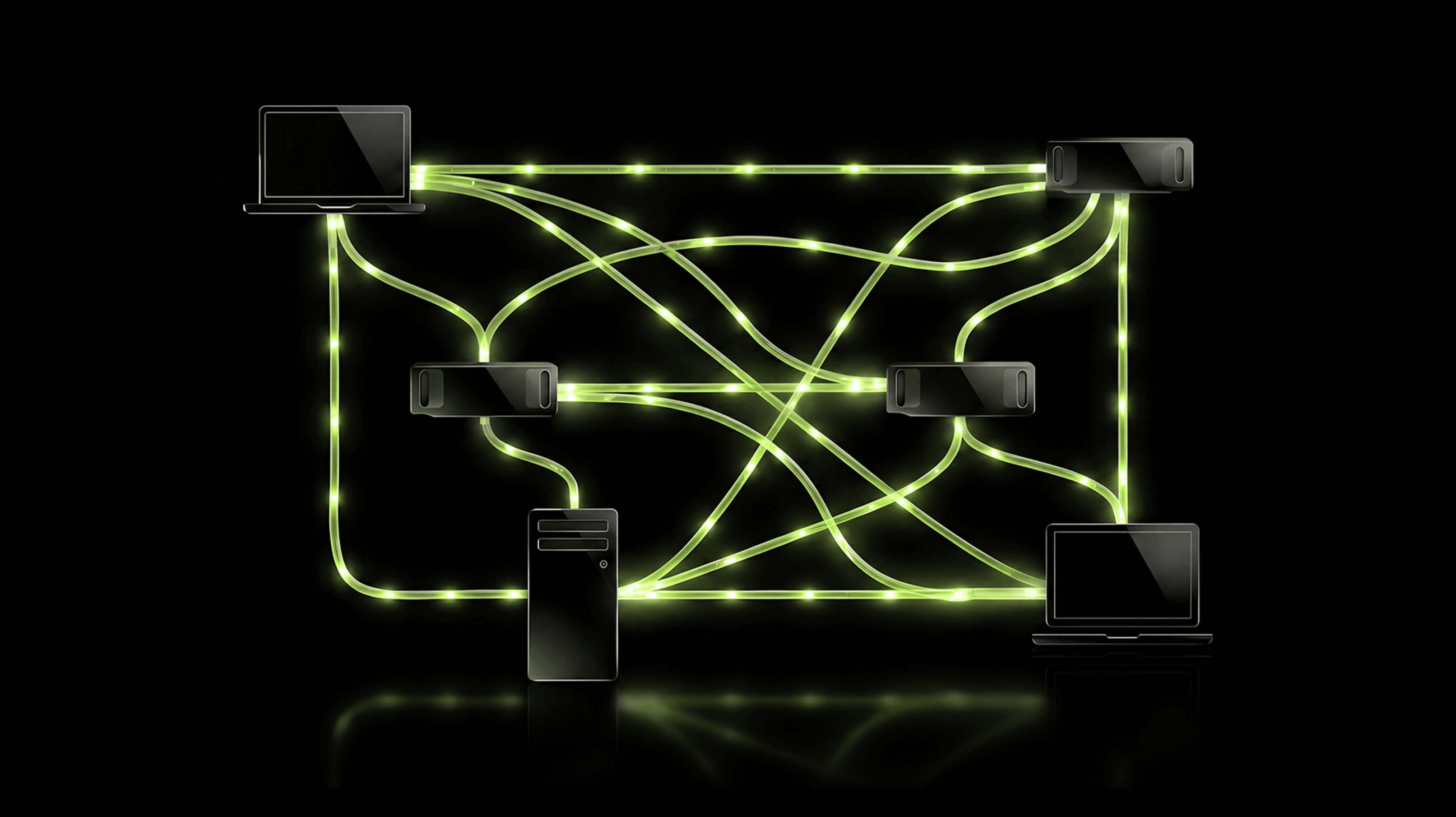
Before PAIR, a user running Ollama or LM Studio on multiple home machines had no straightforward way to pool those machines for a single inference request. Each machine operated independently, and the user typically had to manually choose which one handled a given task. PAIR changes that by acting as a software layer that syncs the machines and distributes inference work among them. The result is that idle compute on a second or third machine can contribute to tasks that a single machine might handle slowly.
Why it matters
Advertisement
Tech Pulse Daily
Get tomorrow's pulse first
Join engineers who read Tech Pulse before stand-up. Free, weekday mornings.
The mechanism is coordination rather than parallelism in the traditional high-performance computing sense. PAIR is not splitting one model across multiple GPUs the way enterprise clusters do. Instead, it appears to handle routing of requests to whichever machine in the personal network is available and capable. For someone with a gaming PC in one room and a workstation in another, PAIR offers a way to treat both as a unified local inference endpoint rather than two separate systems.
The most immediate audience is developers and technically minded hobbyists who already run models locally using Ollama or LM Studio and own more than one capable machine. If you have a single computer and no plans to expand your home setup, PAIR adds nothing to your workflow today. But if you have accumulated multiple machines over time, including older hardware that sits idle most of the day, PAIR gives you a reason to wire them together for AI work.
Researchers who prefer keeping data on-premises rather than sending it to cloud APIs will also want to evaluate this. PAIR's open-source nature means teams at small organizations can audit what the software does before deploying it internally. Builders developing applications on top of Ollama or LM Studio should verify whether PAIR introduces any latency overhead in their specific setups, since routing across a local network adds a coordination step that a single-machine configuration does not have.
Who is affected
PAIR is free. Nvidia has not attached a price to it, and the open-source license means it is not gated behind an Nvidia account or hardware requirement in principle. To get started, a user would need at least two machines that can already run local inference workloads and existing installations of a compatible tool such as Ollama or LM Studio. The coordination PAIR provides is only useful if the machines in question have hardware capable of running the models you intend to use.
Because this is an open-source release, the code repository is the primary distribution channel. Builders who want to verify behavior before committing should read the source directly and test it on a non-production setup first. As with any early open-source software tool, documentation and community support will determine how quickly adoption spreads beyond early adopters who are comfortable troubleshooting without hand-holding.
What to watch next
The most important thing to monitor is whether PAIR gains traction with the Ollama and LM Studio communities, since those projects already have active developer bases that could accelerate adoption and surface real-world performance data quickly. Community benchmarks comparing single-machine inference against PAIR-coordinated multi-machine setups will be the most honest signal of whether the routing overhead is worth the added throughput.
Nvidia's positioning of a free, open-source software tool alongside its GPU hardware business is also worth watching as a strategic signal. If PAIR drives more people to invest in additional Nvidia-powered machines for home inference, the free tool serves a clear business purpose. Builders should also keep an eye on whether support for other local inference platforms beyond Ollama and LM Studio appears in subsequent releases, which would broaden the useful audience considerably.
Developer Action Items
- ☐ Diff the official changelog for Nvidia before you bump — APIs, defaults, and removed flags only.
- ☐ Install through the vendor's documented channel in staging; keep a one-command rollback and time-box the canary.
- ☐ Grep your repo for old flag names, lockfile pins, and plugin versions that the notes mark as breaking.
- ☐ Prefer the first patch cut over the day-zero tag unless you have a reason to be on the leading edge.
- ☐ If The Verge did not name a region, plan, or SKU, screenshot the official availability line before you promise it to users.

Author
Dillip Chowdary
Writes Tech Bytes coverage of AI, engineering, and the tools that actually ship. Editor of Tech Pulse Daily.
Related on Tech Bytes
Search agent beats GPT-6 Astra on benchmarks, just days after release
Read →
Apple launches new Mac Studios with its ‘most powerful chip ever’ — the M5 Ultra
Read →
Claude Fable 5.1 is generally available in GitHub Copilot
Read →
Apple upgrading recent Mac mini orders to M6, M5 Pro models for free
Read →
Today's Tech Pulse briefing
Full briefing →
Advertisement