Only 1 in 500 Visitors Is an AI Agent (So Far)
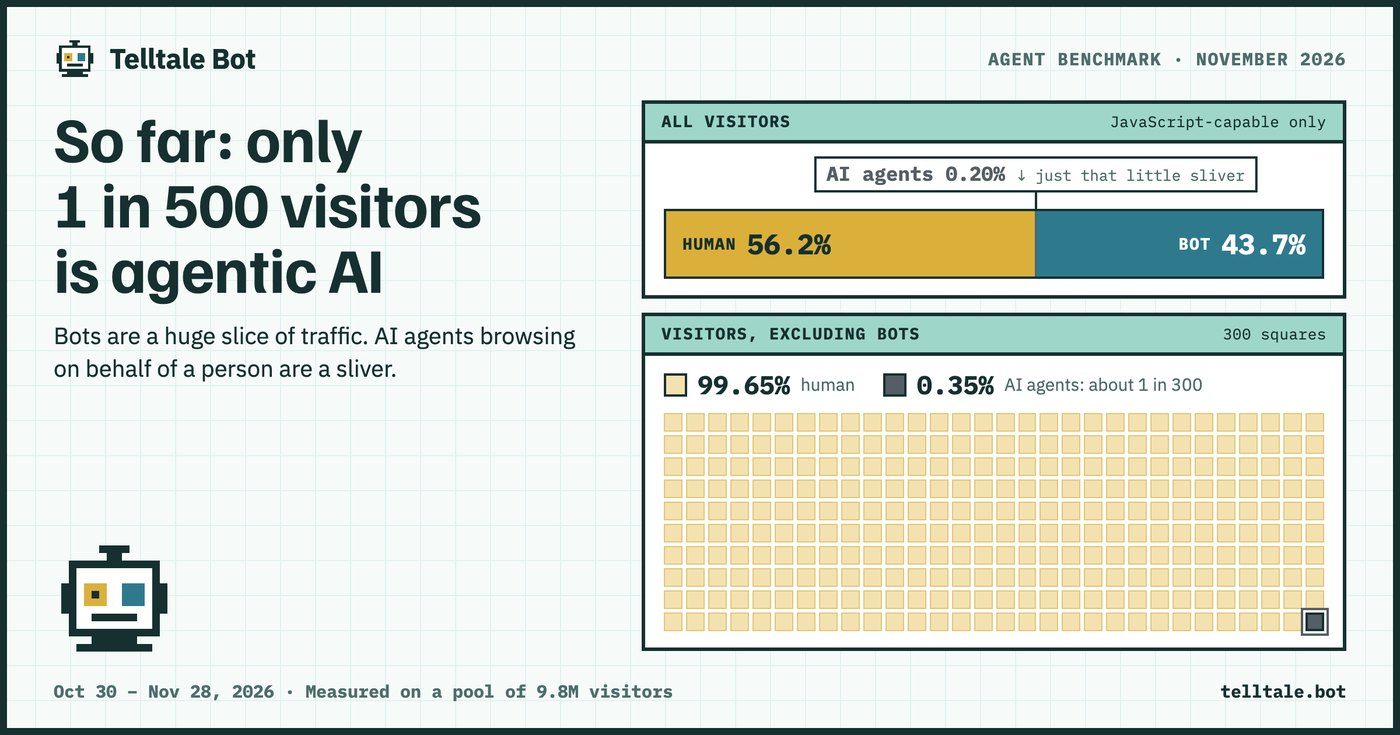
AI agents account for just 0.2 percent of total web traffic and 0.35 percent of non-bot visitors across 9.8 million tracked sessions on Telltale Bot.
By Dillip Chowdary • Nov 29, 2026 • Source: quantable.com
At a glance
- Product
- Telltale Bot
- Company
- Quantable
- Agent share
- 0.2% of all visitors
- Bot volume
- 44% of tracked visits
- Evaluation pool
- 9.8M visitors across hundreds of domains
- Monitoring window
- Oct 30 to Nov 28, 2026
Quantable released initial data from its new bot and agent detection service Telltale Bot, finding that artificial intelligence agents account for just 0.2 percent of all tracked web visitors. Across more than 100 million telemetry reports gathered over two months, autonomous browsing tools generated roughly one in every 500 visits, according to quantable.com's report. Even when filtering out automated crawler networks, agentic visitors made up only 0.35 percent of non-bot traffic, or approximately one in every 300 human-like visits.
This analysis examines traffic volumes, on-site engagement behaviors, and classification benchmarks across multi-tenant enterprise sites. Engineering teams, analytics architects, and infrastructure managers evaluating bot mitigation policies need accurate traffic baselines to distinguish genuine user agents from automated assistants.
01Early adoption numbers across web domains
Telltale Bot evaluated traffic telemetry gathered between October 30 and November 28, 2026, sampling from a pool of 9.8 million total visitors across hundreds of different domains. Automated web traffic made up 44 percent of all evaluated requests, leaving human-like visitors at 56 percent. Within that active non-bot traffic segment, agentic sessions accounted for 0.35 percent of total visits.
The measurement specifically targets autonomous AI assistants that operate inside JavaScript-capable web browsers to execute multi-step user instructions. Tools tracked by the service include Meta Muse, Claude Duet, OpenAI Dots, Grok Bot, and Gemini Task. While background research often relies on static open web fetches or internal model training caches, agentic traffic requires an active browser execution context.
Note: Telltale Bot notes that AI agents injected directly into local browsers via extensions are not always identified compared to standalone applications or cloud exits.
02High conversion rates in automated sessions
Independent telemetry published by Microsoft Clarity provides additional context on how autonomous agents behave once they land on a website. In an evaluation of 5.2 million sessions across 230,511 tracked projects ending September 9, 2026, Clarity observed that 25 percent of all agentic visitors reached an e-commerce checkout page. Another 20 percent of agentic sessions completed and submitted a form.
Clarity also recorded an 88 percent expansion in total agentic traffic volume across a three-week monitoring period. Despite that rapid acceleration, the raw session count averaged only 23 agentic interactions per project over the full duration of the test, representing less than one agent visit per site each day.
Estimated agentic share across typical domain volumes reflects this low baseline:
| Estimated site monthly volume | Implied agentic share |
|---|---|
| 10,000 sessions | 0.25% |
| 50,000 sessions | 0.05% |
Advertisement
Tech Pulse Daily
Get tomorrow's pulse first
Join engineers who read Tech Pulse before stand-up. Free, weekday mornings.
03Measurement differences with network proxies
Telltale Bot identified overall bot traffic at 44 percent, contrasting with broader network numbers like the 60 percent bot volume reported on Cloudflare Radar. The variance stems primarily from client evaluation environments and architectural filtering criteria. Cloudflare samples all inbound HTML fetches across approximately 20 percent of global web traffic, whereas Telltale Bot only counts pageviews where its client-side script executes inside JavaScript-capable environments.
When comparing requests targeting API endpoints rather than full web pages, the metrics converge. Cloudflare Radar records a 39 percent bot share on direct calls to JSON content, sitting close to the 40 percent bot rate seen across smart client requests.
Both measurement methodologies share an inherent sampling bias toward domains with active scraping concerns. Web properties actively deploying third-party bot mitigation or proxy protection services are naturally exposed to higher automated traffic volumes than the broader web.
04Fortyfold spreads between individual sites
Aggregate benchmarks conceal significant distribution variance between individual web properties. Telltale Bot observed a 40x spread in agentic traffic proportions when comparing the lowest-volume site to the highest-volume target in the dataset. Some monitored domains saw virtually no automated agent sessions, while others recorded low single-digit percentages.
Scraping pressure showed a similar divergence across monitored servers. Several customer domains encountered sophisticated crawler waves that bypassed baseline web application firewalls, while others registered only polite indexing crawlers.
Site operators evaluating infrastructure loads must track visitor identities alongside raw page requests. While agentic visitors represent a small percentage of total human-like traffic, individual autonomous tools often display crawler-like behavior by requesting large numbers of sequential pages during a single session.
05Preparing infrastructure for incoming agents
Engineering teams managing high-traffic websites must establish operational policies for agentic visitors while baseline numbers remain below one percent. Site architectures should explicitly handle automated browsers before session volumes increase.
- Audit local visitor logs evaluate real pageview counts and unique visitor cookies across your own production domain instead of relying strictly on network-wide industry averages.
- Monitor pageview velocity track anomalous per-visitor page consumption to isolate agents that generate abnormal server workloads despite low session counts.
- Establish routing rules decide whether your application will serve standard production markup, route agents to lightweight static endpoints, or apply bot mitigation filters.
Frequently asked questions
What percentage of website traffic comes from AI agents?
AI agents account for 0.2 percent of all web visitors and 0.35 percent of non-bot traffic according to data from Telltale Bot.
What actions do AI agents take on websites?
Microsoft Clarity data shows that 25 percent of agentic sessions reached a checkout page and 20 percent submitted a form on the target site.
How does Telltale Bot define agentic web traffic?
Telltale Bot defines agentic traffic as visits from AI assistants that use a real web browser with JavaScript capabilities to browse and perform actions.
Why do bot traffic estimates differ between Telltale Bot and Cloudflare?
Telltale Bot evaluates JavaScript-capable client browsers to measure a 44 percent bot rate, while Cloudflare measures all inbound HTML requests to estimate over 60 percent.
Sources

Author
Dillip Chowdary
Writes Tech Bytes coverage of AI, engineering, and the tools that actually ship. Editor of Tech Pulse Daily.
Related on Tech Bytes
Advertisement