OpenAI and Anthropic cut their LLM prices by up to 80% within a few
OpenAI and Anthropic slashed token rates up to 80 percent through September 2026 as cache discounts and open-weight models reshaped AI developer costs.
By Dillip Chowdary • Oct 25, 2026 • Source: minimaxir.com
OpenAI and Anthropic slashed API token prices across their frontline large language models by up to 80 percent between June and September 2026, triggering an aggressive pricing race across proprietary and open-weight architectures. As documented in minimaxir.com's report, the reductions unfolded through rapid sequential announcements spanning input, output, and prompt cache read tiers. The reductions extended across small utility models such as OpenAI's GPT-5.6 Luna, mid-tier workhorses including Claude Sonnet 5 and GPT-6.1 Sol, and frontier flagships like Claude Opus 5.5.
This breakdown tracks every concrete pricing schedule, cache adjustment, and architectural driver across both catalogs over the four-month sequence. It examines the shift toward cache read optimization for software development pipelines, assesses the competitive pressure exerted by open-weight providers on platforms like OpenRouter, and details what engineering teams managing automated agent workloads must prepare for going into late 2026.
OpenAI and Anthropic cut their LLM prices: what actually changed
The timeline began on June 26, 2026, when OpenAI released GPT-5.6 Sol at $5 per million input tokens, $30 per million output tokens, and $0.50 per million cache read tokens, alongside a smaller GPT-5.6 Luna at $1 input, $6 output, and $0.10 cache read, while an intermediate Terra model received minimal adoption. Anthropic followed on June 30 by introducing Claude Sonnet 5 with introductory launch rates of $2 input, $10 output, and $0.20 cache read, which Anthropic designated as permanent on August 10. Anthropic then launched Claude Opus 5 on July 24 at $5 input, $25 output, and $0.50 cache read.
Pricing escalated rapidly when OpenAI slashed GPT-5.6 Luna by 80 percent on July 30 to $0.20 input, $1.20 output, and $0.02 cache read. On August 21, OpenAI discounted GPT-5.6 Sol by approximately 20 percent to $4 input, $20 output, and $0.40 cache read for three months. By September 22, OpenAI shipped GPT-6 Sol at $2 input, $10 output, and $0.20 cache read while releasing GPT-6 Luna at $0.10 input, $0.50 output, and $0.01 cache read. Following performance concerns with GPT-6 Sol, OpenAI issued GPT-6.1 Sol on September 29, cutting cache reads to $0.10 per million tokens. Anthropic simultaneously debuted Claude Opus 5.5 on September 22 at $4 input, $20 output, and $0.20 cache read.
OpenAI and Anthropic cut their LLM prices: how it works
The steep decline in operational costs centers largely on prompt caching economics. In agentic coding environments, cache reads represent 96 to 99 percent of aggregate token consumption because automated systems retransmit entire cumulative chat dialogues on each turn. Cache hit rates consistently register between 90 and 100 percent depending on inference host configuration. Consequently, Anthropic's September 1 release of Fable 5.1 priced at $10 input, $50 output, and $0.25 cache read cut cache pricing by 75 percent compared to June's Fable 5 rate of $1, driving a direct 70 to 75 percent drop in actual usage bills.
Architectural efficiency gains also lowered the underlying compute required to serve top models. Anthropic stated that Claude Opus 5.5 requires less compute to serve than Opus 5, enabling a 20 percent reduction in input and output charges alongside a wider cache rate reduction that together lowered total operational costs by 40 to 60 percent. OpenAI similarly mirrored Anthropic's 5 percent cache-to-input price ratio with GPT-6.1 Sol, which achieved parity with GPT-6 Astra while maintaining the reduced $0.10 cache read benchmark.
Advertisement
Tech Pulse Daily
Get tomorrow's pulse first
Join engineers who read Tech Pulse before stand-up. Free, weekday mornings.
OpenAI and Anthropic cut their LLM prices: why it matters now
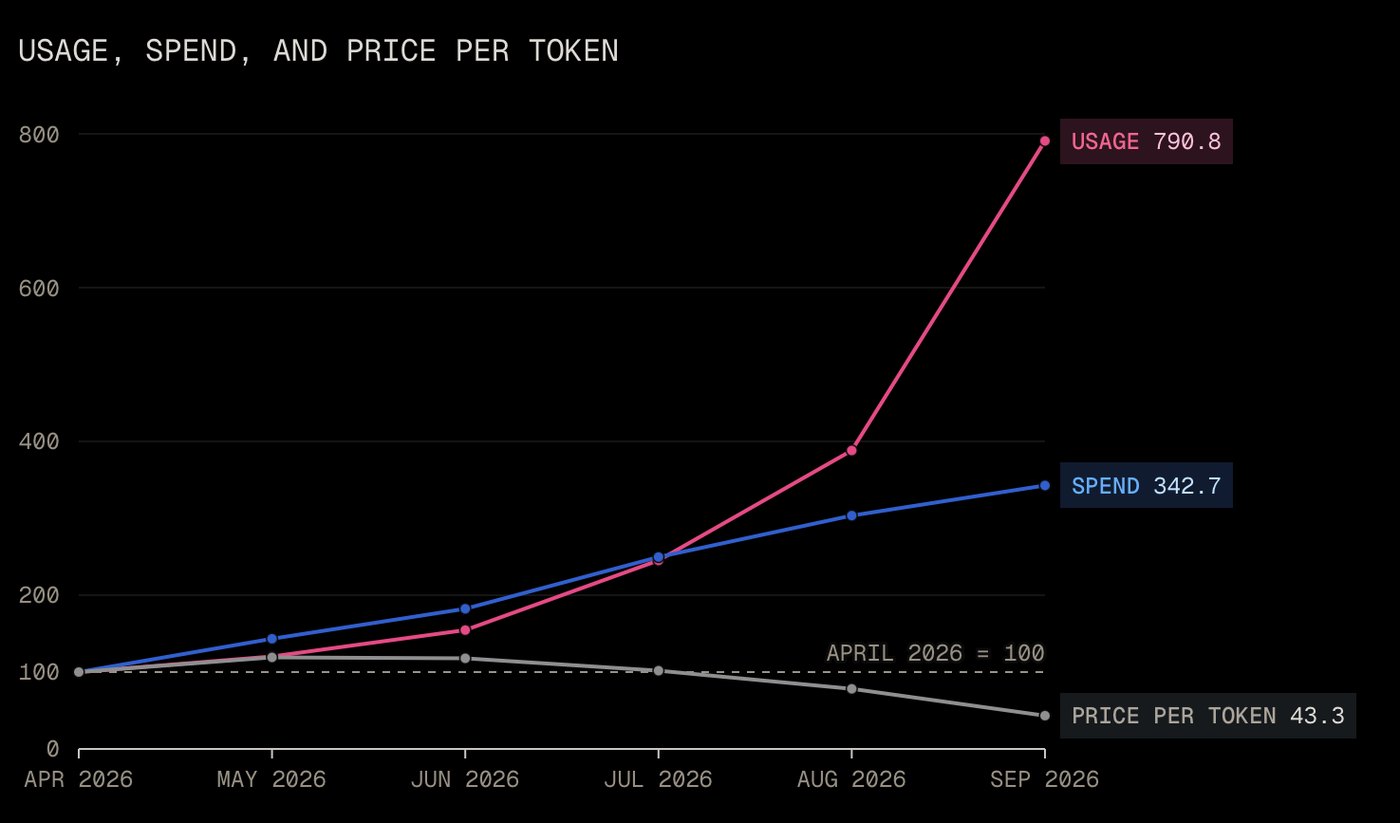
Commoditization across model providers has eliminated proprietary software moats in agent workflows. Developer platforms such as OpenCode and Zed Agent permit users to toggle between competing model endpoints instantly, while OpenRouter routes requests across dozens of hosts via API string adjustments. Platform metrics from Vercel's AI model gateway confirm that industry cost-per-token levels dropped to 43.3 percent of April 2026 figures. Despite the declining unit prices, total customer spend increased because model capabilities improved faster than prices fell, multiplying overall usage volume.
Severe price pressure from open-weight releases forced proprietary labs to abandon high tier margins. In April 2026, DeepSeek launched DeepSeek V4 Flash 0420 at $0.14 input, $0.28 output, and $0.0028 cache read, establishing an ultra-low 2 percent cache read ratio that prompted OpenAI's subsequent 80 percent Luna cut. The updated DeepSeek Flash V4.1 1017 posted a score of 45 on the Artificial Analysis index at $0.15 input, $0.60 output, and $0.003 cache read, expanding from 13 third-party OpenRouter hosts in May to 29 hosts by late October.
OpenAI and Anthropic cut their LLM prices: who is affected
Software engineers utilizing subscription coding harnesses like OpenAI Codex and Claude Code directly absorb these lower operating baselines without sacrificing response quality. The reduced price tiers flow automatically to hosted developer seats and autonomous background processes. Enterprise engineering budgets running continuous integration test loops and automated repository refactoring see immediate relief because their workloads rely heavily on persistent conversation contexts that hit cached prompts repeatedly throughout development sessions.
Third-party model hosters and distributed inference providers on OpenRouter now encounter tighter price discipline. Host providers such as Cloudflare and DeepInfra deliver effective input rates within 10 percent of DeepSeek's base endpoint pricing. While ultra-cheap open-weight endpoints still account for a minority of total token volume, their availability prevents proprietary providers from operating as an unchecked pricing duopoly. Hardware inference margins continue to narrow across the ecosystem as dozens of independent providers compete for routing traffic based on latency and cost.
OpenAI and Anthropic cut their LLM prices: what to watch
The open-weight release schedule in late 2026 poses a direct challenge to the top proprietary benchmarks. Moonshot AI introduced Kimi K3.1 Pro at $2 input, $10 output, and $0.20 cache read, undercutting the original Kimi K3 rate of $3 input, $15 output, and $0.30 cache read. Kimi K3.1 Pro registered a 55 on the Artificial Analysis benchmark, closely approaching Claude Opus 5.5 at 58 while cutting input and output rates in half.
With public model weights for Kimi K3.1 Pro scheduled for release on November 4, more than 20 independent inference providers currently hosting Kimi K3 are expected to support the new model immediately at equivalent rates. Market observers who argued token prices were temporarily subsidized before an inevitable hike face an expanding ecosystem where multi-provider inference and falling compute requirements block artificial price floors. Frontier labs must sustain heavy research investments to maintain separation from rapidly improving open alternatives.
Developer Action Items
- ☐ Diff the official changelog for OpenAI / Anthropic / Claude 5.6 before you bump — APIs, defaults, and removed flags only.
- ☐ Install through the vendor's documented channel in staging; keep a one-command rollback and time-box the canary.
- ☐ Grep your repo for old flag names, lockfile pins, and plugin versions that the notes mark as breaking.
- ☐ Prefer the first patch cut over the day-zero tag unless you have a reason to be on the leading edge.
- ☐ If HN Claude/Codex/Fable did not name a region, plan, or SKU, screenshot the official availability line before you promise it to users.
OpenAI and Anthropic cut their LLM prices FAQ
What triggered the 80 percent price cut on GPT-5.6 Luna?
OpenAI slashed GPT-5.6 Luna rates on July 30, 2026, to $0.20 input, $1.20 output, and $0.02 cache read to counter low-cost open models like DeepSeek V4 Flash.
How do prompt cache read discounts reduce agentic software development costs?
Autonomous coding agents keep previous dialogue history in cache, accounting for 96 to 99 percent of total token volume, so cutting cache rates by 75 percent reduces net operational costs by 70 to 75 percent.
How does Moonshot AI's Kimi K3.1 Pro compare to Claude Opus 5.5?
Kimi K3.1 Pro scores 55 on the Artificial Analysis benchmark compared to 58 for Claude Opus 5.5, while offering half the input and output price at $2 input, $10 output, and $0.20 cache read.
Sources

Author
Dillip Chowdary
Writes Tech Bytes coverage of AI, engineering, and the tools that actually ship. Editor of Tech Pulse Daily.
Related on Tech Bytes
Advertisement