OpenAI Details GPT-Live’s Architecture for Continuous Stateful Voice
OpenAI recently published an engineering account of GPT-Live. OpenAI Details GPT-Live’s Architecture for Continuous Stateful Voice
By Dillip Chowdary • Sep 02, 2026 • Source: InfoQ
What happened
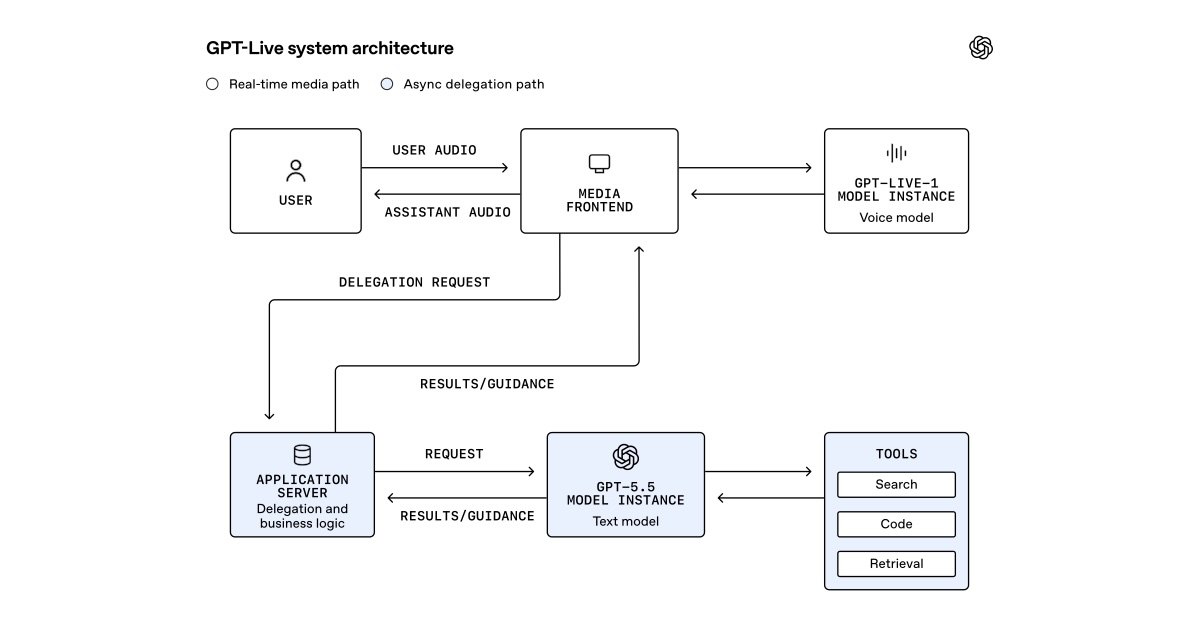
OpenAI recently published an engineering account detailing the architecture of its GPT-Live system, focusing on how the platform achieves continuous stateful voice interaction. According to a report by InfoQ, the design specifically isolates latency-sensitive operations from heavy backend application tasks to ensure smooth user experiences. By decoupling the immediate voice processing systems from broader transactional work, the technology maintains high responsiveness during active conversations.
How it works
This article examines the structural design of the GPT
Advertisement
Tech Pulse Daily
Get tomorrow's pulse first
Join engineers who read Tech Pulse before stand-up. Free, weekday mornings.
Why it matters
InfoQ Homepage News OpenAI Details GPT-Live’s Architecture for Continuous Stateful Voice Interaction Architecture & Design When AI Accelerates Development, Can Your CI Pipeline Keep Up? 0:00 0:00 Normal1.25x1.5x Like Reading list OpenAI recently published an engineering account of GPT-Live.
Who is affected
It described how they designed the system to maintain continuous voice interaction while separating latency-sensitive media processing from broader application work. The live path contains the media pipeline and inference loop, while delegation, tool use, persistence, and other application logic run behind an asynchronous RPC boundary.
What to watch next
The design reflects a central challenge for real-time AI applications. See the full write-up from InfoQ via the source link for quotes and complete context.
Developer Action Items
- ☐ Verify the claim on the official OpenAI page (or InfoQ), not from this recap alone.
- ☐ Name the surface that moved — API, policy, model, hardware, or commercial terms — before you Slack the thread.
- ☐ Assign one owner a day to read the primary material and decide: this-sprint, this-quarter, or noise.
- ☐ Do not change production on day-one coverage. Watch the vendor changelog and one independent write-up first.

Author
Dillip Chowdary
Writes Tech Bytes coverage of AI, engineering, and the tools that actually ship. Editor of Tech Pulse Daily.
Related on Tech Bytes
Elastic Stack 8.19.21 released
Read →
Rockwell Automation Patches Over a Dozen Vulnerabilities Across Products
Read →
OpenAI accused of ‘aiding and abetting’ Tumbler Ridge mass shooting in dozens of new…
Read →
Claude's new system prompt doesn't want to reproduce song lyrics
Read →
Today's Tech Pulse briefing
Full briefing →
Advertisement