OpenAI rolls out new business profiles, making ChatGPT just a little bit
OpenAI rolled out a Business Hub beta on Tuesday, enabling verified business profiles, dedicated brand agents, and discovery insights within ChatGPT.
By Dillip Chowdary • Nov 10, 2026 • Source: TechCrunch
OpenAI launched a centralized Business Hub on Tuesday to introduce business profiles inside ChatGPT, according to TechCrunch's report. The new release enters a beta rollout aimed at transforming the conversational interface into a dependable consumer discovery engine. Enterprises gain formal tools to verify corporate identities, maintain up-to-date service catalogs, and oversee customer engagement across the platform.
This guide examines how the Business Hub operates, how custom conversational agents interact with consumers, and how authentication protocols function across international markets. It details the specific discovery metrics available to commercial teams and reviews OpenAI’s strategic pivot away from direct marketplace transactions. Company founders, digital marketers, and enterprise product managers can use this breakdown to evaluate listing requirements and plan consumer reach.
01Central Business Hub and profile management
The core addition within the Tuesday rollout is the dedicated Business Hub space, which hosts public organizational profiles currently in beta. These profiles allow companies to directly manage official information about their product catalogs and service offerings. The structure closely mirrors directory formats provided by traditional web search engines such as Google.
By registering inside the hub, enterprises ensure that consumer inquiries retrieve verified operational details rather than unconfirmed web scrapes. Companies can correct outdated service descriptions and provide accurate product parameters directly within the platform. OpenAI noted on Tuesday that this administrative hub serves as an initial foundation for integrating commercial entities into user dialogues.
OpenAI framed the update around evolving consumer habits as more internet users adopt conversational interfaces for purchasing decisions. The company explained that people now turn to artificial intelligence to discover products, evaluate options, and finalize buying plans. The administrative hub provides organizations with structured representation as ChatGPT expands from an open-ended assistant into a commercial directory.
02Dedicated business agents and identity verification
Beyond static business directories, eligible companies can build and deploy specialized business agents inside ChatGPT. These custom interactive agents respond directly to shoppers who inquire about inventory, services, and brand specifications. The conversational system enables organizations to answer consumer questions through a dedicated brand representative rather than a generic model response.
Participation requires organizations to complete a mandatory verification protocol before publishing their corporate profiles and automated agents. OpenAI has not published an exhaustive checklist of required documentation for this qualification system. However, the company confirmed that formal validation remains compulsory to protect users against impersonation and unauthorized commercial listings.
Benji Shomair, the vice president of monetization at OpenAI, addressed the security framework while speaking with journalists on Monday. Shomair explained that the organization applies multiple verification methods tailored to different types of business operations in different geographic markets. This regional differentiation allows OpenAI to account for local regulatory standards, corporate registration databases, and varied commercial licensing requirements.
Advertisement
Tech Pulse Daily
Get tomorrow's pulse first
Join engineers who read Tech Pulse before stand-up. Free, weekday mornings.
03Interaction metrics and consumer discovery insights
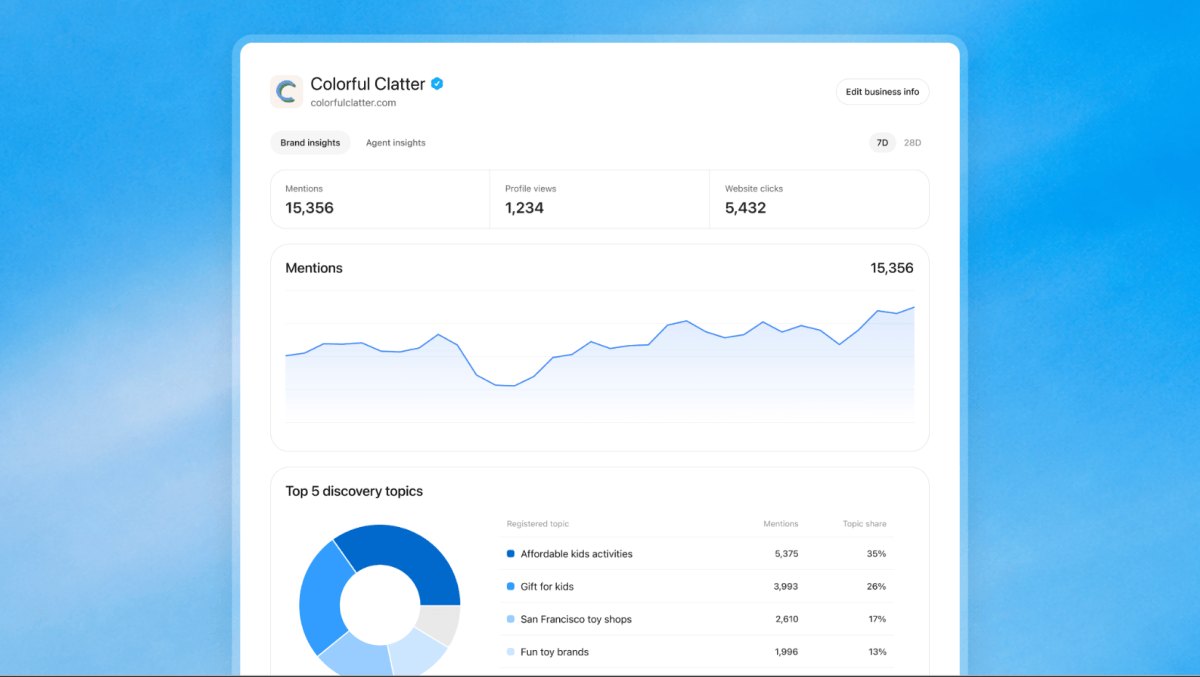
Organizations joining the Business Hub gain access to an administrative reporting tier described as limited business insights. The performance dashboard mirrors basic Google Analytics reporting by tracking how consumers discover and reference brands in conversations. Companies can examine overall exposure levels, audience curiosity trends, and specific interaction patterns generated across chat sessions.
The reporting dashboard surfaces specific interaction signals, including total profile views and aggregate business mentions across user prompts. In addition, the interface tabulates external website clicks generated when users follow referral links out of chat responses. Commercial teams can evaluate these telemetry points alongside other platform metrics to measure brand visibility during active discovery sessions.
OpenAI stated on Tuesday that ChatGPT has become a platform for people and businesses to connect through artificial intelligence. The reporting tools illustrate how often assistant recommendations translate into direct consumer interest. By tracking organic mentions and referral visits, companies can determine how effectively their verified profiles drive qualified traffic to external domains.
04Shift from direct checkout to search discovery
The business profile rollout marks a decisive shift in how OpenAI monetizes commercial activity across ChatGPT. The company previously attempted to establish a native e-commerce ecosystem where shoppers could purchase goods directly inside chat windows. That early commerce project relied on a commission fee system designed to generate substantial transactional revenue for the platform.
During that initial commerce experiment, OpenAI sought to position ChatGPT as a direct competitor to retail marketplaces like Amazon. The initiative even incorporated an integrated checkout cart feature to handle in-app payment processing. However, consumer adoption failed to materialize, prompting OpenAI to shut down the shopping initiative and retire the checkout cart in March.
Rather than processing payments and handling merchant fulfillment, OpenAI is now adopting the informational posture long dominated by Google. Web search engines function primarily as discovery guides where users evaluate businesses and examine brand reputations before buying elsewhere. The new Business Hub aligns ChatGPT with this established directory paradigm by organizing company information instead of selling physical inventory.
05Competition with established search directory models
By assembling business profiles, interactive agents, and query analytics, OpenAI is actively contesting traditional search engine utilities. Internet users have historically relied on Google to verify operational hours, compare brand offerings, and research product reliability. The Business Hub beta allows ChatGPT to address those identical informational needs directly inside generative conversations without redirecting users to standard search results.
Whether this revised discovery model will outperform OpenAI’s defunct e-commerce experiment remains an open question for the industry. Success will depend on whether enterprises embrace verification across global territories and actively maintain their product catalogs. Furthermore, corporate adoption requires measurable return on investment through profile views, prompt mentions, and referral link traffic.
OpenAI described the Tuesday announcement as an early step in bringing commercial organizations more deeply into ChatGPT. If enterprises populate the directory with accurate records, conversational discovery could fundamentally alter how consumers locate businesses online. Continued monitoring will determine whether these business profiles succeed where direct in-app shopping carts previously faltered.
OpenAI rolls out new business profiles FAQ
What is the new Business Hub in ChatGPT?
The Business Hub is a beta feature where companies can create and verify business profiles to update official information about their products and services. It also lets eligible organizations launch specialized business agents to answer consumer questions.
What analytics does the Business Hub provide to companies?
The hub offers limited business insights that track how ChatGPT users interact with commercial entities. Reported metrics include total profile views, business mentions in conversations, and outbound website clicks.
How do companies verify their business profiles on ChatGPT?
Businesses must complete a formal verification process to publish their profiles. Benji Shomair, VP of Monetization at OpenAI, confirmed that the platform uses multiple verification methods tailored to different business types and markets.
Why did OpenAI discontinue its previous e-commerce shopping cart?
OpenAI previously tested a direct e-commerce hub with a commission fee system and an integrated checkout cart to compete with Amazon. The initiative failed to take off and was officially retired in March before OpenAI shifted toward a Google-like discovery model.
Sources

Author
Dillip Chowdary
Writes Tech Bytes coverage of AI, engineering, and the tools that actually ship. Editor of Tech Pulse Daily.
Related on Tech Bytes
Advertisement