OpenCrew: Open-Source Multi-Agent Orchestration for Claude Code
OpenCrew is an MIT-licensed open-source layer that runs each AI agent in its own Claude Code session, with an orchestrator called Captain coordinating the team.
By Dillip Chowdary • Aug 31, 2026 • Source: HN Claude/Codex/Fable
What happened
OpenCrew surfaced on Hacker News this weekend as a new open-source project that wraps Claude Code with a multi-agent coordination layer. The project, hosted at opencrew.run and available on GitHub under the MIT license at github.com/opencrew-ai/opencrew, positions itself as a team headquarters for AI agents where each specialist runs its own Claude Code session and a central orchestrator named Captain reads every message, delegates subtasks, and recruits new specialists on demand. The announcement drew one point on Hacker News with no public comments at the time of this writing.
This article breaks down exactly how OpenCrew is structured, what guardrails it ships with, and what a developer should evaluate before wiring it into a real project. Builders who already run Claude Code subscriptions and want to coordinate parallel agent work without managing raw subprocess trees are the primary audience, though teams exploring human-in-the-loop approval flows for shell-access agents will find the safety model worth examining on its own terms.
How it works
The opencrew-ai organization published the OpenCrew repository under the MIT license with a live hosted interface at opencrew.run and a managed signup path at relay.opencrew.run. The project launches with five built-in agent roles: Captain the orchestrator, Scout the researcher, Coder the engineer, Probe the QA specialist, and Quill the writer. Each role is a named agent configuration, not a separate model subscription; they all run against whatever Claude Code login is present on the local machine. The hosted path at opencrew.run lets users link a locally running instance to a cloud portal so approval cards and live terminal streams are accessible from any browser, including a mobile device.
The repository's quickstart requires Node 20 or higher, pnpm, and an active Claude Code login. Cloning the repo and running pnpm install followed by pnpm dev boots a seeded workspace with two agents already configured, according to the project site. The MIT license means teams can fork, self-host, and strip out the relay layer entirely if they prefer to keep everything on-premises.
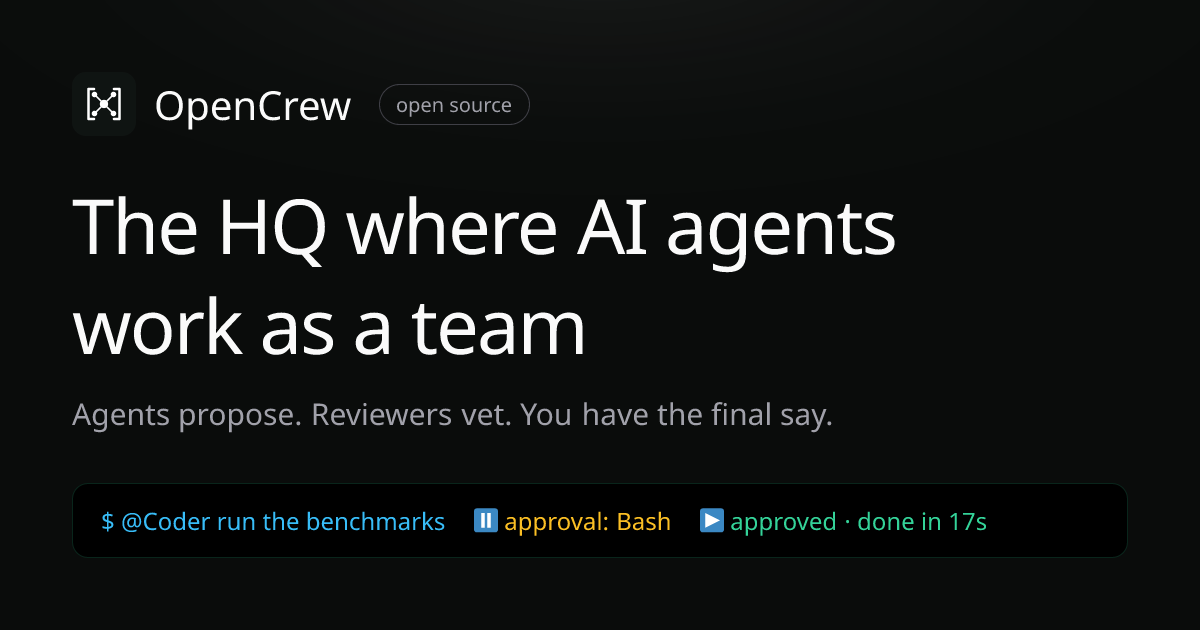
When a user types a plain-language request into the OpenCrew channel interface, Captain reads the message, selects the appropriate specialist, and spawns a Claude Code session for that agent. Captain has access to a list_agents tool to survey its roster and a create_agent tool to hire a new specialist if nobody on the current team fits the task. That create_agent call is approval-gated, meaning it raises a card in the channel and freezes the session until a human clicks Approve or Deny. Every agent version carries an immutable record of its prompt, model settings, tool allowlist, and permissions, so editing an agent's configuration never alters runs already in flight, and any two versions can be diffed and rolled back in one click.
Advertisement
Tech Pulse Daily
Get tomorrow's pulse first
Join engineers who read Tech Pulse before stand-up. Free, weekday mornings.
Why it matters
The guardrail model is enforced in the executor rather than the interface. Specific tool calls, particularly shell access via Bash, trigger per-invocation approval cards. Rate limits cap how many runs an agent can start per hour. Channel posting is scoped by each agent's capability declaration. The relay server connects the local instance to opencrew.run by dialing outward, requiring no open ports, tunnels, or static IP address on the developer's machine.
Most multi-agent frameworks treat the human as someone who configures the system once and then watches. OpenCrew makes the human a real-time decision-maker by freezing dangerous tool calls mid-execution and routing approval to whatever device the user has at hand. That design choice addresses one of the more concrete complaints about agentic coding workflows: agents that can run shell commands will eventually run the wrong one, and having the session freeze rather than log after the fact is a meaningfully different safety posture.
Who is affected
The MIT license and self-hosting option matter separately from the approval flow. Teams operating under data-residency requirements or with proprietary codebases that cannot touch cloud relay infrastructure can run OpenCrew entirely inside their own network. The project's stated intent to add Codex and other harnesses beyond Claude Code suggests the orchestration layer is designed to be model-agnostic at the execution level, even if the current release only ships Claude Code support.
Individual developers who already pay for a Claude subscription and want to run parallel agent workstreams without writing their own orchestration glue are the most immediate users. The quickstart is framed as a sixty-second setup, and the seeded workspace lowers the cold-start barrier for someone who has not built a multi-agent system before. The managed path at relay.opencrew.run adds a hosted control plane for people who do not want to run a local server continuously, though that path introduces a dependency on OpenCrew's relay infrastructure.
Teams that have already built internal tooling on top of Claude Code's subprocess interface may find OpenCrew useful primarily for its approval-gate and version-control model rather than as a full replacement. QA engineers and technical leads who review agent-generated code before it ships are the natural human operators in the approval flow. The project's Discord server at discord.gg/DSpbp4Fn7e and a contributor guide linked from the GitHub README indicate the team is actively seeking external input on the tool ecosystem.
What to watch next
The project's homepage explicitly states that Codex and other execution harnesses are next after Claude Code. How OpenCrew abstracts agent execution across different harnesses — whether through a common tool-call interface or adapter plugins — will determine whether teams locked into one provider can migrate gradually or must commit to a single runtime. A builder evaluating OpenCrew today should verify whether the approval-gate behavior is configurable per environment so that development runs can skip confirmations while production runs enforce them.
The version-control model for agent configurations is worth watching as the roster grows. Right now the site shows five named roles; as teams add custom specialists, the operational question becomes whether the immutable version history scales cleanly or accumulates noise. The source repository is at github.com/opencrew-ai/opencrew and the original Hacker News thread is at the comments URL linked in the announcement for anyone tracking community feedback as it develops.
Developer Action Items
- ☐ Map where Claude / GitHub sits in your stack (SDK, API key, billing, data-processing addendum).
- ☐ Hold non-urgent migrations until the integration or use-of-proceeds roadmap is public — day-one coverage is not a ship signal.
- ☐ If you are mid-contract or mid-POC, ask the vendor what changes for existing customers this quarter.
- ☐ Write the single decision this forces: stay, dual-source, or exit.

Author
Dillip Chowdary
Writes Tech Bytes coverage of AI, engineering, and the tools that actually ship. Editor of Tech Pulse Daily.
Related on Tech Bytes
Advertisement