Opus 5.5 and Fable 5.2 made my overoptimized Rust code more overoptimized
Anthropic deployed Claude Opus 5.5, enabling automated Rust code pipelines to deliver 1.5x execution speedups and synthesize bespoke parallel image decoders.
By Dillip Chowdary • Nov 29, 2026 • Source: minimaxir.com
At a glance
- Product
- Claude Opus 5.5
- Developer
- Anthropic
- Base price
- $20 per month
- High usage
- $100 per month
- Speed gain
- 1.2x to 1.5x speedup
- Key tool
- samply profiler integration
Anthropic released Claude Opus 5.5 and Fable 5.2 as frontier reasoning models designed to execute advanced technical engineering tasks across production development workflows. In a benchmark evaluation detailed in minimaxir.com's report, data scientist Max Woolf deployed Opus 5.5 to optimize high-performance Rust software that had previously hit plateaus under OpenAI GPT 6.1 Astra. The model delivered immediate 1.2x to 1.5x execution speedups across multiple crates, demonstrating noticeable improvements in autonomous code refactoring and systems-level optimization.
This article examines the operational architecture, developer harness trade-offs, and profiling techniques uncovered when running Opus 5.5 across complex Rust repositories. Software engineers, performance specialists, and technical leads evaluating autonomous coding agents will find concrete benchmark data, workflow protocols for asynchronous background tasks, and explicit deployment commands for local developer environments.
01Desktop harness migration and subagent verification
Developers moving from OpenAI Codex to Claude Code historically encountered integration hurdles, particularly with Claude Code restricting third-party editor harnesses such as Zed Agent. While Zed Agent provided a workaround through the Agent Client Protocol, Opus 5.5 frequently initializes asynchronous background jobs that third-party interfaces failed to track reliably. Additionally, Claude Code addressed a frequent developer complaint by supporting repository-level AGENTS.md instruction files alongside CLAUDE.md configurations.
The official Claude desktop application served as the primary harness to navigate these background operational demands during extended testing. The native application provides a dedicated sidebar displaying running background processes while tracking active session and weekly usage limits. Inline image rendering allows engineers to confirm visual inputs immediately, while the built-in Remote Control feature enables long-running optimization passes to run autonomously without continuous manual intervention.
Opus 5.5 also adopted distinct code editing mechanics, frequently generating standalone Python scripts to perform surgical find-and-replace updates instead of executing built-in file editing tools. To maintain development speed during CPU-intensive benchmark loops, the workflow deployed secondary Haiku 5.5 subagents. These auxiliary models conducted nonblocking code reviews and quality inspections in parallel while the primary agent authored code and executed local test suites.
02External prompt sequencing and asynchronous background execution
Asynchronous agent execution introduced specific queueing challenges when coordinating multi-stage optimization passes in Claude Code. Unlike Codex harnesses that hold subsequent prompts until an active task finishes, Claude Code dispatches queued prompts whenever the agent becomes temporarily idle while awaiting background benchmarks. To prevent breakthrough directives from interrupting active work prematurely, developers implemented a structured three-step sequencing protocol:
- Instruction file creation Write breakthrough directives into a separate Markdown file located at /Users/maxwoolf/Desktop/agent_instructions/alpha.md outside the active workspace.
- Conditional prompt execution Add a strict prompt rule commanding the model to read and follow the external file only after completing the primary optimization task.
- Turn conclusion Let the primary agent finish benchmarking and code changes before it accesses the secondary instruction stage.
This quarantine strategy prevented premature prompt execution while preserving contextual integrity across long-running development loops. The process enabled Opus 5.5 to complete multi-hour iterations autonomously, ensuring that complex subsequent commands did not corrupt active compilation steps or skew benchmark results.
03Benchmark speedups and bespoke module synthesis
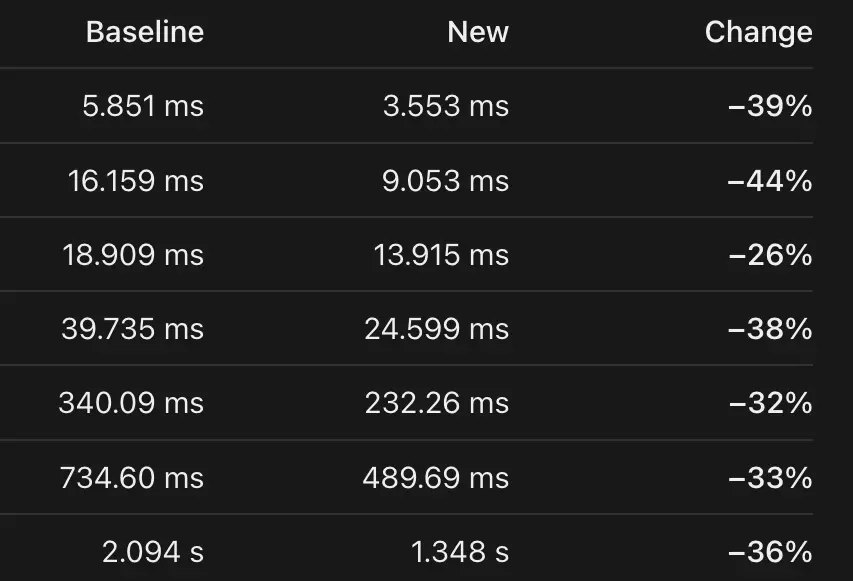
Explicit instructions commanding runtime speedups yielded significant throughput improvements on Rust libraries that had already been aggressively tuned with GPT 6.1 Astra. In single-pass execution runs, Opus 5.5 generated 1.2x to 1.5x performance improvements across multiple distinct crates. Rather than relying solely on incremental algorithmic tuning, the model regularly bypassed standard external dependencies on the execution hot path, authoring bespoke low-level alternatives from scratch.
When optimizing software dependent on the official Rust png library, Opus 5.5 constructed a custom parallel decoding module specifically structured around the application data pipeline. While the synthesized module achieved the required 1.2x to 1.5x speed improvements without introducing regressions, it increased overall code volume and maintenance overhead. Targeted maintenance passes directing the model to trim code size by twenty percent struggled to consolidate the synthesized modules without sacrificing runtime gains.
Advertisement
Tech Pulse Daily
Get tomorrow's pulse first
Join engineers who read Tech Pulse before stand-up. Free, weekday mornings.
| Benchmark Metric or Component | GPT 6.1 Astra Baseline | Claude Opus 5.5 Result |
|---|---|---|
| Runtime execution speedup | 1.0x baseline reference | 1.2x to 1.5x throughput gain |
| Critical dependency handling | Standard png library crate | Custom streaming parallel module |
| Testing tier expenditure | Standard Codex subscription | $20 to $100 per month |
| Evaluation decision window | Multi-week iteration cycles | 48-hour upgrade threshold |
04Automated profiling runs with samply instrumentation
Unlike earlier foundation models that routinely ignored profiling suggestions within developer prompts, Opus 5.5 actively integrated system profiling into its core optimization workflow. The model proactively executed samply to capture detailed execution timelines and pinpoint routines scaling poorly across large data inputs. Following each source modification, the agent initiated secondary profiling runs to confirm that critical hot paths had successfully shifted away from bottlenecks.
Despite autonomous profiling strengths, Claude Code introduced observability trade-offs when orchestrating local benchmark suites. The harness routed criterion benchmark output directly into temporary system files rather than streaming progress to the terminal console. As a result, engineers were unable to view intermediate results as tests progressed and had to wait for the entire benchmark run to finish before analyzing performance shifts.
Note: Criterion benchmark outputs remain captured inside temporary operating system pipes throughout active test runs, preventing live terminal observation until execution terminates completely. Developers requiring immediate metric feedback must wait for full harness completion or inspect temporary files manually outside the application window.
05Installation commands and model switch flags
Engineers can install and update Claude Code globally using standard package managers to maintain compatibility with the latest features. Updating the client ensures support for repository-level AGENTS.md configurations and active background process monitors across local projects.
npm install -g @anthropic-ai/claude-codeWithin active terminal sessions, developers switch to the reasoning engine using inline slash commands or launch pinned instances directly from the command line:
/model opus-5-5claude --model opus-5-5claude config set --global model opus-5-5Access to Opus 5.5 requires an active subscription tier starting at twenty dollars per month for initial evaluations, scaling to one hundred dollars per month for heavy development workloads. Developers running continuous optimization tasks can monitor resource utilization and background task status directly through the desktop interface.
Frequently asked questions
How much does accessing Claude Opus 5.5 cost?
Access begins at a $20 per month subscription tier for standard evaluation, with a $100 per month tier available for higher usage limits.
What performance improvements did Opus 5.5 produce on Rust software?
Opus 5.5 delivered 1.2x to 1.5x execution speedups on Rust crates previously optimized with OpenAI GPT 6.1 Astra by authoring bespoke low-level modules.
How does Opus 5.5 identify system performance bottlenecks?
The model autonomously executes the samply profiler to map execution hot paths and re-profiles the codebase after code modifications to confirm speed gains.
How can developers prevent premature prompt execution in Claude Code?
Developers store follow-up commands in an external Markdown file outside the repository and instruct the agent to access the file only after completing its current task.
Sources

Author
Dillip Chowdary
Writes Tech Bytes coverage of AI, engineering, and the tools that actually ship. Editor of Tech Pulse Daily.
Related on Tech Bytes
Advertisement