Google's newest TPUs: 8tx and 8i Max, built for the agentic era
Google expanded its eighth-generation TPU family to four systems, launching TPU 8tx for confidential compute and the dual-chip TPU 8i Max for agentic AI.
By Dillip Chowdary • Nov 09, 2026 • Source: Google Cloud Blog
Google expanded its eighth-generation custom artificial intelligence accelerator portfolio on November 10, 2026, introducing two specialized hardware systems called TPU 8tx and TPU 8i Max. The new releases double the lineup established in April at Google Cloud Next, where Google unveiled the baseline TPU 8t for large-scale model training and TPU 8i for real-time reasoning. As detailed in Google Cloud Blog's report, this release marks the first time Google has launched four distinct TPU systems within a single calendar year. The company's TPU customer footprint now approaches 100 organizations, including frontier AI research laboratories, financial trading firms, retail enterprises, and academic institutions, operating across cloud clusters and on-premises data center deployments.
This operational overview details the technical specifications, architectural packaging, software integrations, and workload divisions across the full four-chip eighth-generation catalog. Engineering teams, enterprise architects, and infrastructure managers evaluating hardware allocations for high-context autonomous agents or regulated inference workloads will find precise data on memory bandwidth, hardware-level memory isolation, and open-source serving runtimes.
Google's newest TPUs: what actually changed
The most significant change in Google's silicon strategy is the shift from launching monolithic individual chips to deploying system-level modular configurations built on existing silicon. Designing a new chip requires years of layout and fabrication work, while system engineering integrates compute, memory, networking, and security around established dies. Rather than waiting for a multi-year fabrication cycle, Google engineered TPU 8tx by pairing the foundational TPU 8t silicon with custom AMD central processing unit hosts and low-latency networking. In parallel, Google built TPU 8i Max by packaging two existing TPU 8i dies together inside a single physical module, preserving the standard data center rack footprint while doubling available silicon density.
With these additions, Google's eighth-generation accelerator family splits into four distinct workload targets. The original TPU 8t provides up to 2.7 times better training performance than the previous generation, focused on maximum useful intelligence delivered per watt. The baseline TPU 8i delivers up to 80 percent better inference price performance while cutting inter-chip communication delays by up to half. The new TPU 8tx provides hardware-level confidential compute for private fine-tuning and secure execution, while the dual-chip TPU 8i Max doubles compute, static random-access memory, and high-bandwidth memory capacity over standard 8i units to tackle memory-bound reasoning across massive context windows.
Google's newest TPUs: how it works
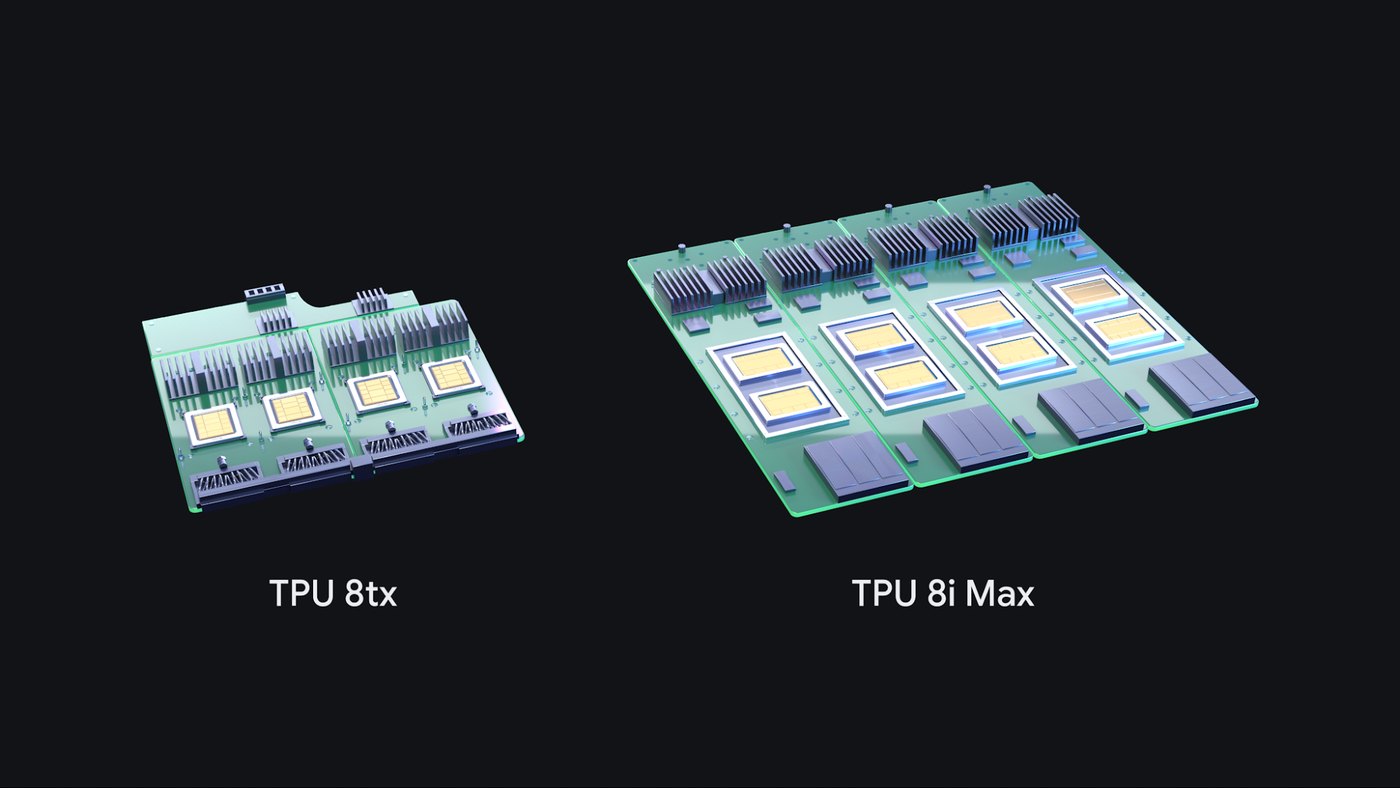
Under the hood, TPU 8tx addresses security vulnerabilities associated with processing sensitive data in active memory. While traditional enterprise environments encrypt datasets during storage and network transmission, data typically decrypts once loaded into working memory. TPU 8tx integrates cryptographic security directly into the silicon layer alongside its AMD host processors, ensuring proprietary model weights, private tuning sets, and active agent states remain isolated even while actively computing. It connects through the low-latency Boardfly network originally developed for real-time reasoning, achieving up to 2x lower latency than standard TPU 8t clusters without degrading compute throughput. This interconnect balance allows teams to run private fine-tuning, knowledge distillation, and reinforcement learning routines on a unified system without transferring data between segregated clusters.
TPU 8i Max resolves the memory wall encountered when autonomous agent pipelines evaluate entire codebases or lengthy video files simultaneously. By fusing two TPU 8i chips into a single package, the module doubles compute throughput, SRAM capacity, and high-bandwidth memory transfer rates in exact alignment. This unified packaging ensures processors do not stall while waiting for token caches or context parameters to stream across the bus. Because the dual-die assembly preserves standard rack dimensions, data center operators double their effective processing density per square foot and per watt without requiring specialized floor redesigns.
Advertisement
Tech Pulse Daily
Get tomorrow's pulse first
Join engineers who read Tech Pulse before stand-up. Free, weekday mornings.
Google's newest TPUs: why it matters
These hardware developments matter because enterprise adoption has shifted from simple prompt-response interactions to multi-step autonomous agents that require persistent context and strict data governance. By introducing hardware-level confidential compute, Google removes the regulatory roadblocks that previously prevented government departments, healthcare networks, and financial institutions from deploying frontier models over proprietary data. Organizations no longer have to build complex, separated staging pipelines to fine-tune internal models; they can execute private training, distillation, and production serving inside the same protected hardware perimeter.
From an efficiency perspective, the dual-die packaging of TPU 8i Max enables data centers to scale processing density against strict thermal and spatial power envelopes. Scaling compute and memory bandwidth in lockstep breaks the communication bottlenecks that cause accelerators to sit idle during large-context evaluation. Concurrently, Google is removing framework lock-in through software updates like TorchTPU, allowing standard PyTorch code and Hugging Face models to run without manual code rewrites. With out-of-the-box backends for vLLM and SGLang, alongside an open-source XLA Serving Engine that trains in Python and serves through low-latency C++ runtimes across TPUs, GPUs, and CPUs, Google has positioned its accelerator line to compete directly on realistic production benchmarks like InferenceX and AgentX.
Google's newest TPUs: who is affected
The immediate impact falls on enterprise software engineers and platform operators working in regulated sectors such as banking, trading, defense, and healthcare. Infrastructure teams managing compliance no longer need to sacrifice inference speed to meet cryptographic standards, as TPU 8tx allows private model evaluation and reinforcement learning without exposing plaintext weights in memory. Developers using coding assistants such as Claude Code, Cursor, and Google Antigravity also gain native support through a new preview TPU agent suite, which automates cluster onboarding, identifies execution bottlenecks, and autotunes custom kernels through plain-language commands.
Enterprise data centers and commercial cloud customers benefit directly from the improved density metrics. Organizations deploying TPU hardware directly into their own facilities can extract twice the compute power and memory capacity per rack using TPU 8i Max, eliminating the need to expand physical data center footprints. Machine learning engineering teams accustomed to GPU-centric workflows can now shift PyTorch codebases directly onto Google Cloud infrastructure without undergoing extensive code rewrites or custom kernel authoring.
Google's newest TPUs: what to watch
Moving forward, industry observers should monitor performance results as external organizations evaluate the vLLM-TorchTPU software stack against large-scale production deployments. While Google reported top-tier price-performance marks on InferenceX and AgentX benchmarks across open-source models, independent verification from trading firms, universities, and commercial cloud tenants will demonstrate how effectively the hardware handles diverse production traffic. The preview TPU agent suite will also show whether automated kernel tuning and onboarding assistance can meaningfully reduce deployment friction for engineers outside Google DeepMind.
Another critical factor will be the rate at which enterprise customers deploy TPUs into private data centers rather than relying exclusively on Google Cloud infrastructure. As Google continues co-designing hardware configurations in response to external enterprise feedback, the modular system-building strategy will face real-world testing. Observers should track whether the dual-chip packaging model expands to future training silicons, as well as how upcoming software optimizations on the XLA Serving Engine affect cross-hardware parity across heterogeneous compute clusters.
Developer Action Items
- ☐ Verify the claim on the official Google / Windows / AMD page (or Google Cloud Blog), not from this recap alone.
- ☐ Name the surface that moved — API, policy, model, hardware, or commercial terms — before you Slack the thread.
- ☐ Assign one owner a day to read the primary material and decide: this-sprint, this-quarter, or noise.
- ☐ Do not change production on day-one coverage. Watch the vendor changelog and one independent write-up first.
Google's newest TPUs FAQ
What are Google TPU 8tx and TPU 8i Max?
They are two new eighth-generation accelerator systems designed for confidential enterprise computing and dual-chip, high-bandwidth memory expansion for autonomous agents.
How does TPU 8tx secure enterprise artificial intelligence workloads?
TPU 8tx pairs TPU 8t silicon with custom AMD CPU hosts to build encryption directly into the hardware layer, keeping model weights and private data protected while in active memory.
What performance improvement does the dual-chip TPU 8i Max provide?
TPU 8i Max combines two TPU 8i dies on a single package to deliver double the compute, double the SRAM, and double the high-bandwidth memory capacity within standard rack footprints.
Can developers run PyTorch models on these eighth-generation TPUs without rewrites?
Yes, Google's open-source TorchTPU software and native backends for vLLM and SGLang allow standard PyTorch and Hugging Face models to execute natively without code modifications.
Sources

Author
Dillip Chowdary
Writes Tech Bytes coverage of AI, engineering, and the tools that actually ship. Editor of Tech Pulse Daily.
Related on Tech Bytes
Advertisement