Project HydraFusion: Frontier quality via multi-model orchestration
In controlled offline evaluations, HydraFusion’s selective coding workflows matched or exceeded the evaluated Opus 5 baseline while reducing estimated workflow.
By Dillip Chowdary • Sep 06, 2026 • Source: GitHub Blog (priority filter)
What happened
GitHub has shipped a research preview of Project HydraFusion inside GitHub Copilot, a multi-model orchestration system that routes coding tasks across several frontier models rather than sending every request to a single one. In controlled offline evaluations, HydraFusion's selective coding workflows matched or exceeded an Opus 5 baseline while reducing estimated workflow cost, a result that positions the project as a serious attempt to close the gap between raw model capability and practical deployment economics.
This article breaks down what HydraFusion actually does under the hood, how the orchestration layer changes the way builders interact with Copilot, and what you should verify before leaning on it in production pipelines. If you maintain AI-assisted development workflows, evaluate Copilot for your organization, or track the cost-quality frontier in large language model tooling, the details below are for you.
GitHub has made HydraFusion available as a research preview within GitHub Copilot. The system is described as a multi-model orchestration approach, meaning it does not pick one model and apply it uniformly to all coding tasks. Instead, it uses selective routing logic to decide which model handles a given workflow step. The offline evaluation benchmark that GitHub used to validate the system showed HydraFusion matching or exceeding an Opus 5 baseline on the coding tasks tested. That comparison matters because Opus 5 represents a high-capability reference point, and demonstrating parity or superiority at lower estimated cost is the central claim the team is making.
How it works
The research preview label signals that this is not a general availability release. GitHub is gathering real-world signal from Copilot users to validate the controlled evaluation results against live usage patterns. The distinction between offline evaluation and production behavior is one the team appears to be taking seriously, which is why the preview phase exists rather than a full rollout.
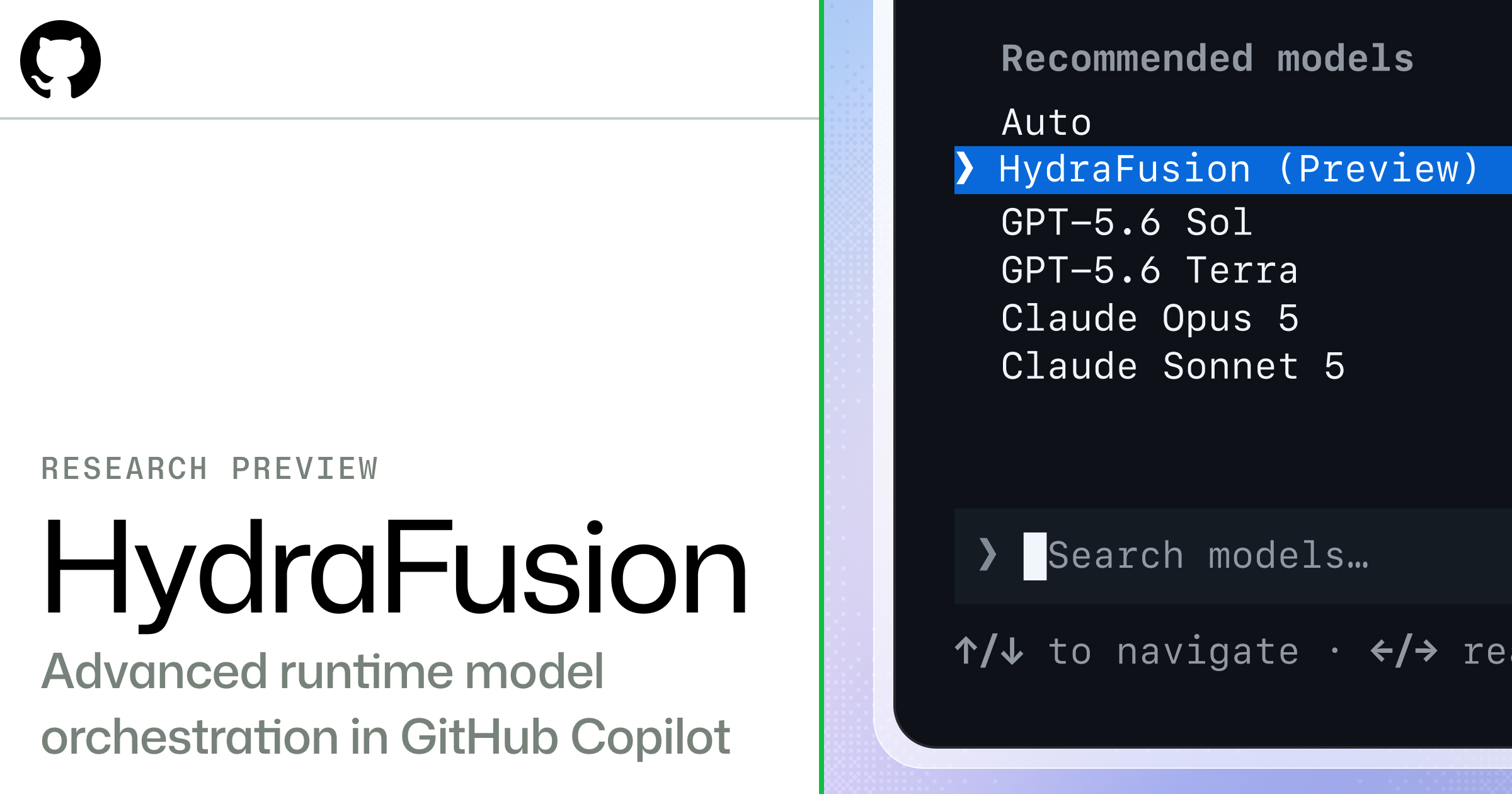
The most consequential shift for builders is that the model doing the work on any given task is no longer fixed or user-selected in the traditional sense. HydraFusion's orchestration layer makes that routing decision automatically based on the nature of the coding workflow. This means a developer writing a complex refactor might get a different underlying model than the same developer asking for a quick docstring, even within a single session, without any explicit configuration change on their end.
Why it matters
Advertisement
Tech Pulse Daily
Get tomorrow's pulse first
Join engineers who read Tech Pulse before stand-up. Free, weekday mornings.
For teams that have built evaluation harnesses or cost-tracking infrastructure around Copilot, this introduces a variable they did not previously have to model. Workflow cost is estimated to decrease relative to always routing to a top-tier model, but the actual cost per session will depend on how the orchestrator classifies the tasks in that session. Builders who depend on deterministic model behavior for compliance or reproducibility audits should verify what guarantees, if any, HydraFusion's routing layer provides.
HydraFusion is available now as a research preview inside GitHub Copilot, so no separate installation is required for existing Copilot subscribers. Access is gated at the research preview level, which typically means opting in through whatever preview enrollment mechanism GitHub has active at the time you read this. Check your Copilot settings or the GitHub Copilot documentation for the current enrollment path, as the specifics of preview access programs can change between the time an announcement publishes and the time a user attempts to join.
If you are evaluating Copilot for an organization rather than using it individually, confirm with GitHub whether HydraFusion is available across all Copilot plan tiers in the preview or only within specific tiers. Research previews sometimes have scope limitations that are not foregrounded in the announcement text.
Who is affected
The offline evaluation framing carries an important caveat: controlled benchmarks do not always replicate in live coding environments. HydraFusion's selective workflows were validated against an Opus 5 baseline in specific task categories, and the claim of matching or exceeding that baseline is scoped to those conditions. Builders should run their own representative task sets against the preview rather than assuming the benchmark results transfer directly to their particular codebase, language distribution, or workflow structure.
Multi-model routing also means that debugging unexpected outputs becomes more complex. If a response is wrong or inconsistent with a previous one, the cause might be routing variation rather than a change in prompting or context. Teams that log Copilot interactions for quality review should check whether HydraFusion exposes which model handled each request, and plan their logging strategy accordingly before relying on the system for high-stakes code generation.
What to watch next
The most important signal to track in the coming weeks is how GitHub reconciles the offline evaluation results with real-world feedback from the research preview cohort. If the cost reduction holds at scale without a meaningful quality regression, HydraFusion could move toward general availability and potentially reshape how Copilot is priced and positioned relative to single-model competitors. Conversely, if routing errors or quality inconsistencies surface at volume, expect a longer preview period and possible changes to the orchestration logic before any broader release.
Beyond the immediate Copilot context, the HydraFusion approach is worth watching as a template for how developer tooling companies handle the economics of frontier model access. Selective routing is a known technique, but a public benchmark comparison against Opus 5 with cost data attached raises the stakes for competing products to make similar claims with similar transparency.
Developer Action Items
- ☐ Diff the official changelog for GitHub / Copilot / Opus before you bump — APIs, defaults, and removed flags only.
- ☐ Install through the vendor's documented channel in staging; keep a one-command rollback and time-box the canary.
- ☐ Grep your repo for old flag names, lockfile pins, and plugin versions that the notes mark as breaking.
- ☐ Prefer the first patch cut over the day-zero tag unless you have a reason to be on the leading edge.
- ☐ If GitHub Blog (priority filter) did not name a region, plan, or SKU, screenshot the official availability line before you promise it to users.

Author
Dillip Chowdary
Writes Tech Bytes coverage of AI, engineering, and the tools that actually ship. Editor of Tech Pulse Daily.
Related on Tech Bytes
Search agent beats GPT-6 Astra on benchmarks, just days after release
Read →
Apple launches new Mac Studios with its ‘most powerful chip ever’ — the M5 Ultra
Read →
Claude Fable 5.1 is generally available in GitHub Copilot
Read →
Apple upgrading recent Mac mini orders to M6, M5 Pro models for free
Read →
Today's Tech Pulse briefing
Full briefing →
Advertisement