Reading Anthropic's S-1 as a Claude Code user
Anthropic filed its S-1 revealing 11.6 billion dollars in Q2 2026 revenue, 900 percent net revenue retention, and that Claude wrote 90 percent of internal code.
By Dillip Chowdary • Oct 31, 2026 • Source: alexkras.com
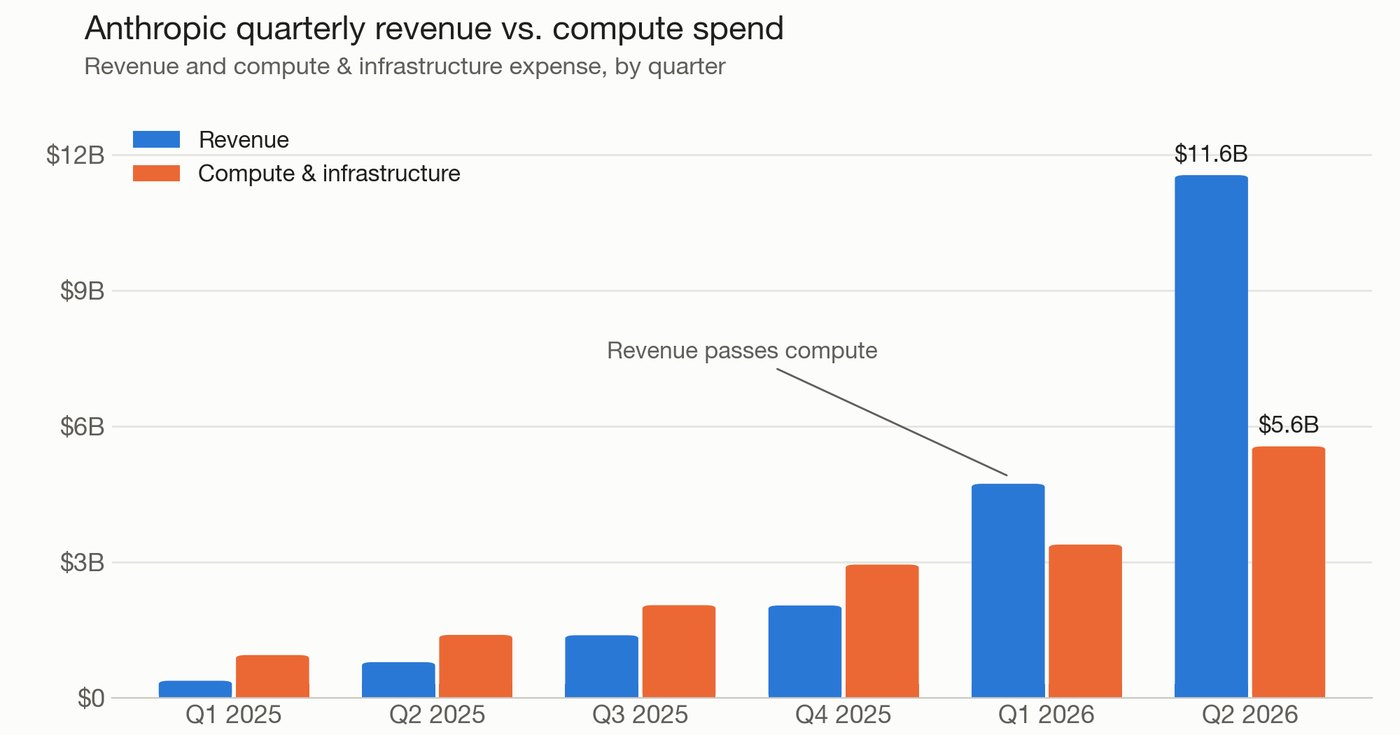
Anthropic filed its Form S-1 registration statement with the Securities and Exchange Commission on October 26, 2026, revealing detailed operational finances, internal software workflows, and product metrics across its frontier foundation models and developer tools. According to alexkras.com's report, the public filing shows that Anthropic crossed an operational milestone in the first quarter of 2026 when top-line revenue surpassed infrastructure compute expenditure, expanding further in the second quarter to 11.6 billion dollars in revenue against 5.6 billion dollars in compute expenses. The disclosures confirm that Anthropic held 131.7 billion dollars in cash, cash equivalents, and short-term investments as of June 30, 2026, reflecting revenue growth of 1,368 percent year over year for the three months ended June 30, 2026, compared to infrastructure compute cost growth of 300 percent during the identical quarterly operating window.
This technical breakdown examines the operational metrics, pricing shifts, customer spend ratios, and governance clauses disclosed in the filing, providing developers, systems architects, and enterprise engineering leads with an unvarnished audit of Anthropic's platform stability. Claude Code has evolved from an experimental coding CLI into the central driver of Anthropic's enterprise recurring revenue, achieving a net revenue retention rate of approximately 900 percent as of September 30, 2026, while trailing twelve-month revenue per employee rose from 1.4 million dollars to over 6.6 million dollars. The filing also documents operational risks, including regulatory supply-chain disputes with the United States government, a five-class share capital design that insulates leadership, and temporary export bans that previously forced the worldwide suspension of specific frontier models.
What shipped in Reading Anthropic's S-1 as a Claude Code user
Anthropic disclosed that Claude Code, originally introduced as a research preview in February 2025, has become its primary autonomous agent implementation and commercial growth vehicle. Alongside Claude Code, the filing tracks the release of Claude Cowork, which debuted as a research preview in January 2026 and accumulated customer adoption faster by September 30, 2026, than Claude Code recorded during an equivalent post-release timeframe. Anthropic also detailed significant model releases throughout late 2025 and 2026, including Claude Opus 5, Claude Opus 5.5, and specialized frontier releases designated as Fable 5 and Mythos 5, positioning the tools as comprehensive agentic environments rather than standalone autocomplete utilities.
The registration statement details how deeply autonomous agents have integrated into Anthropic's own engineering organization. Claude generated more than 90 percent of all code contributions committed to Anthropic's internal repositories during the month of September 2026. This extensive dogfooding coincided with significant organizational revenue efficiency gains, as trailing twelve-month revenue per employee surged from 1.4 million dollars in September 2025 to over 6.6 million dollars by September 30, 2026. The disclosures confirm that coding agents constitute the core enterprise monetization engine of the company rather than a peripheral experimentation project.
What improved in Reading Anthropic's S-1 as a Claude Code user
Anthropic reported substantial efficiency improvements across newer model generations, noting that Claude Opus 5.5 reduced customer execution cost per task by approximately 40 percent relative to Claude Opus 5. Simultaneously, financial economics stabilized across the business: compute expenses exceeded revenue until the beginning of 2026, after which second-quarter revenue reached 11.6 billion dollars against compute costs of 5.6 billion dollars. Top-line revenue accelerated by 1,368 percent year over year for the quarter ending June 30, 2026, whereas underlying compute infrastructure expenses grew by 300 percent across the same timeframe, demonstrating improved hardware utilization and inference margin efficiency.
| Metric | Prior Period / Baseline | Disclosed Filing Value (2026) |
|---|---|---|
| Opus Task Cost | Claude Opus 5 baseline | ~40% reduction with Opus 5.5 |
| Q2 Revenue vs Compute | Compute exceeded revenue (< 2026) | $11.6B revenue vs $5.6B compute |
| YoY Quarterly Growth (Q2) | Compute expense: +300% YoY | Revenue: +1,368% YoY |
| Net Revenue Retention | Historical baseline (~100%) | ~900% (as of September 30, 2026) |
| TTM Revenue Per Employee | $1.4M (September 30, 2025) | > $6.6M (September 30, 2026) |
| Internal Code Contributions | Human-majority contributions | > 90% Claude-written (September 2026) |
| Enterprise Spend Per User | < $75/mo without Claude Code | ~20x higher for top 5% Claude Code users |
The filing confirms that enterprise spending scales dramatically once teams operationalize Claude Code inside daily development pipelines. Enterprise Claude accounts that operated without Claude Code spent an average of less than 75 dollars per user monthly during the third quarter of 2026. In contrast, the top 5 percent of enterprise users running Claude Code spent roughly twenty times that amount, consuming tokens at elevated rates to power automated debugging, test suite synthesis, and repo-level refactoring workflows.
What you gain from Reading Anthropic's S-1 as a Claude Code user
Teams adopting Claude Code gain access to a heavily funded engineering infrastructure that is not facing near-term liquidity pressure. With 131.7 billion dollars in verified cash, cash equivalents, and short-term liquid investments as of June 30, 2026, Anthropic has secured the compute capacity required to sustain high-context agentic reasoning. Furthermore, existing customers expanded their spend by roughly ninefold year over year as of September 30, 2026, excluding consumer Pro and Max subscriptions, validating that engineering teams deploying the agent at scale are capturing tangible organizational velocity that justifies sustained API expenditure.
The filing clarifies the corporate governance structure that shields Anthropic from traditional public market activist interference, though it eliminates common shareholder voting authority. Anthropic operates five share classes: Class A shares hold one vote per share; Class T consists of a single share held by the Long-Term Benefit Trust, comprising five disinterested trustees who select a majority of the board of directors; Class F consists of a single share held by the seven co-founders carrying 50.1 percent of the total stockholder voting power; Class N holds non-voting stock held by strategic partners; and Class E retains limited employee voting rights. This design limits short-term shareholder pressure to extract price hikes, but prevents public markets from overriding leadership decisions.
How to get Reading Anthropic's S-1 as a Claude Code user
Advertisement
Tech Pulse Daily
Get tomorrow's pulse first
Join engineers who read Tech Pulse before stand-up. Free, weekday mornings.
Software developers looking to deploy Anthropic's primary coding agent can install or update the package globally through standard command-line package managers. To install the CLI agent or update an existing installation to the latest published build, run:
npm install -g @anthropic-ai/claude-codeAlternatively, existing CLI installations can update directly from the command prompt:
claude updateOnce inside an active Claude Code interactive terminal session, developers can toggle between underlying frontier models using the internal slash command interface. To transition the current workspace session to specific model generations, enter:
/model claude-fable-5-1Or switch to standard model aliases:
/model fableTo execute a non-interactive session or launch the workspace pinned to a designated model configuration directly from your system shell, supply the model argument flag during invocation:
claude --model fableTo set a persistent default model across all future terminal sessions, export the primary environment variable within your shell profile:
export CLAUDE_MODEL="claude-fable-5-1"What to watch after Reading Anthropic's S-1 as a Claude Code user
Engineering organizations must prepare for policy changes, supply-chain risks, and regulatory interventions disclosed throughout the filing. In February 2026, Anthropic refused United States government directives requiring foundation models for mass domestic surveillance and autonomous weapons systems. The Executive Branch directed federal agencies to halt technology usage, and the Secretary of War designated Anthropic a national security supply-chain risk under Section 4713, barring military suppliers and contractors from commercial activity with the company. While Anthropic successfully challenged the actions in federal district court as unconstitutional First and Fifth Amendment violations, a separate challenge resulted in a 2-1 defeat at the District of Columbia Circuit Court of Appeals on September 25, 2026, which is currently pending a petition for rehearing.
Developers must also plan for operational availability disruptions and upstream API deprecations. In June 2026, the United States Department of Commerce imposed worldwide export restrictions that forced Anthropic to completely disable its Fable 5 and Mythos 5 models for all global users until the export restrictions were formally lifted. Anthropic warns in the filing that it reserves the right to modify rate limits, adjust usage thresholds, alter model performance characteristics, or maintain legacy models based on internal safety and alignment audits rather than developer preference. In addition, customer revenue concentration remains notable, with the top five enterprise customers accounting for approximately 25 percent of total revenue for the nine months ended September 30, 2026.
Developer Action Items
- ☐ Diff the official changelog for Anthropic / Claude / Opus 11.6 before you bump — APIs, defaults, and removed flags only.
- ☐ Install through the vendor's documented channel in staging; keep a one-command rollback and time-box the canary.
- ☐ Grep your repo for old flag names, lockfile pins, and plugin versions that the notes mark as breaking.
- ☐ Prefer the first patch cut over the day-zero tag unless you have a reason to be on the leading edge.
- ☐ If HN Claude/Codex/Fable did not name a region, plan, or SKU, screenshot the official availability line before you promise it to users.
Reading Anthropic's S-1 as a Claude Code user FAQ
What were Anthropic's key financial numbers in the S-1 filing?
In Q2 2026, Anthropic generated 11.6 billion dollars in revenue against 5.6 billion dollars in compute expenses, backed by 131.7 billion dollars in cash and equivalents as of June 30, 2026. Revenue grew 1,368 percent year over year while compute expenses grew 300 percent.
How much code does Claude generate inside Anthropic?
Over 90 percent of all software contributions committed to Anthropic's internal code repositories during September 2026 were written by Claude, coinciding with trailing twelve-month revenue per employee rising to over 6.6 million dollars.
Why did the United States government classify Anthropic as a supply-chain risk?
In February 2026, Anthropic refused requests to deploy its models for mass domestic surveillance or fully autonomous weapons, prompting the Department of War to designate Anthropic as a supply-chain risk under Section 4713. While Anthropic won in district court, the D.C. Circuit Court of Appeals upheld the designation in a 2-1 decision on September 25, 2026, which Anthropic has asked to be reheard.
Who controls voting power at Anthropic under the S-1 capital structure?
The seven co-founders hold Class F stock representing 50.1 percent of total shareholder voting power, while the Long-Term Benefit Trust holds Class T stock that elects a majority of the board of directors, leaving public Class A shareholders with no ability to influence corporate control.
Sources

Author
Dillip Chowdary
Writes Tech Bytes coverage of AI, engineering, and the tools that actually ship. Editor of Tech Pulse Daily.
Related on Tech Bytes
Advertisement