Readyon Builds Four Layer Tenant Isolation for Multi Tenant Amazon EKS
ReadyOn detailed a four-layer tenant isolation design for its Harmony platform on Amazon EKS, combining Karpenter node pools and dedicated Aurora databases.
By Dillip Chowdary • Oct 26, 2026 • Source: InfoQ
ReadyOn detailed a four-layer tenant isolation architecture for its Harmony workforce intelligence platform running on Amazon Elastic Kubernetes Service, according to InfoQ's report. The design addresses the security demands of handling enterprise payroll records, organizational reporting hierarchies, and operational analytics inside shared cloud infrastructure. Instead of relying on conventional logical boundaries alone, ReadyOn combines Kubernetes namespaces, dedicated Karpenter node pools, Amazon VPC security groups, and per-tenant Amazon Aurora database clusters. The company mapped every protective mechanism against an internal ten-stage multi-tenant threat model designed specifically to evaluate lateral movement risks, and reported that red-team adversarial exercises have not yielded a successful cross-tenant breach path.
This breakdown examines how ReadyOn engineers boundaries across the orchestrator, compute fleet, network fabric, and storage systems while preserving a unified Amazon EKS management plane. It is written for cloud architects, platform engineers, and security teams evaluating the tradeoffs between running dedicated single-tenant clusters and operating hardened multi-tenant environments. By replacing single-point controls with overlapping boundaries, the architecture demonstrates how SaaS providers handling high-risk corporate data can isolate enterprise tenants without incurring the sprawling operational overhead of provisioning separate Kubernetes clusters for every corporate customer.
Readyon Builds Four Layer Tenant Isolation: what actually changed
ReadyOn restructured the perimeter around tenant workloads by abandoning the common pattern of relying on software-level logical separation inside a shared relational database. Rather than executing tenant queries across common database tables through application row-level filtering, the company provisioned dedicated Amazon Aurora clusters for every customer. That storage separation anchors the bottom of a four-tier boundary model that spans Kubernetes namespaces, compute nodes, VPC network enforcement, and database instances. Compute provisioning shifted entirely to Karpenter node pools dedicated to individual tenants, preventing pods belonging to different enterprise accounts from sharing the same underlying virtual machine or kernel.
At the orchestrator tier, the team eliminated manual cluster configurations by turning to Argo CD ApplicationSets driven by Git-based configuration repositories. This mechanism automatically generates dedicated Kubernetes namespaces equipped with role-based access control policies, compute resource quotas, admission control rules, and default-deny network rules. Whenever an unauthorized manual change or drift occurs within a namespace, Argo CD automatically reconciles the resource to its declared baseline state. These baseline controls ensure that initial tenant environments are provisioned identically, removing human error and inconsistent security postures across the fleet while hardening the cluster against lateral tenant expansion.
Readyon Builds Four Layer Tenant Isolation: how it works
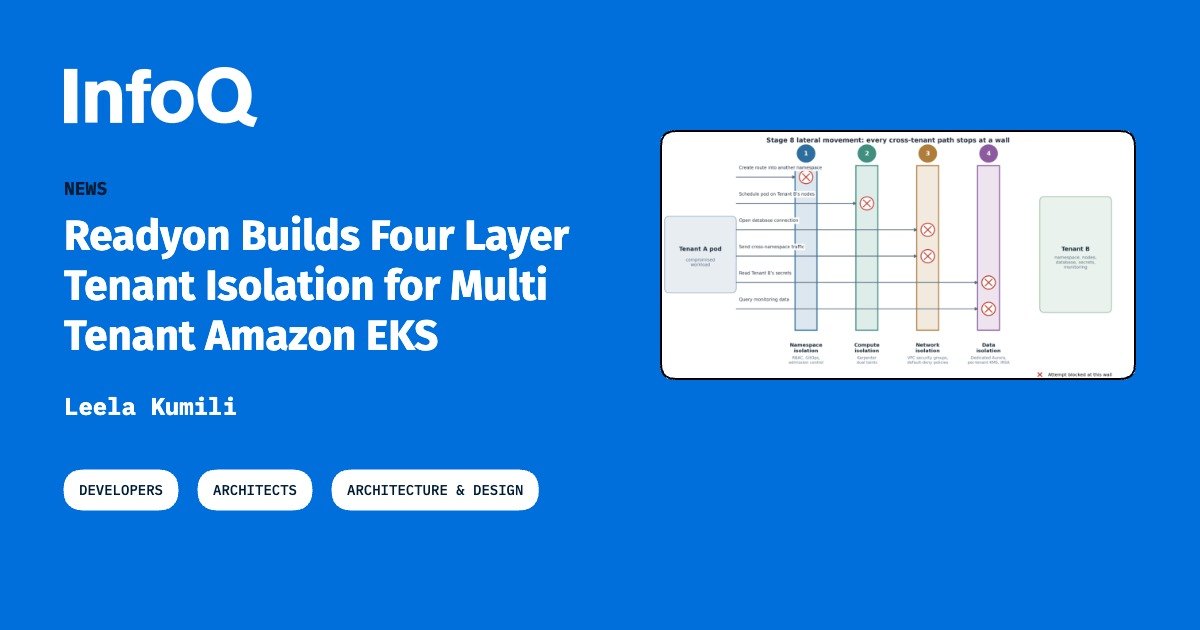
Workload scheduling relies on a dual taint strategy enforced during compute allocation by Karpenter. When Karpenter provisions an isolated compute pool for an enterprise customer, it assigns two specific taints: one identifying the tenant and a second identifying the specific workload type. A tenant pod can only schedule onto a node if it carries matching tolerations for both properties. To prevent a compromised pod definition from forging these properties, an admission controller intercepts incoming pod creation requests, cross-checks the declared tolerations against the namespace metadata, and rejects any pod attempting to schedule onto compute assets assigned to another tenant.
Network enforcement operates concurrently inside and below Kubernetes. Within the cluster, native network policies block inter-namespace traffic by default, preventing any direct container-to-container communication between customer boundaries. Below the cluster fabric, ReadyOn applies Amazon VPC security groups directly to tenant node pools, restricting database network access exclusively to that tenant's dedicated Amazon Aurora instance. Administrative access to the Amazon EKS API endpoint is shielded from public exposure, requiring private routing through a virtual private network, OpenID Connect authentication, and mandatory multi-factor authentication. Application pods authenticate to AWS services using short-lived credentials obtained through IAM Roles for Service Accounts alongside tenant-scoped AWS Secrets Manager paths.
Advertisement
Tech Pulse Daily
Get tomorrow's pulse first
Join engineers who read Tech Pulse before stand-up. Free, weekday mornings.
Readyon Builds Four Layer Tenant Isolation: why it matters now
Standard Kubernetes constructs have long created a deceptive sense of security for organizations migrating mission-critical applications into multi-tenant environments. As AWS product documentation explicitly highlights, Kubernetes namespaces, role-based access control, resource quotas, and network policies establish logical isolation boundaries, but they do not inherently restrict independent workloads from running alongside each other on shared worker nodes. When hostile actors compromise a container in a purely logically separated cluster, kernel vulnerabilities or container escapes can open direct lateral movement channels to co-located customer processes, placing sensitive tenant data at immediate risk.
Industry engineers evaluating the architecture note that shared multi-tenant clusters require a fundamental departure from traditional single-tenant hardening playbooks. William Antonio G, Principal AWS Engineer at Sparq, emphasized that while single-tenant cluster hardening is a well-documented engineering discipline, the underlying threat model changes fundamentally as soon as multiple customers share cluster infrastructure. Similarly, Mohammad Akbarpour, a professor at the Stanford Graduate School of Business, observed that modern software architectures face the dual challenge of pushing AI capabilities forward while keeping strict boundaries around inaccessible data and enterprise workflows.
Readyon Builds Four Layer Tenant Isolation: who is affected
The primary stakeholders directly affected by this architectural design are enterprise customers relying on ReadyOn's Harmony platform to process payroll distributions, sensitive corporate organizational hierarchies, and personnel analytics. For these enterprises, data leaks or lateral cross-tenant access would trigger severe compliance, regulatory, and corporate confidentiality repercussions. Guaranteeing that raw database storage, access tokens, and execution runtimes never intermingle provides enterprise compliance officers with the architectural assurances traditionally found only in isolated, single-tenant hosting models, but delivered through a managed multi-tenant platform.
Platform engineers and operations specialists managing multi-tenant Kubernetes clusters across the wider cloud ecosystem are also directly affected by the practical lessons of this implementation. Engineering teams frequently struggle with the cost and complexity of spinning up isolated EKS clusters for every compliance-focused client versus the security shortcomings of running vanilla namespaces. ReadyOn’s deployment proves that combining Karpenter dynamic node pools, automated admission controllers, and GitOps pipelines allows a lean operations team to enforce hardware and network separation at scale without maintaining hundreds of bespoke Kubernetes control planes.
Readyon Builds Four Layer Tenant Isolation: what to watch
As teams adopt layered multi-tenant topologies, observability across disconnected boundaries has become the critical operational focus. Juan Pablo Gaviria, an engineer analyzing the ReadyOn implementation, warned that isolation depth without matching observability depth is indistinguishable from false confidence. Without distributed telemetry that correlates workload identity inside Kubernetes with downstream VPC security group logs, database connections, and IAM role assumptions, engineering teams cannot verify whether theoretical security walls are holding or silently failing under actual production traffic and sophisticated lateral exploit attempts.
ReadyOn continues testing its infrastructure against its ten-stage multi-tenant threat model, utilizing recurring adversarial exercises to surface potential configuration blind spots. Observers will be tracking whether the overhead of operating dedicated Amazon Aurora clusters and isolated Karpenter node pools scales economically as tenant counts grow into the thousands. The critical metric to watch is whether ReadyOn can maintain its unbroken record of zero cross-tenant attack paths while preserving responsive telemetry and keeping resource provisioning automated through GitOps ApplicationSets.
Developer Action Items
- ☐ Inventory whether Amazon / Kubernetes runs in prod, CI, staging, or on laptops before you debate severity.
- ☐ Confirm the vendor's fixed build for Amazon / Kubernetes from InfoQ, then schedule the patch window.
- ☐ If you cannot patch today, isolate the service, rotate tokens that sat on the affected surface, and raise the logging floor.
- ☐ Record the decision and residual risk so the next on-call does not re-litigate whether you are exposed.
Readyon Builds Four Layer Tenant Isolation FAQ
What are the four isolation layers in ReadyOn's architecture?
The architecture enforces isolation across Kubernetes namespaces, compute nodes provisioned via dedicated Karpenter pools, network controls using VPC security groups with private EKS endpoints, and storage through per-tenant Amazon Aurora database clusters.
How does ReadyOn prevent pods from scheduling onto another tenant's compute nodes?
ReadyOn implements a dual taint strategy where Karpenter nodes require both a tenant-identifying taint and a workload-type taint, backed by an admission controller that validates pod tolerations against the namespace before scheduling.
Why did ReadyOn reject row-level database filtering for customer isolation?
ReadyOn deployed dedicated Amazon Aurora clusters for each tenant instead of row-level filtering to ensure strict physical data separation and prevent cross-tenant data leakage if application-level query controls are bypassed.
How does ReadyOn automate and protect cluster configuration against manual drift?
ReadyOn uses Argo CD ApplicationSets connected to Git-based configuration to automatically generate identical namespaces, admission controls, and default-deny policies, instantly reconciling any unauthorized manual changes.
Sources

Author
Dillip Chowdary
Writes Tech Bytes coverage of AI, engineering, and the tools that actually ship. Editor of Tech Pulse Daily.
Related on Tech Bytes
Advertisement