Russia's War Transforms Ukraine into a World-Leading Military Producer
Ukraine scaled its defense sector by 350 percent since 2022, producing 20 Bohdana howitzers a month and supplying 60 percent of its army's front-line equipment.
By Dillip Chowdary • Nov 29, 2026 • Source: jamestown.org
At a glance
- Product
- Bohdana howitzer, Burya turret, FP-5 missile
- Growth
- 350% defense expansion since 2022
- Bohdana price
- $2.5 million vs $4.3 million Western equivalent
- Maxon interceptor
- $3,500 unit cost vs $20,000 Shahed drone
- Domestic share
- 60% of military equipment produced domestically
- Brave1 grants
- $30 million across 1,500 technical companies
Ukraine expanded its domestic defense manufacturing sector by 350 percent following Russia's 2022 invasion, transforming its wartime supply chain into an ecosystem dominated by agile private hardware producers. A detailed overview in jamestown.org's report documents how private enterprise, state grant programs, and foreign capital now supply 60 percent of the military equipment used by Ukrainian armed forces. The sector achieved a 900 percent investment surge across 2023 and 2024, with foreign and domestic funding totaling between $35 million and $50 million.
This report examines Ukraine's rapid industrial scaling, operational shift toward artificial intelligence systems, and competitive procurement model for defense planners and technology investors. Ukraine now ranks among the top five global arms producers, outproducing all 32 NATO members combined in artillery shells while delivering hardware at fractions of Western costs. Driven by direct battlefield feedback rather than multi-year procurement pipelines, the country is establishing itself as Europe's defensive manufacturing hub.
01Autonomous swarm networks and venture backing
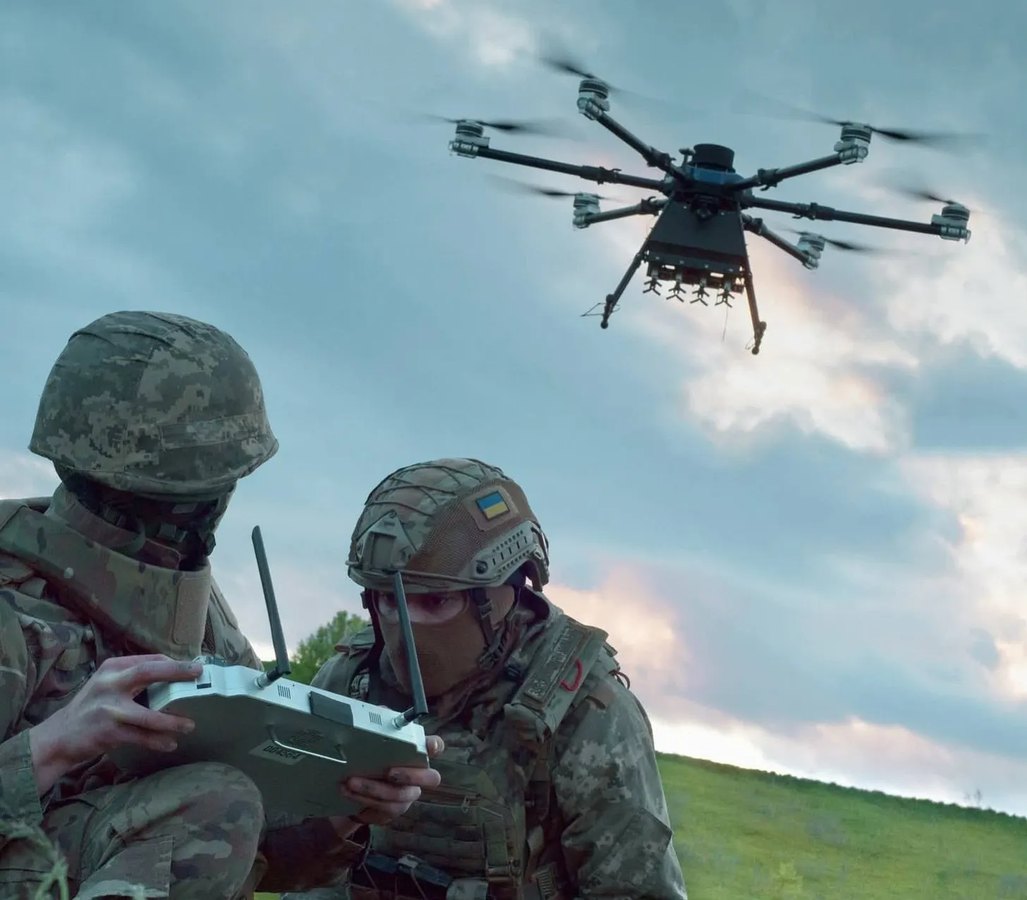
Ukraine stands as the world's largest producer of tactical and long-range drones, with official strategies targeting recognition as the global drone capital after the war ends. Expanding beyond single-pilot configurations, manufacturers are developing artificial intelligence swarms to replace one-operator platforms across the 2025–2026 operational window. The state-run Brave1 platform coordinates technical development, distributing $30 million in grants to 1,500 technology firms.
State grants support 140 electronic warfare producers, including three building to NATO standards, alongside manufacturers constructing 40 ground unmanned vehicles that meet NATO specifications. Technical integrations with American suppliers highlight this operational agility, with California-based CX2 providing software and sensors for long-range drones developed by Ukrainian manufacturer Skyfall. CX2 co-founder Nathan Mintz stated that no American company matches Ukraine's pace, noting that foreign systems frequently failed during front-line deployment.
Capital mobilization reached new levels at Brave1's Defense Tech Valley summit in Lviv, which convened 5,000 participants as the world's largest defense technology investment gathering. Myhaylo Samus, director of the New Geopolitics Research Network think tank, underscored that existential defense priorities drive engineering speed beyond pure financial incentives. Rapid software iterations allow front-line units to field countermeasures within days of electronic interference.
02Domestic artillery factories and private robotics
Domestic manufacturing lines deliver 60 percent of the material used by Ukraine's armed forces, shifting European support from hardware donations toward direct factory financing inside Ukraine. Ukrainian Armor manufactures NATO-standard 155 mm artillery shells, propellant, primers, and fuel under direct licensing agreements with the Czechoslovak Group. Heavy industrial lines expanded significantly since 2022, increasing armored personnel carrier output by 400 percent, artillery production by 200 percent, and anti-tank weaponry by 100 percent.
| Hardware Type | Ukrainian Production | Western Production |
|---|---|---|
| Bohdana Howitzer Output | 20 monthly (2025) | Multi-year wait |
| Bohdana Howitzer Delivery | 60 days | Several years |
| Bohdana Unit Cost | $2.5 million | $4.3 million |
| Interceptor vs Shahed | $3,500 (Maxon) | $20,000 (Shahed) |
Artillery manufacturing highlights the domestic sector's unit economics and speed. Kramatorsk Heavy Duty Machine Tool Building Plant grew output of the Bohdana howitzer from a single unit in 2022 to 20 units every month by 2025. Ukrainian defense enterprises build and deliver complete howitzers in 60 days for $2.5 million, whereas Western defense contractors require multi-year procurement timelines at an average unit price of $4.3 million.
Advertisement
Tech Pulse Daily
Get tomorrow's pulse first
Join engineers who read Tech Pulse before stand-up. Free, weekday mornings.
03Decentralized workshops replacing Soviet state monopolies
More than 500 private enterprises comprise the vast majority of Ukraine's defense footprint, replacing the centralized, state-dominated military monopolies inherited from the Soviet era and maintained by Russia. Only 26 percent of active defense suppliers existed prior to 2022, creating a network of small-scale machine shops, localized component makers, and software houses. Because parts originate primarily within Ukraine, companies bypass expensive overseas supply chains and iterate independently of state hierarchies.
Private foundations and local corporate capital actively seed hardware developers. Frontline, a military robotics firm established in 2023 by the Nezlamni Fund and taxi company UKLON, engineered the Burya 40mm automated grenade launcher turret deployed on Estonian Milrem Themis unmanned ground vehicles. International venture capital has followed, with American firm MITS Capital investing in Ukrainian robotics specialist Tencore, alongside volunteer financing networks like United Angels Network.
Civic and trade coalitions coordinate standardizations across independent workshops. The Ukrainian Council of Gunsmiths represents 270 members, incorporating 100 firms from the National Association of Ukrainian Defense Industries and 80 from Technological Forces of Ukraine. Led respectively by Valentyna Vedrovska and Kateryna Mykhalko, these trade bodies reflect extensive female leadership across defense technology organizations while preserving rapid front-line design cycles.
04Rapid prototype deployment and procurement reform
Ukraine altered its military acquisition process in January 2024 by establishing the Defense Procurement Agency as the sole purchasing authority inside the Ministry of Defense. Chief executive officer Maryna Bezrukova spearheaded structural reforms to remove bureaucratic intermediaries, eliminate profiteering middlemen, and drive down hardware acquisition pricing. The agency purchases direct from private suppliers that test and validate functioning prototypes within one month of development.
Startups bypass protracted approvals by raising private capital, winning competitive state innovation grants, and testing uncrewed prototypes directly in active combat zones. Maxon Systems illustrated this lean operational model by launching corporate operations and fielding operational anti-drone interceptors within seven months. Built at a unit manufacturing cost of $3,500, the interceptor provides a cost-effective asymmetrical defense against Russian Shahed drones costing $20,000 each.
Note: Hardware specifications and technical iterations are dictated directly by combat feedback from Ukrainian armed forces rather than ministry procurement officers or military brass.
05Alliance technology transfers and European security
European governments increasingly view Ukrainian defense factories as essential rearmament partners capable of supplying tested, high-volume production lines to NATO allies. European Union foreign policy chief Kaja Kallas affirmed that a well-armed Ukraine constitutes Europe's primary security guarantee amid continuing Russian aggression. Initiatives like Brave1 and Defense City offer NATO partners direct avenues to trial experimental weapons under live combat conditions, cutting developmental cycles.
Ukraine's production volume outpaces Western European stockpiles, yielding more artillery ammunition than all 32 NATO members combined. Strategic initiatives such as Test in Ukraine integrate low-cost asymmetrical solutions, combining robotic ground vehicles, long-range FP-5 strike missiles, and interceptor drones with allied defensive networks. By scaling high-rate domestic production, Ukraine has shifted from an aid recipient into an indispensable industrial supplier anchoring European military security.
Frequently asked questions
How fast does Ukraine manufacture Bohdana howitzers?
The Kramatorsk Heavy Duty Machine Tool Building Plant produces 20 Bohdana howitzers each month, delivering orders in 60 days for $2.5 million per unit.
What role does the Brave1 platform serve in Ukraine's defense sector?
Brave1 connects defense firms to international investors and has distributed $30 million in grants to 1,500 technical enterprises, including 140 electronic warfare developers.
How does Ukraine's defense industry compare to Soviet-era models?
Over 500 private companies make up the majority of the sector, using decentralized small-scale workshops and localized parts rather than state-dominated industrial monopolies.
What is the cost difference between Ukrainian interceptors and Russian Shahed drones?
Maxon Systems developed front-line interceptors costing $3,500 per unit, countering incoming Shahed drones that cost $20,000 each.
Sources

Author
Dillip Chowdary
Writes Tech Bytes coverage of AI, engineering, and the tools that actually ship. Editor of Tech Pulse Daily.
Related on Tech Bytes
Advertisement