Salesforce: Turning a Freescale Dev Board into a Macintosh
The MPC83xx line houses an e300 core based on the classic PowerPC 603e architecture that previously powered Apple machines prior to the original iMac.
By Dillip Chowdary • Nov 29, 2026 • Source: bbenchoff.com
At a glance
- Product
- Salesforce Mac I/O card
- Base hardware
- Freescale MPC8313E-RDB
- Processor core
- PowerPC e300
- Target OS
- Mac OS 9.2.2
- FPGA chip
- AMD Xilinx Artix-7 XC7A100T
- Dev board price
- $120
Hardware designer Brian Benchoff demonstrated Mac OS 9.2.2 running natively on a Freescale MPC8313E evaluation board paired with a custom FPGA-based PCI expansion card named Salesforce, as detailed in bbenchoff.com's report. The development system boots unmodified Apple system software by pairing an off-the-shelf industrial PowerPC system-on-chip with custom logic that recreates the proprietary Apple input and output architecture.
This engineering report covers how modern embedded processors interact with legacy New World Macintosh boot firmware, and how custom logic bridges standard industrial hardware to vintage Apple software. The breakdown is intended for systems engineers, retrocomputing enthusiasts, and embedded hardware developers exploring hardware emulation, Open Firmware execution, and custom PCI peripheral integration.
01Freescale PowerPC silicon in active production
Motorola originally spun off its semiconductor division into Freescale, which integrated PowerPC processing cores into complex systems-on-chip tailored for networking routers, industrial controllers, and vehicles. A decade after NXP Semiconductors acquired Freescale, these chips remain in commercial production for automotive chassis, engine management, braking units, and legacy aerospace deployments. Surplus component channels also hold tens of thousands of unused units.
The MPC83xx line houses an e300 core based on the classic PowerPC 603e architecture that previously powered Apple machines prior to the original iMac. Because the underlying instruction set matches vintage Apple microprocessors, the chip contains the necessary internal building blocks to execute classic Mac OS without instruction translation or software patching.
The modular structure of late-nineties Macintosh hardware makes clean hardware substitutions possible. Prior open-source initiatives previously brought Mac OS 9 onto alternate PowerPC hardware such as the Nintendo Wii, confirming that system execution depends primarily on fulfilling external board interfaces.
02New World architecture and bus controllers
Apple organized its New World ROM Macintosh systems, from the iMac through the Titanium PowerBook G4, around distinct system and peripheral controllers. The system controller or northbridge managed processor operations, system RAM, PCI hosting, and dedicated graphics buses across models using controller families like Bandit and UniNorth.
Peripherals connected across the PCI bus to a dedicated Mac I/O southbridge responsible for interrupts, direct memory access, storage interfaces, serial communication, sound, and system power management. Apple assigned transit-hub codenames to these peripheral chips, beginning with Grand Central and progressing through O'Hare, Heathrow, Gatwick, Paddington, and KeyLargo.
Single-chip combinations named Pangea and Intrepid later consolidated northbridge and southbridge tasks for consumer iBooks and iMac lines. Apple subsequently divided them again for PowerPC G5 computers into the U3 and U4 system controllers running alongside K2 and Shasta southbridges.
03Open Firmware questions and kernel bootstrap
New World Macintosh motherboards offload system logic from physical ROM chips into software loaded during the power-on sequence. Motherboard flash contains an Open Firmware Forth interpreter that catalogues system components, generates a hardware device tree, and executes a boot script inside the disk-based Mac OS ROM file.
Advertisement
Tech Pulse Daily
Get tomorrow's pulse first
Join engineers who read Tech Pulse before stand-up. Free, weekday mornings.
A bootstrap client program known as the Trampoline bridges the gap between Open Firmware and the core operating system. The program systematically scans system resources by issuing queries across the hardware environment before configuring system memory and handing control over to the operating system.
- Firmware probe Open Firmware tests hardware and constructs the device tree register map.
- Trampoline queries The Trampoline submits 2,118 configuration questions to build the Name Registry.
- NanoKernel handoff Control passes to Apple's microkernel to govern memory management and run 68k emulation.
- System startup Mac OS drivers bind to device-tree nodes and load the System file, extensions, and Finder.
Mac OS evaluates system components through their declared device-tree identities rather than specific board revisions. As long as device-tree entries declare valid registers and peripheral drivers locate matching nodes, the core operating system boots natively without logic modifications.
04Debugger logs and bare board verification
Benchoff secured a Freescale MPC8313E-RDB reference development board featuring an MPC8313 PowerQUICC II Pro processor, an e300 core, 128 MB of DDR2 memory, Ethernet, and an onboard PCI slot for $120 plus $70 shipping. Because the board lacked Apple boot ROMs, QEMU's mac99 machine served as a baseline system reference under an attached debugger.
The logged exchange revealed all 2,118 questions asked by the Trampoline when booting Mac OS 9.2.2. Benchoff constructed a minimal Open Firmware implementation that served matching responses and an identical device tree directly to the dev board, allowing the real Mac OS ROM file to load natively on the e300 processor.
| Platform Parameter | Development Board | Native Power Mac Target |
| :--- | :--- | :--- |
| Processor Core | PowerPC e300 (603e core) | PowerPC 750 / 7400 |
| System Memory | 128 MB DDR2 RAM | SDRAM / PC100 / PC133 |
| Reference Architecture | Freescale MPC8313E-RDB | Apple UniNorth / KeyLargo |
| Boot Firmware | Minimal Open Firmware | Apple Open Firmware / OpenBIOS |
Early testing hit a timing bug when the Trampoline tried calibrating CPU clock speeds against an uninitialized Versatile Interface Adapter timer in RAM. The routine miscalculated the clock at 1.06 GHz instead of 41.67 MHz, running all system clocks 25 times too slow for a week before resolution.
05Custom logic on the PCI bus
Initial validation required testing whether the MPC8313 PCI host could detect, enumerate, and handle interrupts from a reconfigurable chip. Benchoff inserted an off-the-shelf FPGA PCI card intended for computer numerical control machinery to verify electrical signaling and device-tree bindings across the bus.
Note: The preliminary CNC FPGA card confirmed PCI enumeration and interrupt signaling, but complete standalone operation required dedicated display outputs and physical expansion headers.
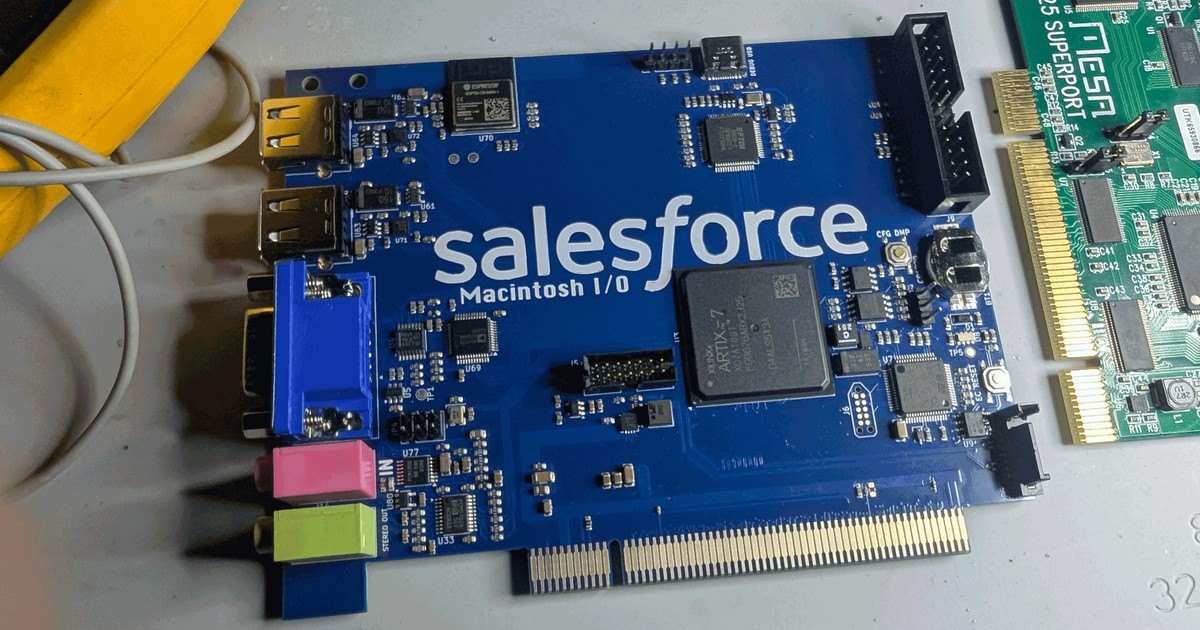
Benchoff designed a custom add-in board named Salesforce, adopting Apple's transit naming convention after San Francisco's multi-billion-dollar transit terminal. The board mounts an AMD Xilinx Artix-7 XC7A100T FPGA costing $41 to host the recreated Mac I/O functions and peripheral controllers needed to drive standard monitors and system interfaces.
Frequently asked questions
What processor powers the Salesforce development system?
The system uses a Freescale MPC8313 PowerQUICC II Pro chip with an e300 core derived from the PowerPC 603e architecture.
How does the development board satisfy Mac OS boot requirements?
A custom Open Firmware implementation answers 2,118 hardware questions logged from QEMU to pass execution cleanly to Apple's NanoKernel.
Why did Brian Benchoff name the FPGA peripheral card Salesforce?
Apple named its classic Mac I/O controller chips after transit centers like Grand Central and Heathrow, inspiring the name from the Salesforce Transit Center.
Sources

Author
Dillip Chowdary
Writes Tech Bytes coverage of AI, engineering, and the tools that actually ship. Editor of Tech Pulse Daily.
Related on Tech Bytes
Advertisement