Sebastian Raschka's from-scratch video course on building reasoning models
Sebastian Raschka launched an 11-hour, eight-part PyTorch video course teaching engineers how to build reasoning models using a Qwen3 0.6B base checkpoint.
By Dillip Chowdary • Oct 26, 2026 • Source: magazine.sebastianraschka.com
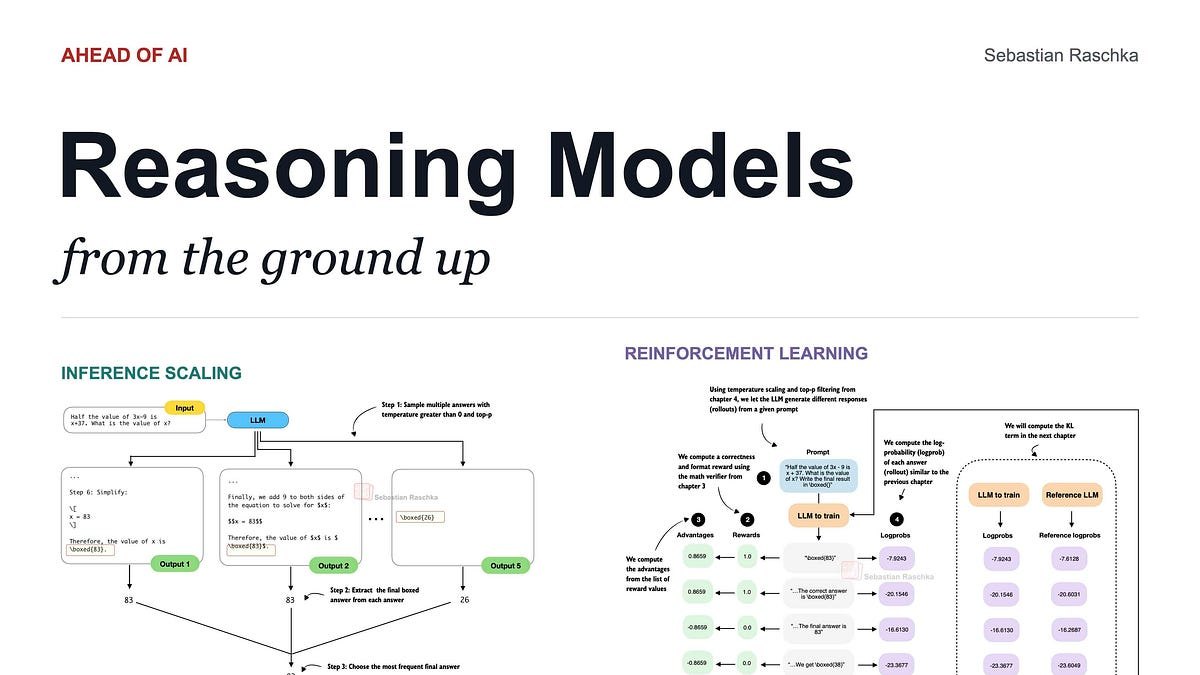
Machine learning researcher Sebastian Raschka released an eight-part video course and hands-on coding curriculum covering the construction of reasoning models from the ground up, as detailed in magazine.sebastianraschka.com's report. The complete series spans more than 11 hours of instructional programming and works directly with Python and PyTorch. Rather than treating advanced reasoning architectures as opaque black boxes, the curriculum steps through the mechanics of post-training, answer evaluation, inference-time scaling, reinforcement learning, and model distillation. The materials build on Raschka's prior educational work and accompany his print volume published in color through Manning and Amazon, titled Build a Reasoning Model (From Scratch).
This breakdown examines the complete structure of the educational release, detailing how engineers can construct reasoning engines using a lightweight open base model. Raschka positions reasoning models as the core engines that operate inside broader agent harnesses, supplying the computational power required for complex math, software engineering, and multi-step tool execution. The material targets developers, research engineers, and technical practitioners who already possess baseline familiarity with Python and PyTorch and seek to understand modern LLM reasoning without relying on third-party proprietary APIs or uninspected automated wrappers.
Sebastian Raschka's from-scratch video course: what actually changed
The instructional curriculum transitions away from theoretical discussions of reasoning effort toward direct, line-by-line PyTorch implementations of post-training and inference mechanics. Instead of training a base model entirely from scratch, the video series begins with an existing pre-trained Qwen3 0.6B checkpoint. By fixing the foundational weights at the start, the coursework directs all engineering effort into the evaluation and improvement phases: writing custom streaming text generation, building key-value caching routines, integrating torch.compile, constructing rigorous answer verification pipelines, and executing reinforcement learning workflows.
The educational release also formalizes the conceptual framework connecting conventional language models, reasoning models, and agent harnesses. Under Raschka's framing, a reasoning model represents a conventional language model that has received additional post-training through reinforcement learning with verifiable rewards and optional inference-scaling mechanisms. The reasoning model then functions as the central engine, while the surrounding agent harness provides the tooling, context management, and interface plumbing needed to tackle tasks like large-scale software engineering, personal assistant duties, and travel coordination.
Sebastian Raschka's from-scratch video course: how it works
The technical implementation begins in video one with environment configuration using the uv package manager, covering dependency management across CUDA GPUs and Apple Silicon hardware alongside remote VS Code setups. Video two loads the Qwen3 0.6B weights, processes token encoding and decoding, tracks tensor shapes and logits, and implements greedy decoding alongside streaming text generation. To optimize performance, learners construct a key-value cache to reuse attention keys and values across sequential steps and benchmark throughput after fusing operations with torch.compile.
Video three implements a custom math verifier that extracts answers, normalizes strings, and tests for mathematical equivalence across the MATH-500 evaluation benchmark. This grading mechanism serves two distinct operational roles: establishing a baseline performance score against standard reasoning targets and providing the automated ground-truth reward signal needed for reinforcement learning with verifiable rewards in later modules. Video four progresses to inference-time scaling, implementing diverse sampling strategies and self-consistency protocols that improve output accuracy while holding base model weights fixed.
Advertisement
Tech Pulse Daily
Get tomorrow's pulse first
Join engineers who read Tech Pulse before stand-up. Free, weekday mornings.
Sebastian Raschka's from-scratch video course: why it matters now
Almost all current-generation large language models operate as reasoning models or incorporate dedicated reasoning modes with tunable effort settings. Despite their widespread deployment across industry platforms, the internal techniques that grant models extended contemplation capabilities—such as reinforcement learning with verifiable rewards, self-consistency sampling, and distillation—often remain obscured inside proprietary laboratory pipelines. Raschka's curriculum demystifies these processes by demonstrating that the fundamental algorithmic components can be coded explicitly in standard PyTorch using accessible consumer hardware.
Providing open, reproducible implementations ensures that developers are not entirely dependent on commercial hosted endpoints to study advanced reasoning dynamics. By grounding the curriculum on verifiable problem domains such as mathematics and code, the course illustrates how verifiable reward signals enable systematic capability gains that generalize outward into other operational domains. The hands-on format allows researchers and machine learning practitioners to prototype alternative verification rubrics, inspect token-by-token generation logs, and observe exactly how reinforcement updates alter output trajectories.
Sebastian Raschka's from-scratch video course: who is affected
The curriculum directly serves software engineers, data scientists, and applied AI researchers who want to bridge the gap between general deep learning principles and modern reasoning architectures. Because the coursework is designed to run its initial generation and evaluation scripts directly on standard CPUs, engineers without enterprise cluster access can participate immediately, shifting to standard local GPUs or cloud instances only when executing compute-intensive training routines. Readers seeking a compressed conceptual overview can also consult Raschka's separate 90-minute AI Reasoning Models course on LinkedIn Learning.
Teams building production agent applications benefit from understanding the engine-and-harness distinction emphasized throughout the lectures. Rather than attempting to solve high-level reasoning failures solely through elaborate agent scaffolding, context packing, or prompt tweaks, system designers can analyze whether their underlying model possesses sufficient post-trained reasoning capability. Raschka's structured pairings—coordinating the eight video lectures with the corresponding chapters and exercises of the Manning and Amazon print book—provide an organized onboarding path for engineering teams seeking internal autonomy over their reasoning pipelines.
Sebastian Raschka's from-scratch video course: what to watch
Technical teams should watch the interaction between inference-time scaling techniques and downstream distillation methods as developers seek lower operational costs. Raschka's ongoing Ahead of AI publications continue to evaluate mechanisms for tuning reasoning effort levels dynamically, allowing systems to allocate additional inference compute only when complex prompts require multi-step verification. Observers should also track how practitioners extend the MATH-500 verifier architecture to non-mathematical domains that permit automated unit tests, strict syntax verification, or schema validation.
Hardware utilization patterns represent another key area to observe. As demonstrated in the early video lessons on the Qwen3 0.6B model, combining streaming generation, custom key-value caching, and torch.compile yields notable generation speedups even on modest hardware configurations. The release of further LLM research roundups and open source companion repositories will indicate how quickly small open-weights models running custom reinforcement loops can match the reasoning benchmarks set by larger proprietary hosted endpoints.
Developer Action Items
- ☐ Diff the official changelog for Apple / Amazon / Framework before you bump — APIs, defaults, and removed flags only.
- ☐ Install through the vendor's documented channel in staging; keep a one-command rollback and time-box the canary.
- ☐ Grep your repo for old flag names, lockfile pins, and plugin versions that the notes mark as breaking.
- ☐ Prefer the first patch cut over the day-zero tag unless you have a reason to be on the leading edge.
- ☐ If Hacker News Best did not name a region, plan, or SKU, screenshot the official availability line before you promise it to users.
Sebastian Raschka's from-scratch video course FAQ
What base model and programming framework does the video course use?
The course implements reasoning techniques in Python and PyTorch starting from pre-trained Qwen3 0.6B model weights.
How long is the video series and what topics does it cover?
The curriculum consists of eight videos totaling over 11 hours of coding that cover evaluation, inference-time scaling, reinforcement learning, and distillation.
What are the hardware and software prerequisites for working through the code?
Learners need familiarity with Python and PyTorch; dependencies are managed with uv, early text-generation and evaluation runs on CPUs, and a GPU is recommended for later training experiments.
Sources

Author
Dillip Chowdary
Writes Tech Bytes coverage of AI, engineering, and the tools that actually ship. Editor of Tech Pulse Daily.
Related on Tech Bytes
Advertisement