See what 5 builders are making with Gemini 4 Argon
Google launched Gemini 4 Argon with expanded 3D visual coding and spatial reasoning, enabling developers to build multiplayer games and physics simulations.
By Dillip Chowdary • Oct 24, 2026 • Source: Google Keyword Blog
Google launched Gemini 4 Argon, a new frontier artificial intelligence model engineered to execute complex multi-step technical workflows across coding, mathematics, science, cybersecurity, legal analysis, and finance. The rollout follows broad deployment across developer platforms, expanding multimodal reasoning into spatial coordination, mathematical precision, and visual programming. As detailed in Google Keyword Blog's report, software builders are applying the system to generate realistic environmental physics, real-time seismic globes, mechanical engines, single-image 3D models, and browser-based multiplayer games.
This report examines the technical capabilities of these early community implementations, the external graphics libraries and platforms connected to the model, and the global distribution channels currently hosting access. Software developers, graphics programmers, scientific researchers, and web application engineers can examine how Argon maintains long reasoning chains across environments like Blender, Three.js, and Google Antigravity. By focusing on concrete software builds rather than abstract benchmark scores, technical teams can evaluate how sequential prompt execution translates into functional 3D mechanics and live data visualizations.
See what 5 builders are making with Gemini 4: what actually changed
Rather than generating isolated code snippets or static 2D assets, Gemini 4 Argon introduces expanded spatial reasoning, mathematical precision, and visual coding capable of coordinating multiple physical properties simultaneously. Previous foundation models struggled to maintain structural coherence across extended generation cycles, requiring developers to write integration scripts to connect disconnected elements. Argon sustains depth and precision throughout multi-step tasks, outperforming competing frontier models on benchmark evaluations across complex domains. This sustained attention enables builders to create complete, interactive 3D simulations where lighting, reflections, fluid movement, and collision mechanics resolve within a unified software workflow.
The tangible impact of these upgrades is evident in early software projects published after Google rolled out Argon broadly last week. Developer Lumina (@LuminaBench on X) deployed Argon to generate a 3D simulation of a seaplane floating on water. Because the model coordinated the motions of disparate elements simultaneously, the resulting simulation produced realistic surface lighting, water movement, and accurate environmental reflections. Meanwhile, developer Chong-U (@chongdashu on X) used the model to construct Backyard Rascals, a multiplayer browser game featuring cartoon animals that navigate real-time collisions, cheer, and race to capture opposing flags.
See what 5 builders are making with Gemini 4: how it works
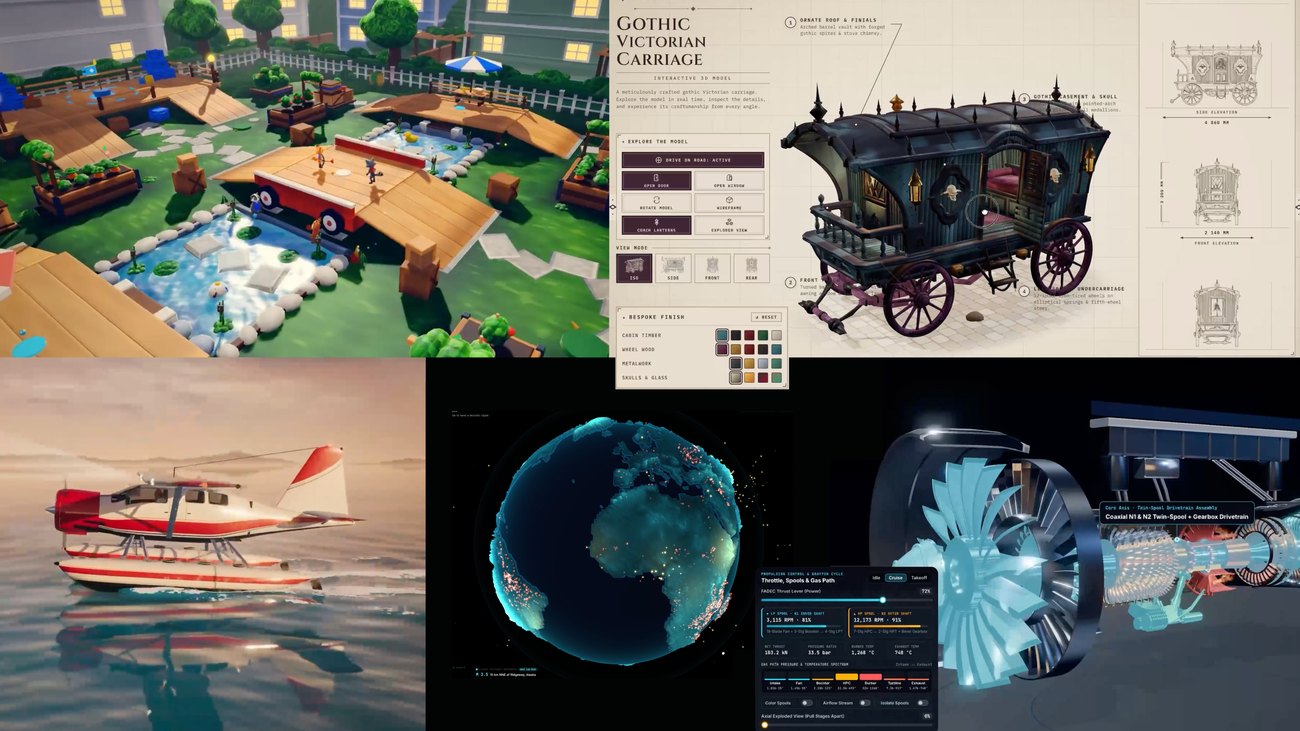
The underlying technical workflow relies on Argon's capacity to translate dense, unstructured source material into precise coordinates and programmatic scene graphs. Working inside Google Antigravity, developer Alex Patrascu (@maxescu on X) connected two independent real-time data feeds: active global wildfire tracking from NASA and seismic shockwave records from the U.S. Geological Survey. Gemini 4 Argon parsed the incoming geological data, mapped global coordinates, and generated an interactive 3D globe displaying animated seismic shockwaves and active wildfire hotspots, demonstrating high-level cross-domain reasoning across raw data ingestion and visual coding.
Other builders leveraged Argon to convert flat 2D references and mechanical schematics directly into interactive objects. Creator The Bugged Dev (@thebuggeddev on X) provided Argon with a single flat image of a Gothic Victorian carriage, which the model translated into an interactive 3D experience with functioning doors, windows, flickering oil lamps, and an undercarriage that reacts dynamically to road bumps. Concurrently, Ashutosh Shrivastava (@ai_for_success on X) paired Argon with Blender and Three.js to construct an interactive high-bypass turbofan jet engine simulation, modeling individual elements before rendering the entire assembly with live measurements and part-by-part specifications.
Advertisement
Tech Pulse Daily
Get tomorrow's pulse first
Join engineers who read Tech Pulse before stand-up. Free, weekday mornings.
See what 5 builders are making with Gemini 4: why it matters now
Interactive 3D development and engineering simulations have historically required deep domain expertise, proprietary modeling software, and extensive manual shader development. Gemini 4 Argon demonstrates that a frontier artificial intelligence model can handle spatial math, graphic rendering, and code syntax concurrently without requiring dedicated narrow fine-tuning. By unifying coding, math, and visual asset generation into a single promptable interface, Argon significantly compresses prototyping timelines for independent developers. Tasks that formerly demanded multidisciplinary teams can now be tested, debugged, and rendered in rapid succession through structured natural language guidance.
The model's arrival also marks an important transition from short-horizon chat interactions toward dependable execution in deep, multi-step real-world problems. In demanding domains such as scientific computing, cybersecurity analysis, finance, and legal review, maintaining logical precision over long operational sequences is vital to prevent cascading failures. The five community builds confirm that Argon maintains contextual stability and structural accuracy across complex procedural pipelines. This capability gives technical organizations confidence that frontier models can reliably construct functioning software architectures rather than merely offering superficial advice or isolated code fragments.
See what 5 builders are making with Gemini 4: who is affected
Software engineers, indie game creators, and visual interface designers are directly impacted by Argon's capacity to deliver functional browser-ready 3D applications. By automating the generation of Three.js and Blender pipelines, the model enables developers without deep backgrounds in computer graphics or linear algebra to build rich spatial tools. Projects like Backyard Rascals illustrate that game logic, multiplayer state synchronization, and character animations can be prototyped in days rather than months, shifting the barrier to entry for creative web applications away from specialized tooling and toward iterative prompt engineering.
Technical professionals in data science, earth observation, and mechanical engineering are similarly affected by Argon's data synthesis strengths. The integration of live NASA and USGS data feeds shows that monitoring teams can rapidly construct bespoke situational awareness dashboards without building dedicated visualization backends from scratch. Additionally, mechanical engineers and product design teams can utilize Argon to simulate complex machinery like turbofan jet engines with live telemetry and part-level specifications, allowing stakeholders to inspect and validate functional components virtually before committing resources to physical fabrication.
See what 5 builders are making with Gemini 4: what to watch
The immediate operational focus centers on how Gemini 4 Argon scales across diverse developer environments and production workloads. Google has released the model globally through the API in Google AI Studio and the Gemini developer platform. In addition, paid Google AI Ultra and Pro subscribers can access Argon within Google Antigravity, while subscribers can also deploy the model through the Gemini application interface and AI Mode in Google Search. Monitoring how these varying interfaces handle high-concurrency API calls will determine Argon's viability for enterprise infrastructure.
Over the coming months, engineering teams should evaluate whether Argon's multi-step precision remains robust as applications scale beyond isolated prototypes into distributed web services. While individual simulations of jet engines, carriages, and capture-the-flag matches prove Argon's spatial and visual competence, running real-time multiplayer networks or heavy 3D scene graphs introduces significant latency and memory constraints. Developers should monitor Google's future API rate tiers, execution speeds for lengthy multi-step reasoning tasks, and deeper official integrations with production graphics engines and enterprise development suites.
Developer Action Items
- ☐ Diff the official changelog for Gemini / Google / Windows before you bump — APIs, defaults, and removed flags only.
- ☐ Install through the vendor's documented channel in staging; keep a one-command rollback and time-box the canary.
- ☐ Grep your repo for old flag names, lockfile pins, and plugin versions that the notes mark as breaking.
- ☐ Prefer the first patch cut over the day-zero tag unless you have a reason to be on the leading edge.
- ☐ If Google Keyword Blog did not name a region, plan, or SKU, screenshot the official availability line before you promise it to users.
See what 5 builders are making with Gemini 4 FAQ
What is Gemini 4 Argon?
Gemini 4 Argon is Google's new frontier artificial intelligence model designed to execute complex, multi-step tasks across coding, mathematics, science, cybersecurity, legal analysis, and 3D world building.
How can developers access Gemini 4 Argon?
Developers and enterprises can access Gemini 4 Argon via the API in Google AI Studio and the Gemini platform, through Google Antigravity for Google AI Ultra and paid Pro subscribers, and within the Gemini app and AI Mode in Search.
What did builders create using Gemini 4 Argon?
Community builders created a 3D seaplane water simulation, an interactive 3D globe mapping NASA wildfire and USGS seismic data, a Blender and Three.js turbofan jet engine, a 3D Victorian carriage from a single image, and a multiplayer browser game.
Which tools did builders combine with Gemini 4 Argon?
Builders integrated Gemini 4 Argon with Google Antigravity for live coordinate mapping, Blender and Three.js for mechanical rendering, and standard web browsers for real-time multiplayer gaming.
Sources

Author
Dillip Chowdary
Writes Tech Bytes coverage of AI, engineering, and the tools that actually ship. Editor of Tech Pulse Daily.
Related on Tech Bytes
Advertisement