See what 5 builders are making with Gemini 4 Carbon
Google rolled out Gemini 4 Carbon for complex engineering tasks, powering projects that simulate over one million particles and render 52,000 plants in CUDA.
By Dillip Chowdary • Nov 19, 2026 • Source: Google Keyword Blog
At a glance
- Product
- Gemini 4 Carbon
- Developer
- Release date
- November 17, 2026
- Availability
- Google AI Studio, Android Studio, Ultra, Business
- Core capability
- Deep reasoning and extended verification loops
Google launched Gemini 4 Carbon as its most capable artificial intelligence model for complex technical projects requiring deep reasoning and extended verification tasks. According to Google Keyword Blog's report, the model rolled out broadly to developers to support physical simulations, particle systems, and interactive tools. Technical teams deploy the model across developer tools and enterprise integrations to build live physical simulations and process disorganized records.
This report examines five independent software builds created with Carbon across graphics programming, web shaders, physical mechanics, data extraction, and three-dimensional rendering. It provides engineers, graphics programmers, and enterprise technical leads with a factual review of how builders deployed the model to manage dynamic components. Readers will also find a breakdown of platform availability across developer interfaces, consumer subscriptions, and enterprise tools.
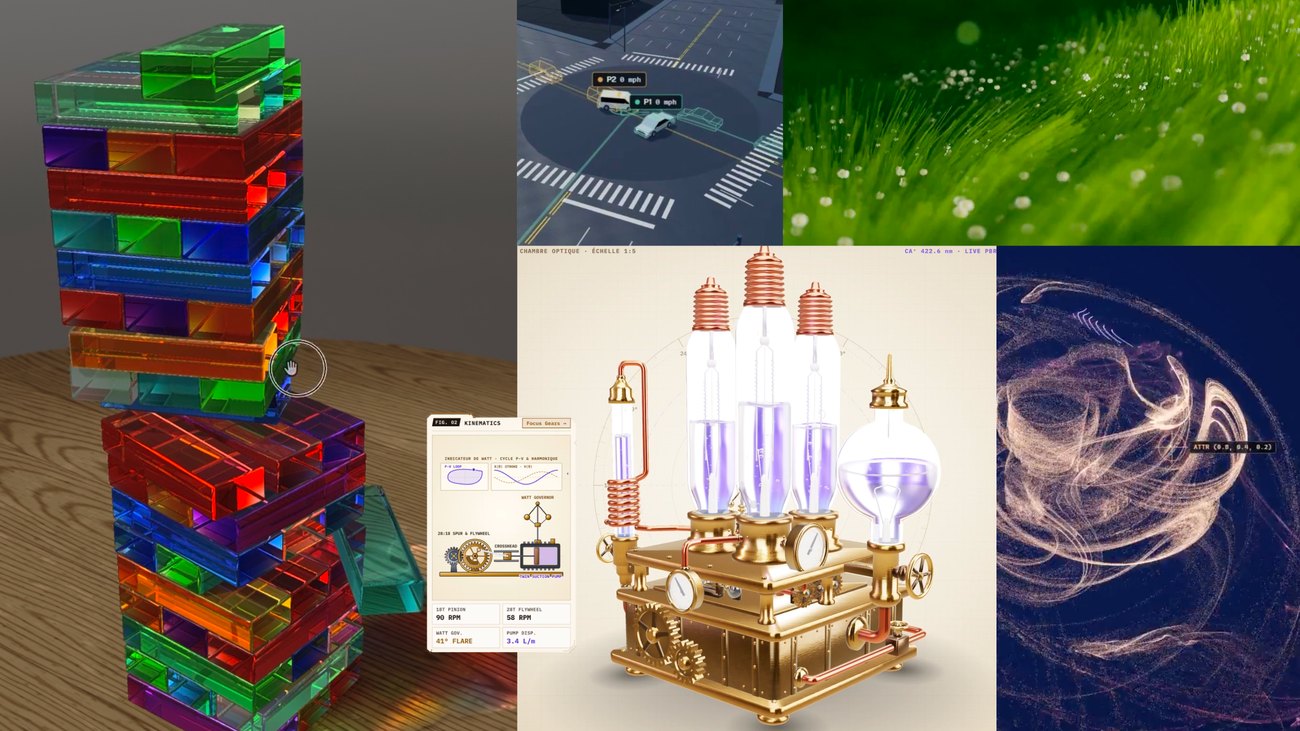
01Fifty-two thousand grass blades in CUDA
Glitter Gal coded an outdoor meadow simulation from scratch using C++ and NVIDIA CUDA alongside Carbon. The software renders fifty-two thousand individual wildflowers and grass blades across an expansive virtual field. Carbon assisted in drafting shader pipelines and calculating geometric instancing rules necessary to display every botanical element with distinct placement.
The technical focus centered on resolving dynamic wind resistance across thousands of independent organic assets without triggering frame performance bottlenecks. Carbon generated custom physics routines that synthesize wind behavior to match each changing gust across the meadow terrain. This verification structure prevented thread collisions during high-volume vertex transformations while keeping calculation overhead minimal across the entire rendering pipeline.
02Million-particle tidal simulation with WebGPU
Chubby engineered a real-time web simulation modeling the dynamics of marine currents with WebGPU. The project visualizes exactly 1,048,576 glowing particles swirling continuously within a browser window. Carbon structured the compute shader algorithms to process the entire particle field concurrently directly on modern graphics hardware.
The visual presentation replicates the complex fluid flow of live ocean tides through mathematical vector fields. Each of the one million luminous particles shifts trajectory according to simulated hydraulic pressure and tidal forces. Carbon provided the underlying numerical formulas to ensure the particle stream flows smoothly while maintaining fluid frame updates across client machines.
03Stained glass block tower physics
Advertisement
Tech Pulse Daily
Get tomorrow's pulse first
Join engineers who read Tech Pulse before stand-up. Free, weekday mornings.
Andrew V designed an interactive block-stacking game centered on the fragile physical characteristics of colored glass materials. Rather than using traditional rigid building blocks, every piece in the virtual tower is modeled as brittle stained glass. Carbon provided the structural calculations required to simulate realistic optical transparency and dynamic surface reflections as daylight passes through each colored pane.
The simulation extends beyond visual refraction into acoustic response and fracture mechanics when game components interact. The model determined how the glass tower catches light, produces distinct acoustic ringing tones when tapped, and disintegrates upon destabilization. Carbon computed the collision impact vectors that govern how each glass block shatters into sharp polygonal shards when collapsing.
04Fourteen interactive tools from public data
Developer Giyu_codes examined disorganized government filings to build functional software for neglected commercial sectors. Working alongside Carbon, the programmer parsed through unstructured municipal datasets that previously lacked standardized search mechanisms or usable visual dashboards. The effort converted scattered public documentation into fourteen distinct interactive software utilities featuring real-time three-dimensional visual representations.
Carbon resolved inconsistent data formatting, missing attribute fields, and disparate database schemas across the original public records. The model analyzed the unstructured records, grouped relevant domain metrics, and synthesized clean backend schemas to feed the user interfaces. The resulting tools allow specialized business operators to monitor regulatory disclosures, track resource allocations, and interact with complex public metrics directly.
05Parisian optics laboratory with ninety-two instruments
Software creator The Bugged Dev recreated a nineteenth-century Parisian optics laboratory starting from a single historical reference photograph. Carbon extrapolated the three-dimensional layout of the historical facility, generating accurate physical dimensions and spatial arrangements for the entire virtual workspace. The virtual laboratory environment features ninety-two individual brass and glass optical instruments that users can manipulate inside the simulation.
Every scientific apparatus within the virtual room operates as a functional physics simulation rather than a static visual mesh. Users can physically align mirrors, rotate brass thumbscrews, adjust focus prisms, and calibrate light sources to observe real optical distortions. Carbon generated the optical propagation formulas required to compute how light rays refract, disperse, and reflect through every individual lens assembly.
Note: Developers can access Carbon through the Gemini API paid tier in Google AI Studio and Android Studio. Google AI Ultra subscribers can use the model in Google Antigravity, AI Studio, the Gemini app, and AI Mode in Search, while Gemini for business users can deploy it through the API, model dropdown, Google Antigravity, or CodeMender.
Frequently asked questions
What is Gemini 4 Carbon?
Gemini 4 Carbon is Google's most capable AI model designed for technical projects, deep reasoning, and extended verification tasks. Developers use it to build live simulations, complex particle systems, and interactive tools.
How can developers access Gemini 4 Carbon?
Developers can access Carbon through the Gemini API paid tier in Google AI Studio and Android Studio. Business customers can access it via the API, model dropdown, Google Antigravity, or CodeMender.
What consumer plans include access to Gemini 4 Carbon?
Google AI Ultra subscribers can access Carbon through Google Antigravity, AI Studio, the Gemini app, and AI Mode in Search.
What projects did builders create with Carbon?
Builders rendered 52,000 wildflowers in CUDA, simulated 1,048,576 particles with WebGPU, modeled a glass-shattering game, created 14 public data tools, and reconstructed a 92-instrument optics lab.
Sources

Author
Dillip Chowdary
Writes Tech Bytes coverage of AI, engineering, and the tools that actually ship. Editor of Tech Pulse Daily.
Related on Tech Bytes
Advertisement