See what 6 builders are making with Gemini 4 Hydrogen
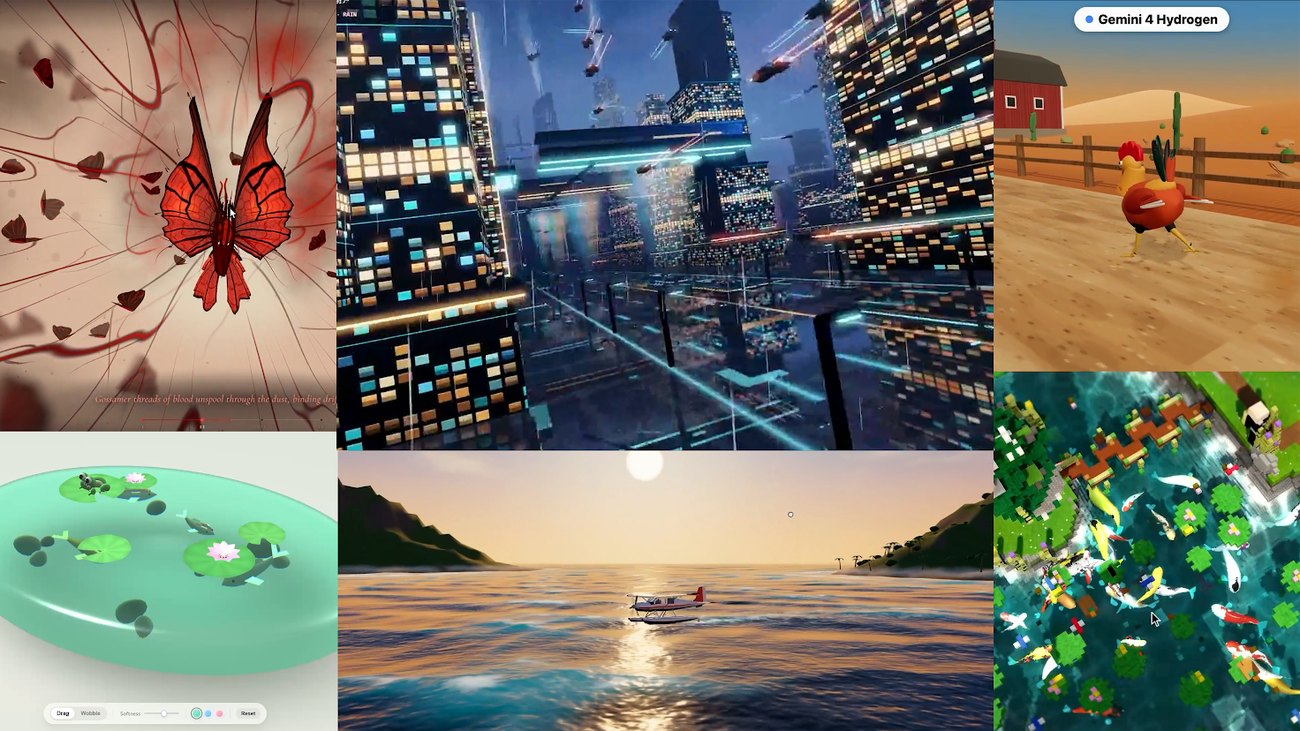
Google showcased six Gemini 4 Hydrogen builds, from a voxel koi pond to a Carbon-led swarm moth, and one desert ranch scene rendered in under a minute.
By Dillip Chowdary • Nov 28, 2026 • Source: Google Keyword Blog
At a glance
- Model
- Gemini 4 Hydrogen
- Launched
- November 12, 2026
- Showcase date
- November 23, 2026
- Price
- $1.50 in / $7.50 out per million tokens
- Context
- 1M tokens input, up to 1M output
- Developer access
- Gemini API, AI Studio, Android Studio
Google is showcasing six early projects that builders made with Gemini 4 Hydrogen, its fast execution model, in Google's Keyword post on six Gemini 4 Hydrogen builder projects published November 23, 2026. The projects range from a rainy sci-fi skyline and two contrasting koi ponds to an interactive ruby-red moth and a side-by-side test against Gemini 3.8 Flash.
This piece walks through each of the six demos, the tools they were built in, the launch numbers Google published for Hydrogen on November 12, and where developers and subscribers can use the model today. It is aimed at developers deciding whether Hydrogen is worth trying for 3D, front-end and agentic coding work.
01Hydrogen as Carbon's execution engine
Google introduced Gemini 4 Hydrogen on November 12, 2026, in a launch post by Koray Kavukcuoglu, SVP of Google DeepMind and Chief AI Architect at Google. The company describes Hydrogen as built for rapid execution across diverse agentic workflows, while its frontier models, Gemini 4 Carbon and Gemini 4 Argon, handle deep, long-horizon reasoning.
According to the builders post, Hydrogen can stand on its own as a model for everyday work or pair with Carbon as the high-efficiency execution engine in multi-model workflows. On the Artificial Analysis Intelligence Index at its default high thinking level, Google says Hydrogen scores 51, one point above Argon's 50, and reaches 54 at xhigh. The launch post also lists 58.8% on HLE-Diamond and 71.6% on Agents' Last Exam v1.1.
Molly McHugh-Johnson, a contributor to Google's Keyword blog, wrote that builders had already been putting Hydrogen to work in the days after launch.
02Rainy skyline and a seaplane flight
The first demo came from @kimmonismus, who built a sci-fi-inspired journey through a Three.js skyline under rainy skies. The builder ran Hydrogen on high thinking inside Google Antigravity, Google's agentic development platform. High is Hydrogen's default thinking level, one of four alongside low, medium and a new xhigh setting, per the launch post.
The second came from @LuminaBench, who flew a seaplane across the sea in a scene that shows the passage of time. As the plane sweeps across the water, the scene changes from morning to night.
03Voxel and jelly koi ponds
Two builders took the same subject in opposite directions. @IamEmily2050 used Hydrogen in the Gemini app, not a developer tool, to create a 3D voxel koi pond with a red pagoda, cherry blossoms and lantern-lit bridges.
Advertisement
Tech Pulse Daily
Get tomorrow's pulse first
Join engineers who read Tech Pulse before stand-up. Free, weekday mornings.
@notjazii then put a softer spin on the idea. That version gives the koi pond a squishy, jelly-like form instead of the angular, blocky edges of the voxel build.
04A ruby-red moth from a swarm of workers
The most involved project paired both of Google's newest models. @thtbee_ built an interactive crimson moth in Google Antigravity, with Gemini 4 Carbon orchestrating a /swarm of Hydrogen workers to produce the animation, its atmospheric visuals and sound. The moth responds to clicks, and Hydrogen also recorded the demo video.
That split matches the multi-model setup described at launch. Google's launch post says its Antigravity Orchestrator can switch between Carbon and Hydrogen in one session, with Carbon coordinating while Hydrogen runs worker and verifier agents in isolated workspaces. On Terminal-Bench 4.0, Google said that setup reached near-Carbon task success while using 24% less quota on average and finishing 19% faster.
05Desert ranch test against Gemini 3.8 Flash
The final demo is a direct comparison. @Bhavani_00007 ran the same animated 3D desert ranch prompt on Gemini 3.8 Flash and on Hydrogen, and Hydrogen brought the scene to life in under one minute. Google did not publish a time for the 3.8 Flash run.
Google's launch post gives the headline numbers against Gemini 3.8 Flash, which Hydrogen follows. Pricing is $1.50 per million input tokens and $7.50 per million output tokens, flat across a native 1M-token context window, with up to 1M output tokens. Google also says Hydrogen reduces overreach in agentic tasks by up to 81% and under-service by up to 79%.
| Measure | Gemini 3.8 Flash | Gemini 4 Hydrogen |
|---|---|---|
| Terminal-Bench 4.1 | 18.2% | 57% |
| Task speed at high default | Baseline | 2.5x faster |
| Fabricated claims | Baseline | More than 5x fewer |
| Partner graph, SQL, data workflows | Baseline | 2x to 2.8x faster, 12% to 23% fewer tokens |
| 3D desert ranch demo | Not stated | Under 1 minute |
Developers can start with Hydrogen through the Gemini API in Google AI Studio and Android Studio. Paid Google AI Pro and Ultra subscribers can use it in Google Antigravity, anyone can select it in the Gemini app model drop-down and in Google Search, and enterprise teams can reach it in Gemini for business.
Free Gemini app users get Hydrogen through auto model selection when it fits the prompt, and Google Search access covers all users globally. Gemini in Google Sheets starts with AI Pro and Ultra subscribers and eligible business subscriptions, where Google says canvas outputs arrive more than 30% faster than previous models.
Note: The benchmark and speed figures are Google's own, from its November 12 launch post, and the six demos are builder showcases selected by Google rather than controlled tests.
Frequently asked questions
What did builders make with Gemini 4 Hydrogen?
Google highlighted six projects: a rainy Three.js sci-fi skyline, a seaplane flight from morning to night, a voxel koi pond, a jelly-like koi pond, an interactive ruby-red moth, and a 3D desert ranch compared with Gemini 3.8 Flash.
How does Gemini 4 Hydrogen work with Gemini 4 Carbon?
Hydrogen can run alone or act as the execution engine for Carbon. In the moth demo, Carbon orchestrated a /swarm of Hydrogen workers in Google Antigravity to build the animation and sound.
How fast is Gemini 4 Hydrogen compared with Gemini 3.8 Flash?
Google says Hydrogen finishes tasks 2.5x faster at its high default setting and scores 57% on Terminal-Bench 4.1 versus 18.2% for 3.8 Flash. One builder's desert ranch scene came together in under a minute.
Where can I use Gemini 4 Hydrogen?
Developers can use the Gemini API in Google AI Studio and Android Studio, AI Pro and Ultra subscribers can use Google Antigravity, and anyone can pick it in the Gemini app and Google Search. Enterprise teams get it in Gemini for business.
How much does Gemini 4 Hydrogen cost?
Google lists $1.50 per million input tokens and $7.50 per million output tokens, flat across the full 1M-token context window.
Sources

Author
Dillip Chowdary
Writes Tech Bytes coverage of AI, engineering, and the tools that actually ship. Editor of Tech Pulse Daily.
Related on Tech Bytes
Electric boat maker Zin Boats raises $5M and launches propulsion business beyond the water
Read →
Hex Package Manager Warns of Potential Data Breach
Read →
Most Unicorns Are Worth More Than Their Last Funding-Round Valuations, Crunchbase…
Read →
Run local models in your .NET apps with Llama on Windows
Read →
Today's Tech Pulse briefing
Full briefing →
Advertisement