SessionGraph: Visualize all your coding agent sessions in one interactive
SessionGraph launched a local visual explorer and search index that maps coding history across 54 agent harnesses including Claude Code and Codex.
By Dillip Chowdary • Nov 29, 2026 • Source: sessiongraph.ai
At a glance
- Product
- SessionGraph
- Deployment
- Local desktop app and npx runner
- Compatibility
- 54 AI coding agent harnesses
- Search protocols
- In-memory JavaScript and local HTTP API
- Supported platforms
- macOS, Windows, and Linux
- Privacy architecture
- Fully local and private session storage
SessionGraph launched a local session visualization tool designed to unify historical logs across terminal coding agents and AI harnesses into an interactive graph. According to sessiongraph.ai's report, the utility runs as a local desktop application that parses local storage stores directly without transmitting conversation transcripts to remote servers. Developers can open the interface immediately by running npx sessiongraph in any terminal.
This report details SessionGraph's architecture, desktop installer packages, multi-harness compatibility matrix, local indexing engine, and programmatic HTTP search endpoints. Engineers and teams running autonomous coding agents can use this breakdown to evaluate local indexing and cross-tool session retrieval. It examines how the engine processes local session caches to reconstruct conversation histories without cloud dependencies.
01Local terminal launcher and interactive graph desktop
SessionGraph operates as a self-contained desktop application that interrogates agent session stores directly from the host filesystem. Developers execute the single npx sessiongraph command within their terminal to trigger local indexing and launch the explorer immediately. Because all operations happen on the local machine, development logs and prompt histories remain private.
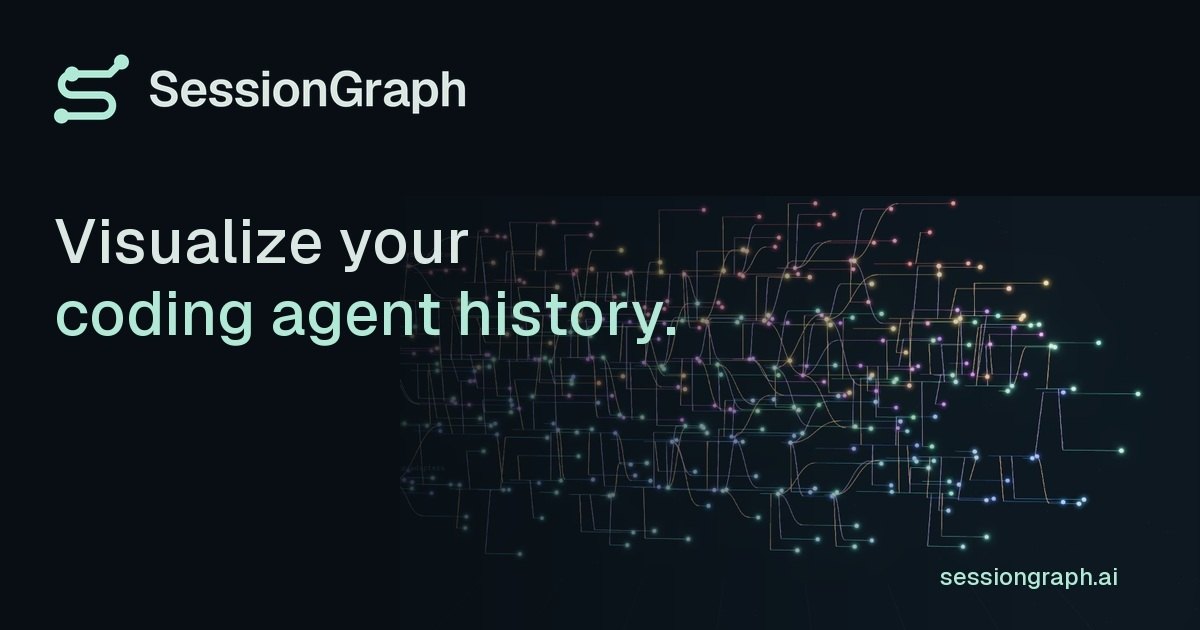
The desktop interface maps individual development workflows into visual graphs that reveal how automated agents branched during coding tasks. Engineers can inspect past runs, trace task progression across distinct sessions, and compare project execution patterns with colleagues. The visual representation replaces disconnected terminal scrollbacks with an interactive map that links related session checkpoints.
Note: The software performs indexing and graph rendering entirely within the local host environment without sending codebase context or session data to external cloud services. All analysis remains confined to local disk caches, ensuring proprietary code and credentials never leave the machine.
02Standalone installer packages for desktop platforms
Beyond the on-demand terminal execution path, SessionGraph distributes dedicated standalone installers across major desktop operating systems. Apple users can choose native package builds optimized for either Apple Silicon or Intel Mac architectures. These binary distributions allow engineers to launch the visual session explorer as a persistent application without Node package manager invocations.
| Platform | Architecture | Package Format |
|---|---|---|
| macOS | Apple Silicon | Native installer download |
| macOS | Intel Mac | Native installer download |
| Windows | x64 | Standard installer download |
| Windows | x64 | MSI enterprise installer |
| Linux | x64 | AppImage, DEB, RPM |
| Linux | ARM64 | AppImage, DEB, RPM |
Windows developers receive two deployment options consisting of a standard executable installer and an enterprise-ready MSI package. Both installers establish local desktop associations and register the required file listeners to interface with agent session directories. System administrators can leverage the MSI bundle to automate client rollouts across workstation fleets.
Linux distributions receive packaging covering both x64 and ARM64 architectures. Users can deploy standalone AppImage binaries or install native DEB and RPM packages tailored for Debian, Ubuntu, Fedora, and Red Hat distributions. This broad binary matrix ensures that engineers running headless servers or custom Linux desktops can run the graph interface natively.
Advertisement
Tech Pulse Daily
Get tomorrow's pulse first
Join engineers who read Tech Pulse before stand-up. Free, weekday mornings.
03Broad coverage across fifty-four coding harnesses
SessionGraph includes native parsing adapters for fifty-four distinct AI coding agents and harness frameworks. The platform ingests sessions from major terminal runners and assistants including OpenCode, Claude Code, Codex, Cursor, Gemini CLI, and GitHub Copilot CLI. It also captures interactions generated through T3 Code, Cline, Roo Code, Kilo Code, Pi, Amp, Continue, Qwen Code, and GitHub Copilot Chat.
Integration extends across specialized coding runtimes such as Factory Droid, OpenClaw, Hermes Agent, Goose, Zed Agent, and Kiro. The parser supports Google Antigravity along with the dedicated Antigravity CLI and Antigravity IDE Extension environments. Developers running Mistral Vibe, Junie, Aside, Augment Code, Cherry Studio, CodeBuddy, Codebuff, Command Code, Crush, and DeepSeek Harness can also index their sessions.
Coverage encompasses autonomous agent environments like Devin CLI and Devin Desktop alongside Freebuff, Fx, Gajae-Code, Grok Build, and Jcode. Supported runtimes also feature Kilo CLI, Kimchi, Kimi CLI or Code, MiMo Code, MiniMax Code, Muse Code, Mux, Octofriend, and Oh My Pi. Rounding out the catalog, the indexer aggregates OpenCodeReview, Prime Agent, Proma, Senpi or OmO Native, Unsloth Studio, WorkBuddy, Xiaomi MiMo AI, and ZCode.
04Unified local indexing and session query function
SessionGraph aggregates the fragmented session stores of these disparate tools into a single consolidated local database. Rather than hunting through hidden cache folders or separate application histories, developers can search all historical prompts and diffs from one unified interface. The centralized index allows users to inspect previous architectural decisions across different coding assistants.
The engine provides a direct JavaScript querying method represented by the search_sessions function for filtering recorded conversations. For instance, executing search_sessions with a query targeting invoice retries instantly surfaces matching discussions across different harnesses. In testing scenarios, this lookup returned two sessions titled Fix duplicate invoice retries from Codex and Test invoice retry backoff from Claude Code.
This cross-harness discovery mechanism allows software teams to recover previous context when migrating between development assistants. A developer who previously debugged retry logic inside Claude Code can locate the exact reasoning while working in Codex or Cursor. Surfacing completed runs and prompt sequences prevents redundant troubleshooting across multi-agent engineering workflows.
05Programmatic HTTP endpoint and search JSON payloads
In addition to desktop graph exploration and internal function calls, SessionGraph exposes a local HTTP search interface for automated tool integration. Developers query the running index by sending standard GET requests directly to the v1 search endpoint. Appending encoded parameters such as query=invoice%20retries enables background scripts, shell aliases, or local IDE extensions to extract session records on demand.
Responses from the HTTP endpoint arrive formatted as clean JSON objects containing structured metadata for each matched session. The root data wrapper encapsulates a hits array that details session objects alongside a total integer showing aggregate matches. For the invoice retry inquiry, the payload returns a total of two with individual session entries providing title strings.
By returning standardized JSON payloads over HTTP, SessionGraph functions as a programmable local session retrieval backend. Engineers can script automated audits of agent activities, extract generated unit tests, or build internal dashboards that monitor agent usage across local workspaces. The local server architecture couples low-latency data access with strict privacy protections.
Frequently asked questions
How do you start SessionGraph locally?
Developers can run npx sessiongraph in the terminal to index local harness session stores and open the desktop exploration application. Standalone installers are also available for macOS, Windows, and Linux.
Does SessionGraph upload private coding sessions to external servers?
No, SessionGraph operates fully locally and privately on the host machine. It reads and indexes local harness stores directly without sending codebase files or transcripts to remote servers.
Which coding agent harnesses work with SessionGraph?
SessionGraph supports 54 coding agent environments, including Claude Code, Codex, Cursor, Gemini CLI, OpenCode, Antigravity, and Devin. It also covers extensions and desktop clients like Cline, Roo Code, and Zed Agent.
Can you search historical agent sessions programmatically?
Yes, SessionGraph supports programmatic search via the search_sessions function and an HTTP GET endpoint at /v1/search. The endpoint returns JSON payloads containing matching session titles and match totals.
Sources

Author
Dillip Chowdary
Writes Tech Bytes coverage of AI, engineering, and the tools that actually ship. Editor of Tech Pulse Daily.
Related on Tech Bytes
Advertisement