Signal is blocking Gemini and Siri AI from reading your screen
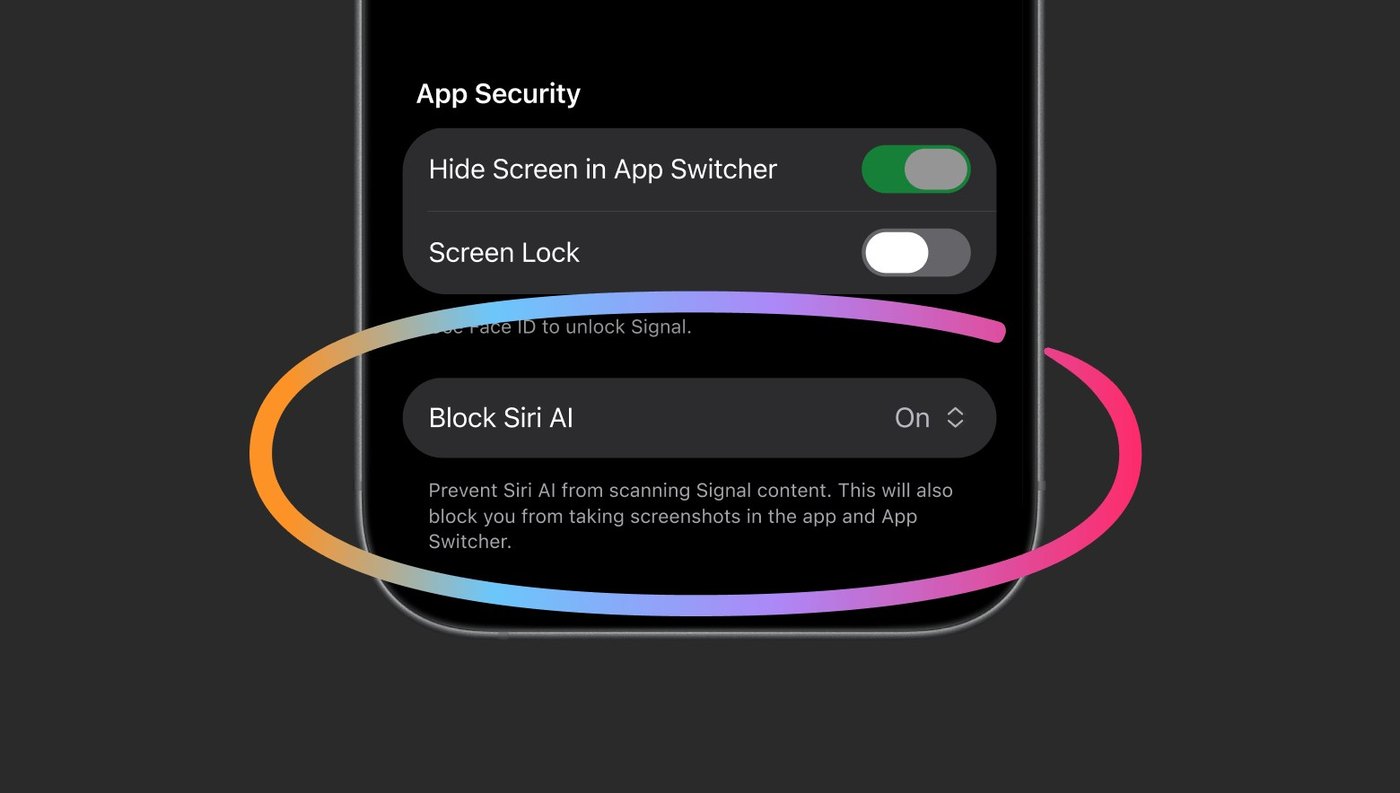
Signal restricted screenshots on iOS 27 and Android devices to prevent artificial intelligence assistants like Siri and Gemini from reading user chat screens.
By Dillip Chowdary • Nov 20, 2026 • Source: The Verge
At a glance
- Product
- Signal messaging application
- Target platforms
- iOS 27 and Android
- Organization lead
- President Meredith Whittaker
- Blocked tools
- Apple Siri and Google Gemini
- Unresolved risks
- Local device filesystem data retrieval
- Desktop status
- Protections currently unavailable on macOS
Signal is restricting screenshot capabilities on iOS 27 and Android devices to prevent artificial intelligence assistants from extracting user messages and on-screen data. According to The Verge's report, the messaging service rolled out the defensive measure after warning that system-level agentic tools analyze visual information to harvest personal details. Signal president Meredith Whittaker stated that these background capabilities directly undermine the organization's ability to independently guarantee user privacy.
This report covers Signal's platform restrictions, the technical mechanics of on-screen artificial intelligence ingestion, and the implications for mobile security architecture. Mobile application developers, security engineers, and privacy-conscious users need clear insight into how host operating systems process visual application state. The changes demonstrate an escalating conflict between platform providers and independent encryption services seeking to preserve data confidentiality.
01Display buffer blocks and operating systems
Signal deployed software restrictions that block display captures directly across iOS 27 and Android operating systems. This countermeasure stops device-level digital assistants from ingesting active message threads through standard screen grab interfaces. By disallowing capture routines within the application viewport, the client prevents automatic text harvesting by background services.
The defensive implementation specifically shields communication records from Apple Siri, Google Gemini, and automated Android assistants that scan user displays. Without these protections, operating system agents can continuously analyze on-screen text to build persistent user profiles. Whittaker stressed that platform vendors currently force developers into extreme compromises when attempting to isolate application data.
02Application settings and assistant analysis
Signal introduced a dedicated toggle inside its application settings that allows mobile device owners to manage screenshot blocking manually. The setting gives account holders direct authority over screen capture policies on their handsets. Signal displays an explicit notification within Android security settings to guide users through the option.
Restoring screenshot functionality re-enables standard capture utilities on the handset immediately. However, Whittaker warned that re-enabling screenshots potentially exposes user and contact content to artificial intelligence assistants, breaking Signal's privacy guarantees. The security toggle forces users to choose between local capture utility and strict communications isolation.
| Platform | Protection status | AI agent targeted |
|---|---|---|
| iOS 27 | Restricted by default | Siri |
| Android | Restricted by default | Gemini |
| macOS | Unprotected | Desktop assistants |
Advertisement
Tech Pulse Daily
Get tomorrow's pulse first
Join engineers who read Tech Pulse before stand-up. Free, weekday mornings.
Note: Signal confirmed that screenshot protections cannot currently be implemented on macOS because Apple fails to offer developers granular controls without breaking core user experience functions. The organization explained that desktop environments require deeper platform cooperation to isolate visual data without compromising stability.
03Underlying storage access and defense gaps
Whittaker openly acknowledged that blocking display captures remains an incomplete defensive measure against autonomous system agents. While the restriction stops visual screen grabs, it cannot halt alternative data acquisition pathways available to operating system tools. Specifically, agents operating with system privileges can potentially retrieve communication databases directly from local device filesystems.
Signal encountered similar architectural privacy challenges during the previous year when Microsoft introduced Recall for personal computers. The encrypted messaging service struggled to prevent that feature from recording protected chats due to minimal platform disclosure. The incident demonstrated that endpoint encryption remains vulnerable when host operating systems track user activities locally.
04Operating system platform policy gaps
Signal issued a direct appeal to Apple, Google, and Microsoft demanding simple technical tools and comprehensive engineering documentation. Whittaker argued that independent software developers urgently need standardized controls to govern how background assistants interact with application data. Without verified access controls, platform vendors maintain unilateral authority over endpoint data extraction.
The messaging foundation emphasized that current system-level agent integrations constitute an existential threat to application privacy. Because autonomous tools operate below the application layer, independent software cannot independently guarantee security against the host environment. Whittaker noted that this structural vulnerability threatens software makers across the broader mobile software landscape.
05Accessibility permissions and third party agents
Third-party artificial intelligence tools create severe secondary exposure risks by exploiting deep accessibility settings on consumer devices. Signal warned that external software such as Meta Muse uses elevated accessibility privileges like a skeleton key to access private application content. When users grant broad accessibility access, third-party tools can bypass normal application sandboxes entirely.
Whittaker described Signal as an early warning for the broader software ecosystem as operating system vendors integrate agentic intelligence across device layers. She urged independent software developers and privacy advocates to recognize the ecosystem-wide dangers posed by unchecked operating system agents. Unregulated platform integrations risk eroding basic encryption principles across all modern computing platforms.
Frequently asked questions
Why is Signal restricting screenshots on mobile devices?
Signal is restricting screenshots on iOS 27 and Android to prevent operating system AI agents like Siri and Gemini from scanning private messages.
Can users turn screenshots back on inside Signal?
Users can re-enable screenshots in app settings, but Signal warns this exposes conversations to AI agents and breaks privacy guarantees.
Why are screenshot protections missing on macOS?
Apple does not provide developers with tools to restrict AI data access on macOS without causing drastic compromises to the core user experience.
What threat do third-party tools like Meta Muse present?
Meta Muse and similar third-party tools can exploit deep accessibility permissions like a skeleton key to extract private application data.
Sources

Author
Dillip Chowdary
Writes Tech Bytes coverage of AI, engineering, and the tools that actually ship. Editor of Tech Pulse Daily.
Related on Tech Bytes
Advertisement