TechCrunch Mobility: Blue-green is the color of autonomy
Federal regulators proposed cyan exterior lights for driverless vehicles as General Motors set a 2028 timeline for eyes-off highway driving systems.
By Dillip Chowdary • Oct 26, 2026 • Source: TechCrunch
Federal safety regulators at the National Highway Traffic Safety Administration have proposed new equipment specifications that introduce cyan-colored lighting to signal when an autonomous vehicle operates without a human driver monitoring the roadway, as detailed in TechCrunch's report. The proposal is part of an agency-wide effort to overhaul federal motor vehicle safety standards that were originally drafted around human drivers, manual controls, and physical mirrors. Alongside the regulatory shift, major automakers and mobility operators announced significant technology timelines, with General Motors setting a 2028 deployment date for hands-off, eyes-off automated driving and Rivian acquiring a specialized 3D simulation startup.
This breakdown covers the federal government's suggested lighting rules, regulatory modernizations for pedal-free vehicles, automaker platform overhauls, and commercial autonomy transactions across the United States and international markets. The findings matter directly to automotive software engineers, fleet operators, regulatory compliance teams, and mobility executives who must adapt physical hardware, safety validation pipelines, and commercial deployment schedules to align with emerging federal standards and competitive automated driving platforms.
TechCrunch Mobility: what actually changed
Under the newly issued proposal, the National Highway Traffic Safety Administration introduced equipment guidelines that permit and recommend the use of cyan, or blue-green, exterior lights on vehicles operating in automated mode. The specification requires the cyan lighting to emit a steady illumination rather than flashing, and the light must remain visible from the front, rear, and both lateral sides of the vehicle. Crucially, the federal agency did not make the cyan exterior lighting a mandatory requirement, framing it as an authorized option to establish a uniform external marker for driverless driving systems while operating without occupant intervention.
Beyond color specifications, the proposal removes longstanding federal rules that require manual operating controls for vehicle turn signals, high beams, and hazard flashers. This revision addresses structural conflicts between legacy Federal Motor Vehicle Safety Standards and emerging vehicle architectures, such as the Tesla Cybercab and Zoox robotaxi, which are designed entirely without steering wheels, brake pedals, side mirrors, or interior rearview mirrors. According to NHTSA administrator Jonathan Morrison, updating these legacy standards is intended to accelerate the commercial deployment of automated driving systems while preserving baseline roadway safety.
TechCrunch Mobility: how it works
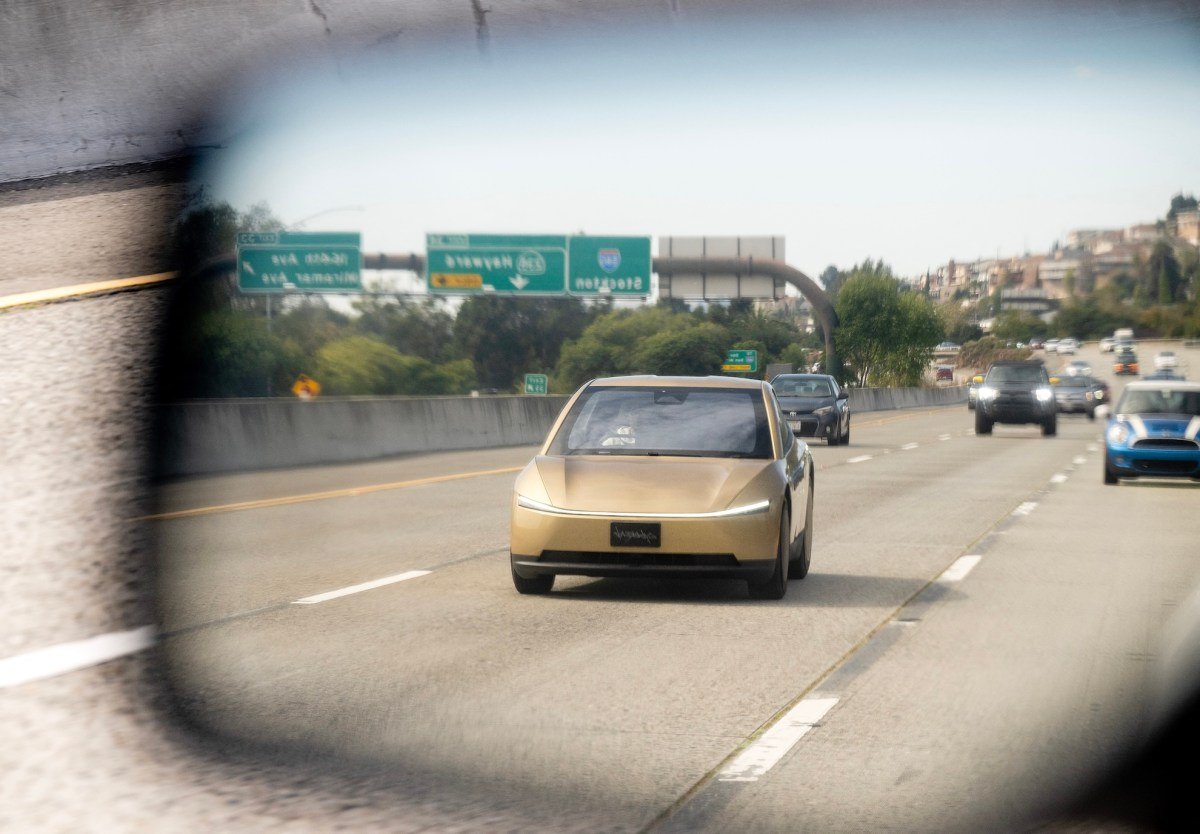
External identification relies on automated systems activating the steady cyan illumination whenever the automated driving system engages and assumes full driving responsibility without a human driver. To support these operational modes on passenger vehicles, General Motors outlined an overhaul of the electrical and computational architecture across its future lineup during its annual GM Forward presentation. The company is re-engineering its in-vehicle hardware stack to support higher software compute throughput, a custom conversational AI assistant to replace its 30-year-old OnStar architecture, and an automated highway driving feature scheduled for 2028 that permits eyes-off, hands-off operation without requiring the driver to monitor the roadway.
On the software development and simulation side, Rivian completed the acquisition of Third Dimension, a United Kingdom startup founded by gaming and autonomous vehicle veterans with fifteen engineers that previously raised a 7 million dollar seed round. Rivian head of autonomy James Philbin explained that the startup uses artificial intelligence to convert real-world video and imagery into photorealistic virtual 3D environments, addressing the simulation-to-real data gap. By generating synthetic environments directly from collected road data, engineering teams can stress-test vehicle perception models and motion planning systems in simulation before executing hardware runs on public roads.
Advertisement
Tech Pulse Daily
Get tomorrow's pulse first
Join engineers who read Tech Pulse before stand-up. Free, weekday mornings.
TechCrunch Mobility: why it matters now
The federal proposal arrives as regulatory bodies attempt to reconcile vehicle standards with driverless platforms entering mass production and commercial service. Legacy motor vehicle rules mandate physical equipment that purpose-built robotaxis cannot accommodate, creating legal friction for manufacturers seeking commercial authorization. The introduction of standardized cyan lighting provides human drivers, pedestrians, and emergency personnel with immediate visual confirmation that an oncoming vehicle operates under automated control, preventing confusion at intersections, crosswalks, and passenger drop-off zones as driverless fleets expand into denser urban centers.
At the same time, commercial competition is driving automakers to compress engineering schedules using enterprise automation. General Motors confirmed it has integrated enterprise artificial intelligence tools across internal operations, cutting its traditional four- to five-year vehicle development cycle down by half. With Tesla preparing to manufacture its Cybercab and beginning production of its Optimus humanoid robot despite third-quarter profits declining 43 percent year-over-year, legacy automakers and electric vehicle manufacturers are retooling their computational architectures to secure market share ahead of commercial rollouts projected between 2027 and 2028.
TechCrunch Mobility: who is affected
Automakers, fleet operators, and hardware suppliers are directly affected by the revised lighting and control guidelines. General Motors is structuring its immediate deployment roadmap around the 2028 Cadillac Escalade IQ, which will serve as the initial platform for the company's revamped compute platform and eyes-off highway driving system. Meanwhile, GM closed a facility south of Detroit that assembled battery packs for the flagship Cadillac Celestiq and drive units for the Chevrolet Corvette E-Ray plug-in hybrid due to an expiring facility lease, demonstrating shifting operational footprints across its electrified production facilities.
Commercial robotaxi operators and autonomous aviation companies are similarly scaling their operational boundaries. Waymo expanded its commercial ride-hailing services to include routes to and from Harry Reid International Airport in Las Vegas and announced plans to launch robotaxi operations in Madrid, Spain, in 2027. In international ride-hailing, inDrive signed a memorandum of understanding with Chinese autonomous driving developer Pony.ai and Nvidia to begin robotaxi trials in Kazakhstan in 2027. In the aviation sector, autonomous flight startup Reliable Robotics closed a 115 million dollar Series D extension consisting of 90 million dollars in equity and 25 million dollars in debt, raising its valuation past 1 billion dollars.
TechCrunch Mobility: what to watch
Industry observers must track the formal public comment and adoption trajectory of the NHTSA automated vehicle framework, particularly whether state regulators and municipal transportation departments adopt cyan lighting as an operational requirement for testing permits. Vehicle manufacturers will also monitor how Google integrates personal intelligence features across its in-car Gemini software, which links vehicle interfaces directly to user accounts across Gmail, Google Calendar, YouTube, Google Maps, and search histories to personalize routing and voice interactions based on previous user activities.
Corporate restructuring among high-profile autonomy companies will also remain under scrutiny following confirmation from Elon Musk that special board committees at Tesla and SpaceX are reviewing a potential merger. While SpaceX generated 7.5 billion dollars in revenue from its artificial intelligence business, representing 52 percent of its overall revenue, Tesla delayed its unsupervised Full Self-Driving release to the second quarter of next year. Concurrently, Rivian chief executive RJ Scaringe signaled that advances in autonomous vehicle architectures will influence subsequent vehicle platform designs beyond the R1S, R2, and upcoming R4 lines.
Developer Action Items
- ☐ Map where Tesla sits in your stack (SDK, API key, billing, data-processing addendum).
- ☐ Hold non-urgent migrations until the integration or use-of-proceeds roadmap is public — day-one coverage is not a ship signal.
- ☐ If you are mid-contract or mid-POC, ask the vendor what changes for existing customers this quarter.
- ☐ Write the single decision this forces: stay, dual-source, or exit.
TechCrunch Mobility FAQ
What color did federal regulators propose for autonomous vehicles?
The National Highway Traffic Safety Administration proposed cyan, or blue-green, steady-burning exterior lights that are visible from the front, rear, and both sides of an autonomous vehicle.
Is cyan lighting mandatory for all self-driving cars under the proposal?
No, the National Highway Traffic Safety Administration suggested cyan lighting as an authorized equipment option rather than a mandatory requirement.
When will General Motors debut its hands-off, eyes-off automated driving feature?
General Motors plans to launch its hands-off, eyes-off automated highway driving feature in 2028, debuting alongside a compute overhaul on the Cadillac Escalade IQ.
Which startup did Rivian acquire to improve its autonomous vehicle simulation?
Rivian acquired Third Dimension, a United Kingdom startup with fifteen engineers that uses artificial intelligence to convert video and image data into 3D simulation worlds.
Where does Waymo plan to launch international robotaxi operations?
Waymo announced plans to launch its autonomous robotaxi service in Madrid, Spain, with operations scheduled to open to riders in 2027.
Sources

Author
Dillip Chowdary
Writes Tech Bytes coverage of AI, engineering, and the tools that actually ship. Editor of Tech Pulse Daily.
Related on Tech Bytes
Advertisement