Telegram Desktop vulnerability allowed any user's file to be stolen
Telegram patched a high-severity IPC injection vulnerability tracked as CVE-2026-107181 in Telegram Desktop 7.2.9 that enabled one-click account takeover.
By Dillip Chowdary • Oct 10, 2026 • Source: beaksec.github.io
Telegram Desktop patched a high-severity flaw tracked as CVE-2026-107181 that permitted remote attackers to achieve arbitrary file read and complete account takeover through a single clicked link. The vulnerability allowed malicious actors to craft specialized links that exploited local socket communication boundaries, forcing the application to exfiltrate private session data to an attacker-controlled channel without user interaction. The security issue was detailed in beaksec.github.io's report detailing how local command parsing and internal URI handlers can be chained to compromise desktop messaging clients.
This article covers the technical architecture of the inter-process communication flaw, the internal URI handlers involved, the target scope of affected software builds, and the remediation steps necessary to secure vulnerable installations. It is intended for software engineers, security researchers, system administrators, and users running Telegram Desktop across desktop operating systems who require a precise breakdown of the exploit mechanism and its structural patch.
What broke in Telegram Desktop vulnerability allowed any
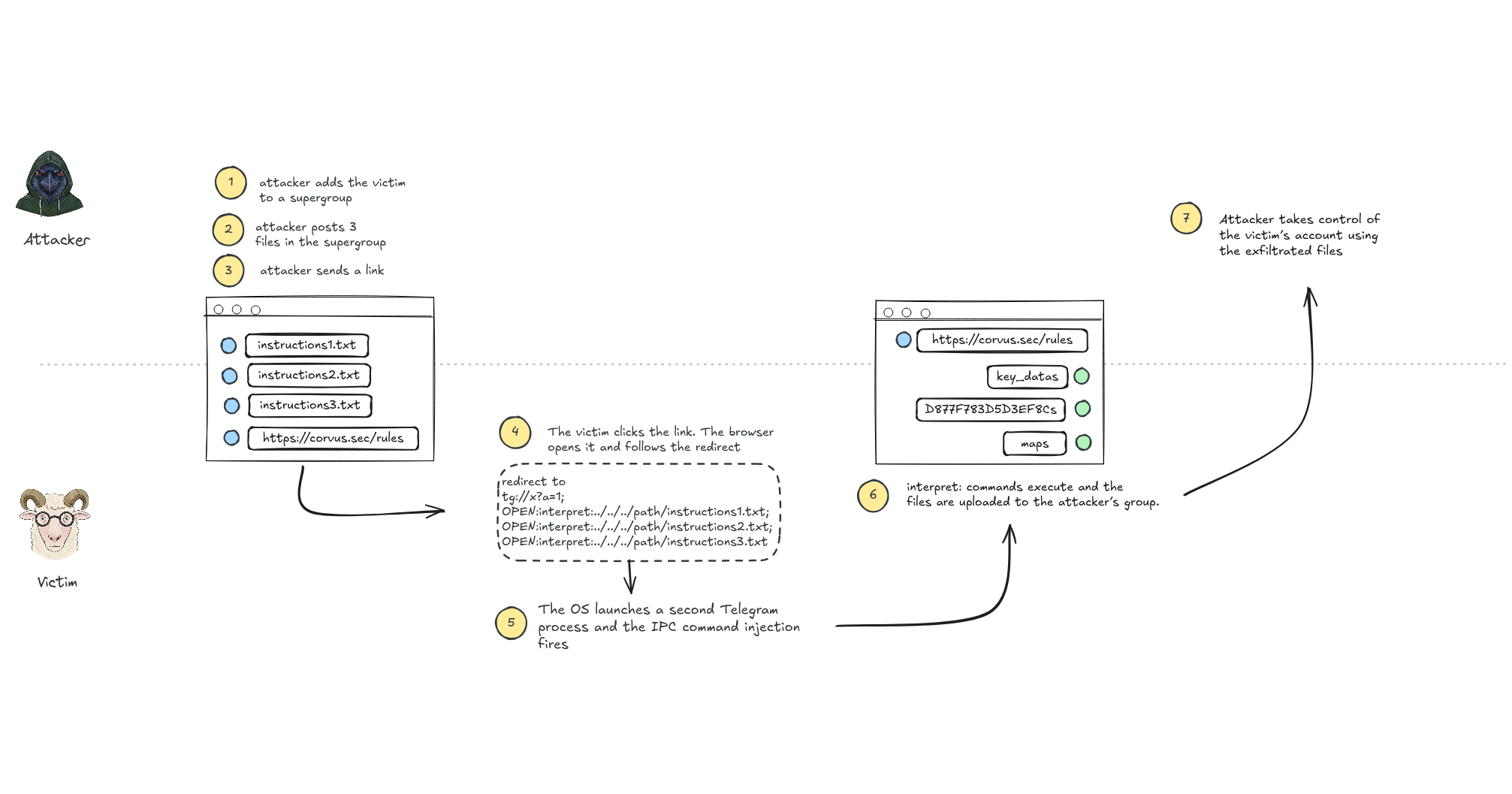
The vulnerability stems from two combined software defects within Telegram Desktop's URL handling and inter-process communication serialization routines. When a operating-system level tg:// link is clicked, the system launches a new process that attempts to pass the incoming URL string over a local socket to an already-running Telegram server instance. During this transfer, Telegram flattens instructions into simple text strings separated by semicolons without properly escaping embedded semicolon characters. An attacker-controlled URL containing a semicolon allows arbitrary IPC instructions, such as OPEN:, to be injected directly into the running application's command queue.
The second defect involves an unauthenticated internal URI scheme named interpret: accessible via the injected OPEN: command. Originally built as an internal deployment utility to publish release binaries and changelogs to Telegram channels, interpret: parses an instruction text file containing destination channel identifiers and target local file paths. Because the underlying InterpretSendPath function performs no authorization checks or user confirmation prompts, receiving an injected interpret: link forces Telegram Desktop to automatically read any file specified in the instruction script and transmit its contents across the network.
Who is exposed by Telegram Desktop vulnerability allowed any
The flaw impacts Telegram Desktop builds up to version 7.2.8 across supported desktop platforms, with active exploit behavior confirmed on Windows running version 6.9.3. Devices running vulnerable clients are exposed whenever a user clicks a specially formatted link within a chat group or external application. The security issue carries a Common Vulnerability Scoring System vector of CVSS:3.1/AV:N/AC:L/PR:N/UI:R/S:U/C:H/I:H/A:N, yielding an overall CVSS score of 8.1 High due to the potential for complete account compromise and unauthorized local data exfiltration.
Because Telegram Desktop automatically downloads received group chat attachments up to 8 MiB by default into predictable local file system paths, an attacker can stage an instruction file inside a victim's downloads folder without requiring manual file saving. Once the instruction file lands in the standard download location or relative application data directory, the attacker needs only to convince the user to click a single link to trigger the unauthorized read operation. This allows remote users to extract sensitive login session files and complete an account takeover without possessing administrative rights on the target host machine.
Advertisement
Tech Pulse Daily
Get tomorrow's pulse first
Join engineers who read Tech Pulse before stand-up. Free, weekday mornings.
What to do now about Telegram Desktop vulnerability allowed any
System administrators and end users must immediately update all installed Telegram Desktop clients to version 7.2.9 or later. The patch, committed in repository revision db3405699f, resolves the command injection vulnerability and restricts unauthenticated calls to internal URI handlers. Organizations deploying Telegram Desktop in enterprise environments should verify that existing instances are updated past version 7.2.8 to prevent potential lateral movement or credential theft using local socket injection vectors.
In addition to updating software versions, users can mitigate automatic file staging risks by adjusting client media auto-download settings. Restricting automatic file downloads in group chats prevents arbitrary incoming attachments from being saved automatically to predictable file system paths like %APPDATA%\Telegram Desktop or default user download directories. Combining client updates with cautious link handling reduces exposure to zero-click asset staging and one-click socket execution chains.
How the Telegram Desktop vulnerability allowed any issue works
When Telegram Desktop process clients launch a tg:// link while another instance is active, the client serializes the URL string in sandbox.cpp by building a line format of OPEN:<url>;. The receiving server instance in sandbox.cpp reads incoming socket bytes, splits the buffer at every semicolon character, and processes each segment starting with OPEN: as a standalone URL. Passing a link formatted as tg://x?a=1;OPEN:interpret:instructions.txt causes the receiver to parse two distinct commands: OPEN:tg://x?a=1 and OPEN:interpret:instructions.txt.
Upon receiving the injected OPEN:interpret: instruction, the internal application handler routes the target file path to InterpretSendPath inside support_helper.cpp. The function opens the specified file path, reads its raw UTF-8 content, and packages the data into a message directed to the channel ID defined inside the instruction file. By using relative path navigation from Telegram's working data folder, an attacker can point the instruction file's target parameter to local authentication session files, causing Telegram Desktop to upload its own session credentials to the attacker's channel.
What is still unknown about Telegram Desktop vulnerability allowed any
While the primary injection vector and patch commit db3405699f focus on Telegram Desktop up to version 7.2.8 on Windows, the full scope of potential URI scheme targets within older release branches remains undisclosed. The original release scripts utilized Telegram -sendpath interpret:// calls to automate deployment workflows, but full audit details regarding other internal debug schemes across non-Windows operating systems have not been explicitly published.
Additionally, public security reports have not detailed whether active exploitation occurred in the wild prior to the issuance of CVE-2026-107181 and the release of version 7.2.9. It remains unspecified how many third-party forks or customized builds of the Telegram Desktop client integrated the vulnerable inter-process IPC code without applying the corresponding upstream patch.
Developer Action Items
- ☐ Inventory whether GitHub / Windows runs in prod, CI, staging, or on laptops before you debate severity.
- ☐ Pull the vendor advisory for CVE-2026-107181 and patch from that page — not from a social recap.
- ☐ If you cannot patch today, isolate the service, rotate tokens that sat on the affected surface, and raise the logging floor.
- ☐ Record the decision and residual risk so the next on-call does not re-litigate whether you are exposed.
Telegram Desktop vulnerability allowed any FAQ
What versions of Telegram Desktop are affected by this vulnerability?
Telegram Desktop versions up to 7.2.8 are affected, with confirmed exploitation verified on Windows version 6.9.3.
How does an attacker execute the vulnerability on a victim's machine?
An attacker sends a file into a group chat to stage an instruction script, then tricks the user into clicking a crafted link that injects commands over a local socket.
Has Telegram patched the security flaw?
Yes, Telegram fixed the vulnerability in version 7.2.9 under git commit db3405699f.
Sources

Author
Dillip Chowdary
Writes Tech Bytes coverage of AI, engineering, and the tools that actually ship. Editor of Tech Pulse Daily.
Related on Tech Bytes
Advertisement