The agent tax has arrived: Google Workspace's MCP pricing
Google introduced paid Model Context Protocol access for Workspace apps, charging developers roughly $0.20 per 1,000 requests beyond a 5,000 daily free tier.
In short
Developers and AI labs building agentic integrations · $0.20 per 1,000 requests after 5,000 free calls · Billing scheduled to begin in April · Audit request volumes across Google Cloud projects
By Dillip Chowdary • Nov 28, 2026 • Source: martinalderson.com
At a glance
- Who it is for
- Developers and AI labs building agentic integrations
- The number
- $0.20 per 1,000 requests after 5,000 free calls
- Available
- Billing scheduled to begin in April
- What to do
- Audit request volumes across Google Cloud projects
- Free tier limit
- 5,000 requests per day across a Google Cloud project
- Search revenue
- Rose 12% last quarter but missed estimates by $1.5B
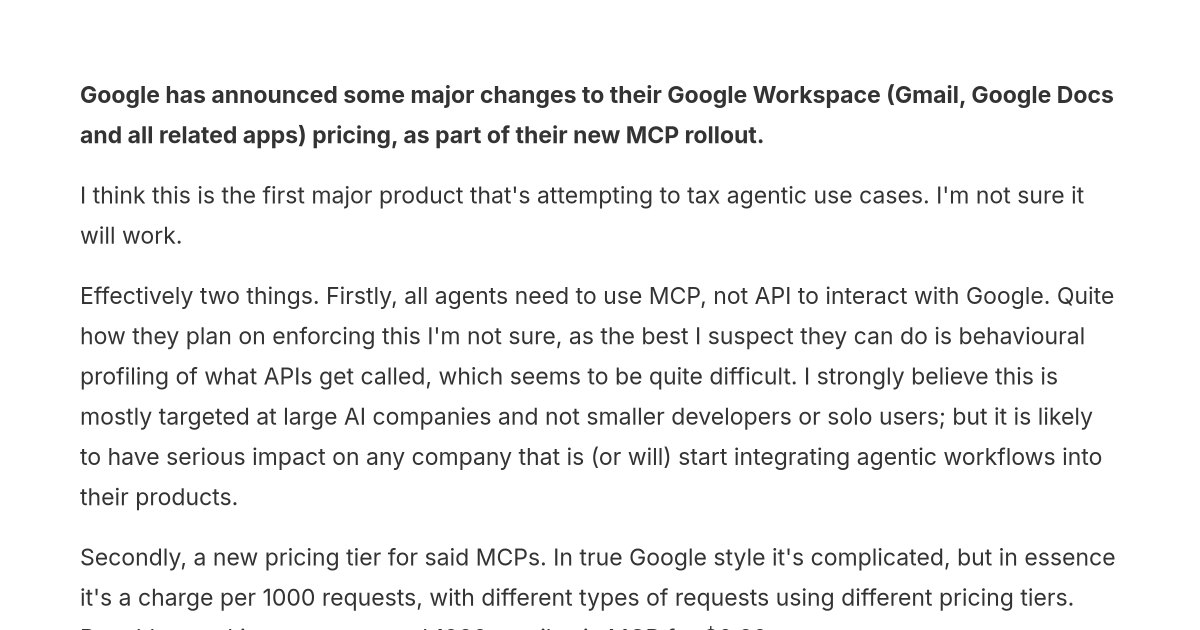
Google announced new pricing for Google Workspace applications under its Model Context Protocol rollout, charging roughly $0.20 per 1,000 requests after a shared limit of 5,000 free daily calls according to martinalderson.com's report.
The policy targets software engineering teams and AI laboratories building automated agents that interact with Gmail and Google Docs. Developers should audit existing cloud project call volumes immediately and determine whether their applications must absorb the request fees before April.
01Mandatory Model Context Protocol rollout
Google is requiring all autonomous agents to interact with Google Workspace services through the Model Context Protocol rather than standard application programming interfaces. While technical enforcement may require behavioral profiling of incoming API calls, the mandate specifically targets third-party agent platforms connecting to enterprise email and document repositories.
The transition introduces a structured pricing schedule where requests are billed per 1,000 calls across differentiated functional categories. Solo developers and internal operations receive a baseline tier of 5,000 free requests per day, though that cap is pooled across every service connected to a specific Google Cloud project.
Organizations exceeding that baseline threshold face operational hurdles when integrating automated workflows into commercial products. The pooled cloud project limit means multiple agent instances rapidly consume available quota units during standard operations. That shared ceiling exposes enterprise deployments to escalating usage charges during routine data processing.
02Quota allowances and request charges
The new structure creates a stark asymmetry between legacy applications and modern autonomous agents querying identical underlying records. Traditional software relying on standard endpoints receives user-level quotas of 6,000 units per minute alongside project ceilings of 20,000 emails per minute without incurring billing charges.
Under the paid tier, legacy applications receive an allowance of 10 million daily email reads before any fees accumulate. Autonomous agents operating over the protocol receive zero free requests once transferred to the paid tier, paying approximately $0.20 per 1,000 calls starting from their initial query.
| Integration Model | User Quota | Project Free Allowance | Paid Tier Baseline | Overage Rate |
|---|---|---|---|---|
| Legacy REST API | 6,000 units/min per user (~100 emails/min) | 20,000 emails/min free cap | 10 million reads/day before fees | Free with approved quota request |
| Workspace MCP | Shared across Google Cloud project | 5,000 requests/day per project | 0 free requests on paid tier | ~$0.20 per 1,000 requests |
A system retrieving data through standard programming interfaces processes thousands of messages every minute at zero cost. That identical workload conducted by an autonomous system requires continuous payment per thousand interactions, fundamentally altering the economics of background office productivity tools.
Advertisement
Tech Pulse Daily
Get tomorrow's pulse first
Join engineers who read Tech Pulse before stand-up. Free, weekday mornings.
03Frontier lab margin pressure
The pricing structure arrives as external platforms like OpenAI and Anthropic experience massive surges in user-driven workspace connections. While early integrations with Gemini struggled to complete basic formatting requests in presentation software, third-party models rapidly expanded their automated interactions with corporate email systems.
Subscribers paying $20 monthly for external AI assistants frequently conduct extensive inbox searches that accumulate 10,000 protocol requests per account. That query volume generates $2 in direct infrastructure charges that external labs must absorb against existing subscription margins. These cumulative request fees threaten customer unit economics across frontier platforms.
Frontier laboratories face the difficult choice of reducing profit margins ahead of initial public offerings or capping customer request volume. Restricting external query allowances damages user experience and risks pushing corporate clients back toward native Gemini workflows that operate without artificial rate caps.
04System of record switching costs
Search advertising revenue grew 12% in the recent quarter but fell short of analyst projections by more than $1.5 billion. Implementing per-request fees on autonomous queries allows the company to demonstrate a concrete mechanism for capturing revenue as automated assistants replace human search clicks.
Competing systems of record including Salesforce, Atlassian, and Intuit may attempt similar monetization frameworks to safeguard proprietary enterprise workflows. However, imposing friction on programmatic access risks accelerating customer churn if organizations choose to export structured records through standard data dumps instead.
Modern autonomous tooling has dramatically reduced the friction required to migrate data between competing software providers. Connected browser instances can inspect private internal endpoints, extract full data catalogs, and reformat legacy information for self-hosted or alternative platforms without requiring enterprise migration assistance.
05April billing and platform competitors
The proposed monetization model prompted Cloudflare's leadership to publicly weigh launching an alternative email platform to capture disenfranchised users. Longstanding SaaS business models bundled programming interfaces into base seat subscriptions, but charging distinct rates based on whether software or humans initiate queries disrupts that arrangement.
Note: Full billing enforcement for the protocol tiers is scheduled to begin in April, though ongoing market reception and developer pushback could force adjustments to fee schedules before launch. Google has not yet published technical documentation outlining how automated agent traffic will be distinguished from traditional API calls.
Charging customers an incremental fee to access previously inclusive personal data risks destabilizing established enterprise relationships. If the pricing structure endures through commercial deployment, enterprise software vendors across the industry will likely adopt parallel agent surcharges across their product portfolios.
Frequently asked questions
How much does Google charge for Workspace MCP requests?
Google charges approximately $0.20 per 1,000 requests under the paid tier. Projects receive a shared free allowance of 5,000 calls each day before billing applies to all requests.
How does the MCP allowance compare to the legacy REST API?
The legacy REST API provides each user with 6,000 quota units per minute and a project cap of 20,000 emails per minute. In contrast, the MCP tier restricts the entire cloud project to 5,000 free daily calls.
Why is Google transitioning Workspace agents to MCP pricing?
Google is countering margin pressure from frontier labs whose subscribers search Gmail via external models rather than Gemini. The policy also creates an investor narrative to monetize automated queries as search revenue growth slows.
When will the Google Workspace MCP pricing take effect?
Billing under the new pricing model is scheduled to begin in April. Google has not yet detailed how it will enforce mandatory MCP usage over standard API calls.
Sources

Author
Dillip Chowdary
Writes Tech Bytes coverage of AI, engineering, and the tools that actually ship. Editor of Tech Pulse Daily.
Related on Tech Bytes
Advertisement