The Anthropic Feedback Loop: Cost of Capital Diversions and Delusions
If Damodaran had to name the single input his valuation revolves around most, it is Anthropic's target revenues reaching one trillion dollars within a decade.
By Dillip Chowdary • Nov 11, 2026 • Source: aswathdamodaran.substack.com

Aswath Damodaran has published a detailed follow-up to his Anthropic valuation, defending his methodology, ranking the most fragile assumptions in his model, and working through the feedback he received after the original post drew strong reactions. His aswathdamodaran.substack.com's report revisits the equity estimate, sharpens the treatment of compute commitments, dilution risk, and governance, and plays devil's advocate against his own numbers.
This piece is for investors, analysts, and AI-industry observers who want to understand why Damodaran's $1.45 trillion equity estimate landed where it did, what has changed since the original post, and which inputs he considers most likely to break — without having to reconstruct the spreadsheet themselves.
01Revised equity value after Q3 numbers landed
Damodaran updated his Anthropic valuation to $1.45 trillion in equity value, a slight reduction from his prior estimate of $1.475 trillion, after adjusting trailing twelve-month revenue and operating income figures to incorporate leaked third-quarter 2026 numbers. The revision was minor because slowing Q3 revenue growth was already an open secret that he had baked into his original story.
Replacing the third-quarter 2025 figures with third-quarter 2026 figures raised the base revenue level, so the year-one growth rate was adjusted downward to still deliver roughly $100 billion in revenues for the coming twelve months. The share count he used adds reported outstanding shares to restricted shares granted to employees, though bankers will adjust that count before any public offering to hit a per-share price they consider more marketable.
The updated model also corrected prior errors that, by his own account, did not change the aggregate equity value. He used a 9.74% cost of capital, incorporating a technology-sector cost of equity and a cost of debt based on a BB+ credit rating, placing Anthropic near the 90th percentile of US companies in 2026.
02Target revenues of $1 trillion in ten years
If Damodaran had to name the single input his valuation revolves around most, it is Anthropic's target revenues reaching one trillion dollars within a decade. That scale would put Anthropic alongside Amazon and Walmart at the very top of global revenue tables — companies that reach that size on volume but often at compressed margins.
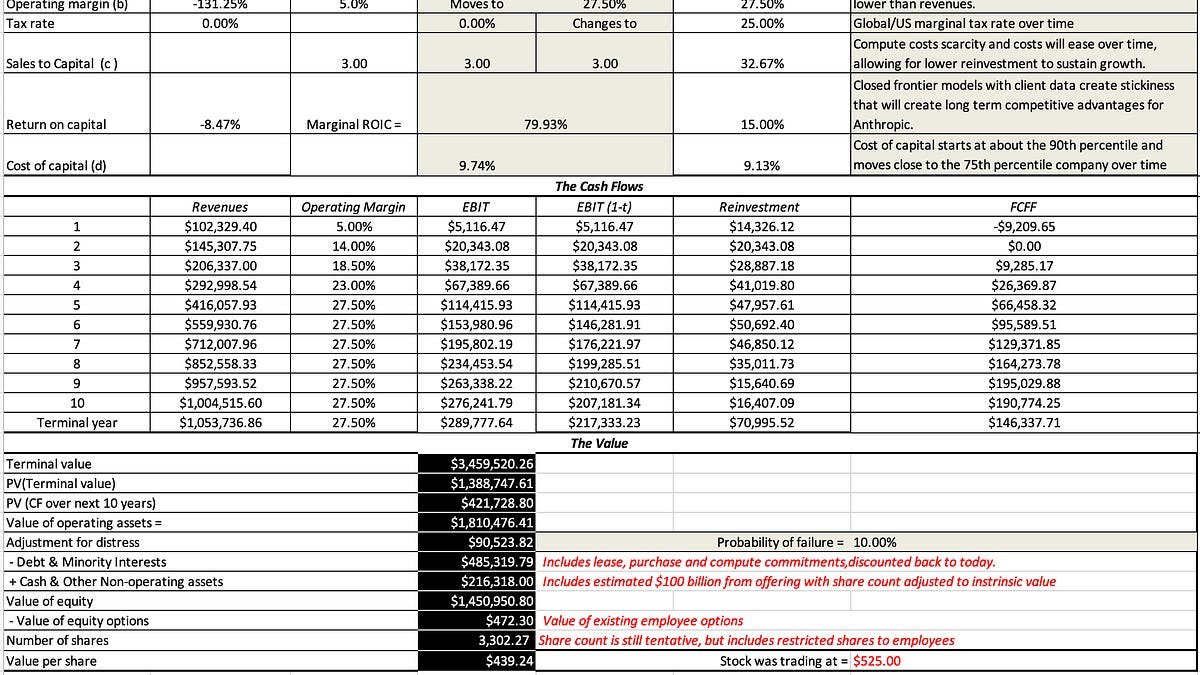
The assumption is not just a revenue forecast. It is simultaneously a bet on AI agents and products achieving broad demand, on that demand being successfully monetized, and on Anthropic specifically emerging as the dominant winner in the premium segment of the AI market with meaningful pricing power. Each of those conditions has to hold for the trillion-dollar figure to survive.
If any part fails, revenues fall short of the target and the damage compounds: lower revenue growth depresses margins, creates idle compute capacity, and raises the probability that the company does not survive to reach its terminal state.
Advertisement
Tech Pulse Daily
Get tomorrow's pulse first
Join engineers who read Tech Pulse before stand-up. Free, weekday mornings.
03Compute commitments between $400 billion and $800 billion
Damodaran flagged compute commitments as a persistent source of uncertainty, noting that Anthropic's prospectus scattered commitment figures throughout the text rather than consolidating them in a single table comparable to the purchase-commitment schedule. That presentation gap has produced estimates ranging from $400 billion to $800 billion, with no consensus on timing or the contractual standing of each figure.
His own model estimates contractual commitments at just over $450 billion in aggregate, with a present value of roughly $373 billion. He drew an analogy to Netflix's content-commitment accounting, which he has long struggled with in his own Netflix valuations, where long-term lease and rental deals create recurring uncertainty about timing and optionality.
He acknowledged that additional details on these commitments are likely to surface and will require revisiting, making compute obligations a long-duration open question for anyone attempting to value or price the company.
04Dilution risk from stock, options, and convertibles
Anthropic has used its equity as currency across several channels: restricted stock and options for employees, convertible bonds that add an equity kicker to borrowing, and the expectation of future share issuances to fund ongoing negative free cash flows. Damodaran's treatment of each is distinct.
For stock-based compensation, he valued equity options at their option value rather than exercise value, arriving at $472 million, which he netted against the equity estimate to reach the value of common equity. Restricted shares were included in the share count used to compute value per share. For convertible debt, he used the marked-to-market figure — the same marking that produced a $72 billion hit to Anthropic's 2026 earnings — as a proxy for fair value and subtracted it out to remove the conversion option from equity.
Future share issuances tied to funding negative free cash flows were not added to the share count, because those same negative cash flows already reduce the present value of the business. Adding shares on top of that deduction would be double counting, he argued.
05Governance structure flagged as a red flag
Damodaran reiterated the criticism he made in his original post: Anthropic's combination of public benefit corporation status with a voting share structure that leaves founders in control regardless of how much outside equity capital the company raises is a red flag, not a feature. Some readers pushed back, arguing that keeping technically sophisticated founders in control of an AI company is a positive given the stakes involved.
He acknowledged the counterargument but maintained his view that the structure creates a fundamental agency problem for public investors, who cede governance rights at the moment of investment without a credible path to reclaiming them. The debate reflects a broader tension in AI-company capital raises between mission-driven founder control and conventional investor protections.
He also addressed criticism of his 9.74% cost of capital, reserving a fuller treatment for later in the post, and stated plainly that he does not believe cost of capital is the input that most moves the valuation — target revenues carry far greater weight on both magnitude and fragility.
Anthropic Feedback Loop FAQ
What is Damodaran's current equity value estimate for Anthropic?
His updated estimate is $1.45 trillion, slightly below his prior figure of $1.475 trillion after incorporating leaked third-quarter 2026 revenue and operating income data.
What cost of capital did Damodaran use for Anthropic?
He applied a 9.74% cost of capital based on a technology-sector cost of equity and a cost of debt consistent with a BB+ credit rating, placing Anthropic near the 90th percentile of US companies in 2026.
How large are Anthropic's compute commitments?
Estimates range from $400 billion to $800 billion depending on interpretation of the prospectus disclosures; Damodaran's own model puts contractual commitments at just over $450 billion, with a present value of roughly $373 billion.
How did Damodaran handle the $72 billion convertible debt hit to Anthropic's 2026 earnings?
He treated the marked-to-market convertible debt figure as fair value and subtracted it from the equity estimate to remove the conversion option, rather than counting the future dilutive shares separately.
What does Damodaran identify as the most fragile input in his Anthropic valuation?
Target revenues reaching one trillion dollars in ten years — a figure that depends simultaneously on AI-agent demand, successful monetization, and Anthropic winning the premium market segment with pricing power.
Sources

Author
Dillip Chowdary
Writes Tech Bytes coverage of AI, engineering, and the tools that actually ship. Editor of Tech Pulse Daily.
Related on Tech Bytes
Advertisement