The Linkerd Story: The people Behind The Service Mesh — A new documentary
CNCF and Buoyant will premiere a new documentary exploring a decade of Linkerd service mesh development at KubeCon North America on November 9, 2026.
By Dillip Chowdary • Nov 02, 2026 • Source: CNCF Blog (Eng)
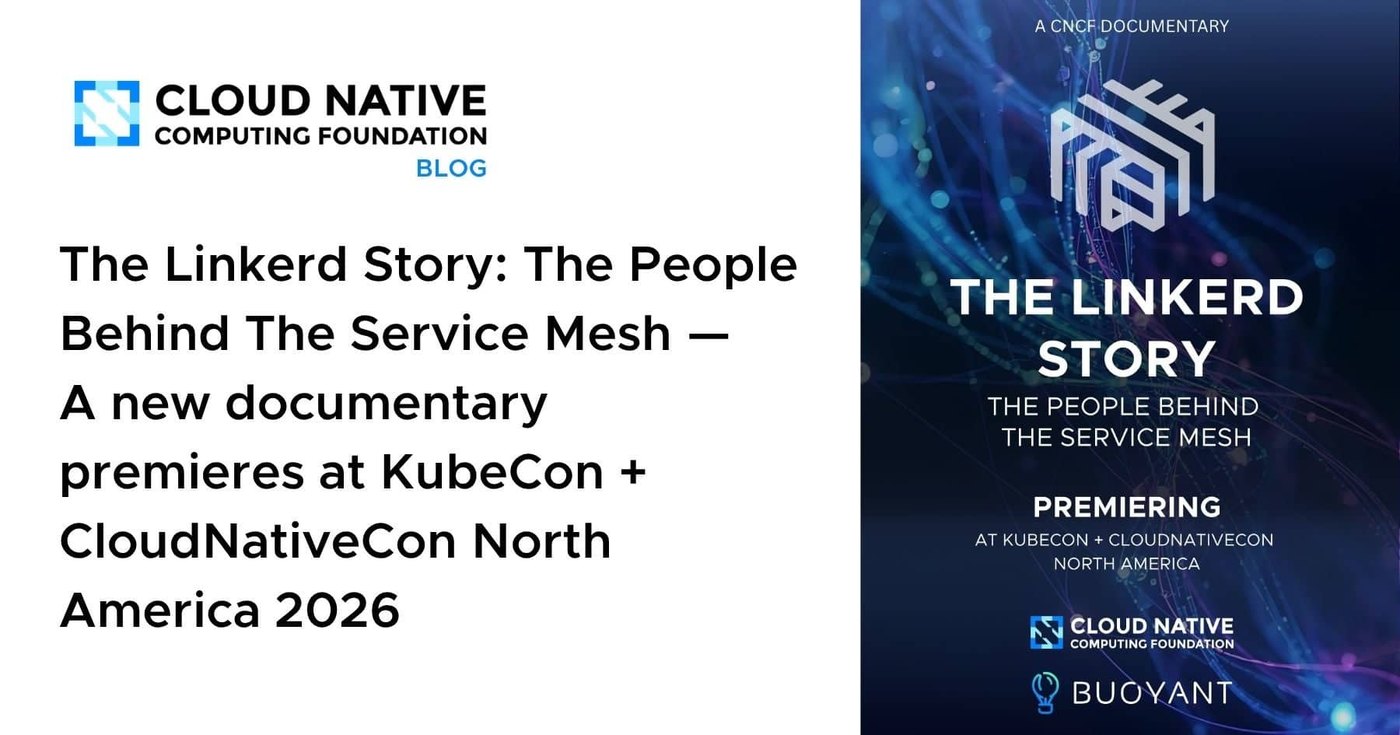
The Cloud Native Computing Foundation and Buoyant announced The Linkerd Story: The People Behind The Service Mesh, a documentary chronicling a decade of cloud native service mesh evolution. As detailed in CNCF Blog (Eng)'s report, the film premieres Monday, November 9, 2026, at KubeCon + CloudNativeCon North America 2026 in Salt Lake City. The documentary examines how early infrastructure challenges at Twitter sparked an open source networking movement that established the modern service mesh category.
This report details the technical milestones, operational shifts, and community governance structures featured in the film, exploring the trajectory from Twitter's internal Finagle library to dedicated Kubernetes sidecars. It is written for platform architects, systems engineers, Kubernetes operators, and infrastructure leaders who manage distributed systems and evaluate service mesh performance, operational simplicity, and open source longevity across enterprise production deployments. By documenting both technical rewrites and end-user deployments, this analysis outlines the essential engineering lessons uncovered across a decade of running service mesh infrastructure.
01Linkerd Story: what actually changed
The documentary establishes a formal historical record of the engineering shifts that transformed Linkerd from a localized networking experiment into a foundational cloud native project. Linkerd originated at Twitter, where infrastructure engineers tackled the operational difficulties of managing communication across complex distributed systems. Drawing from their work with Finagle, a Twitter library built to manage inter-service requests, the team created a standalone proxy approach to handle networking externally. That technical innovation defined the service mesh category, altering how engineering organizations manage security, reliability, and observability across microservice architectures.
Technical decisions throughout Linkerd's ten-year timeline focused consistently on resolving operator friction and simplifying cluster management. The documentary tracks the project's evolution into a dedicated Kubernetes-focused service mesh, followed by the architectural decision to build lightweight sidecar proxies using Rust instead of heavier runtime stacks. Adopting Rust allowed the project to deliver secure, low-overhead micro-proxies that minimize memory usage and CPU footprint on worker nodes. These core architectural adjustments reshaped the software into an efficient networking layer capable of meeting strict enterprise performance requirements without imposing operational complexity on cluster teams.
02Linkerd Story: how it works
Linkerd operates by deploying compact proxy instances alongside containerized application workloads across Kubernetes environments. Rather than requiring engineers to modify internal application logic or embed specialized networking libraries inside microservices, the platform transparently intercepts all inbound and outbound TCP traffic at the pod level. The purpose-built Rust micro-proxies handle transport encryption, telemetry gathering, and intelligent routing directly. This sidecar pattern abstracts networking concerns away from application containers, ensuring uniform policy enforcement, latency-aware request routing, and precise telemetry collection without demanding ongoing manual intervention from developers.
The overarching design prioritizes operational simplicity to make complex distributed networking manageable for lean operations teams. The project coordinates data plane sidecars through a centralized control plane that automates certificate rotation, mutual TLS verification, and diagnostic monitoring. By avoiding complex feature sets that bloat operational requirements, the architecture allows cluster administrators to introduce transparent security and real-time observability across services with minimal resource utilization. This focus on pragmatic usability directly reflects the engineering goal explored in the documentary: turning complex infrastructure networking into an unobtrusive, dependable background utility.
Advertisement
Tech Pulse Daily
Get tomorrow's pulse first
Join engineers who read Tech Pulse before stand-up. Free, weekday mornings.
03Linkerd Story: why it matters now
Achieving a full decade of continuous development marks a rare milestone within the cloud native software ecosystem. Many early open source networking experiments struggled with maintainer exhaustion, vendor instability, or excessive complexity, but Linkerd advanced through community-led governance to become a CNCF graduated project. Graduation within the Cloud Native Computing Foundation confirms that the project adheres to strict standards of open governance, intellectual property neutrality, and sustainable development. This milestone assures enterprise adopters that Linkerd is built to outlast market fluctuations and single-vendor pressures while maintaining architectural stability.
The film demonstrates that technical viability in open source is inextricably tied to community health, persistent collaboration, and shared responsibility. Linkerd's maintainers, ambassadors, and community contributors emphasize that building software on which global organizations depend requires durable personal relationships, patient code reviews, and transparent decision-making processes. Highlighting one contributor's stated ambition for Linkerd to thrive and serve production environments for another hundred years, the documentary illustrates how open collaboration transforms foundational code into lasting digital infrastructure capable of supporting critical cloud native workloads for decades to come.
04Linkerd Story: who is affected
The documentary showcases tangible case studies of enterprise end users who integrate Linkerd directly into mission-critical operational workflows. Texas-based grocery retailer H-E-B turned to Linkerd while accelerating the deployment of its curbside fulfillment services, relying on the service mesh to stabilize service communications across retail backends. When rapid customer adoption increased network transaction volume, Linkerd provided the operational consistency, traffic management, and fault tolerance necessary to maintain smooth digital ordering pipelines, directly supporting the physical communities and retail stores that depended on curbside operations.
Beyond retail platforms, Linkerd's evolution directly shapes the broader cloud native ecosystem of site reliability engineers, security officers, and open source developers. Maintainers, ambassadors, and community members carry the operational burden of sustaining software that underpins critical enterprise services across finance, retail, and technology. By sharing operational knowledge, contributing documentation, and resolving edge-case production issues, the community ensures that organizations deploying Kubernetes clusters can operate reliable, secure, and observable distributed networks without being forced into proprietary vendor lock-in or fragile networking architectures.
05Linkerd Story: what to watch
The documentary will make its official debut on Monday, November 9, 2026, at 6:30 PM MST in Room 151 on Level 1 of the Salt Palace Convention Center in Salt Lake City during KubeCon + CloudNativeCon North America 2026. Presented jointly by the Cloud Native Computing Foundation and Buoyant, the premiere offers in-person attendees a behind-the-scenes exploration of the technical choices, engineering milestones, and collaborative relationships that defined a decade of service mesh innovation across the global cloud native computing landscape.
Looking beyond the festival screening, industry watchers should track how Linkerd balances its foundational commitment to lightweight Rust proxies and operational minimalism against competing service mesh architectures. As enterprise platform teams demand tighter security boundaries, simpler observability, and lower overhead across distributed clusters, Linkerd's open governance and CNCF graduated standing position it as a benchmark for long-term project sustainability. The project's trajectory will demonstrate whether community-driven, focused tooling can continue meeting modern enterprise demands while upholding the long-term hundred-year viability championed by its contributors.
Linkerd Story FAQ
When and where will The Linkerd Story documentary premiere?
The documentary premieres on Monday, November 9, 2026, at 6:30 PM MST in Room 151 on Level 1 of the Salt Palace Convention Center in Salt Lake City during KubeCon + CloudNativeCon North America 2026.
How did Linkerd originate?
Linkerd originated at Twitter, where engineers facing distributed systems scaling challenges drew inspiration from Finagle, an internal inter-service communication library, to pioneer the service mesh category.
What technical transitions defined Linkerd's evolution?
Linkerd evolved into a Kubernetes-focused service mesh and replaced heavier runtimes with lightweight sidecar micro-proxies written in Rust to minimize resource overhead and simplify day-two operations.
Which enterprise deployment is highlighted in the documentary?
The film features Texas-based grocery retailer H-E-B, which used Linkerd to maintain reliable service communications during the rapid scaling of its curbside fulfillment services.
Sources

Author
Dillip Chowdary
Writes Tech Bytes coverage of AI, engineering, and the tools that actually ship. Editor of Tech Pulse Daily.
Related on Tech Bytes
Advertisement