These ‘Ghostly’ Galaxies Have Lost Their Dark Matter
Astrophysicists confirmed that diffuse galaxy DF9 holds the mass of 100 million suns in normal matter alone after an ancient collision stripped its dark matter.
By Dillip Chowdary • Nov 14, 2026 • Source: Wired

Astrophysicists analyzing three diffuse galaxies roughly 65 million light-years from Earth published research solving the puzzle of how star systems can exist without dark matter. In a paper published in June 2026 in The Astrophysical Journal, researchers demonstrated that an ancient galactic collision separated visible gas from dark matter, according to Wired's report. The finding provides compelling physical evidence that dark matter is a tangible substance rather than a mathematical flaw in gravitational theory.
This analysis examines the telescope data behind galaxies DF2, DF4, and DF9, the mechanics of high-speed cosmic collisions, and the competing explanations offered by astrophysicists. It is written for cosmologists, physics researchers, and astronomy observers evaluating the ongoing debate between particle dark matter candidates and modified gravity frameworks.
01Three diffuse galaxies along a line
Astronomers first spotted the anomalous galaxy DF2 in 2018 using observations from the Keck Observatory in Hawaii to track stellar motions. Although the structure matches the spatial dimensions of the Milky Way, it contains 200 times fewer stars and appears remarkably faint. Mass estimations revealed that DF2 contains at most 400 times less dark matter than standard cosmological models predict.
Telescope surveys identified a second phantom system, DF4, in 2019 with a matching deficiency of dark matter. In 2026, researchers announced that a third neighbor, DF9, belongs to the same grouping. DF9 holds the mass of roughly 100 million suns, which is fully accounted for by normal matter alone and would be 100 times heavier if packed with dark matter.
Yale University astrophysicist Michael Keim described the systems as ghostly objects dimly illuminated by a smattering of stars rather than bright swirling spirals. King’s College London theoretical physicist Shyam Balaji noted that almost all galaxies in the universe remain dominated by dark matter. The discovery that all three gossamer galaxies exist along a single line led researchers to seek a shared origin story.
02High speed collision and jousting knights
The study published in The Astrophysical Journal proposes that two typical galaxies met in a head-on collision eons ago. During the impact, normal gas and dust interacted through electromagnetic forces, causing the material to tangle, slow down, and clump into three new star-forming fragments. The dark matter halos experienced almost no friction and passed straight through the crash site like a specter passing through a wall.
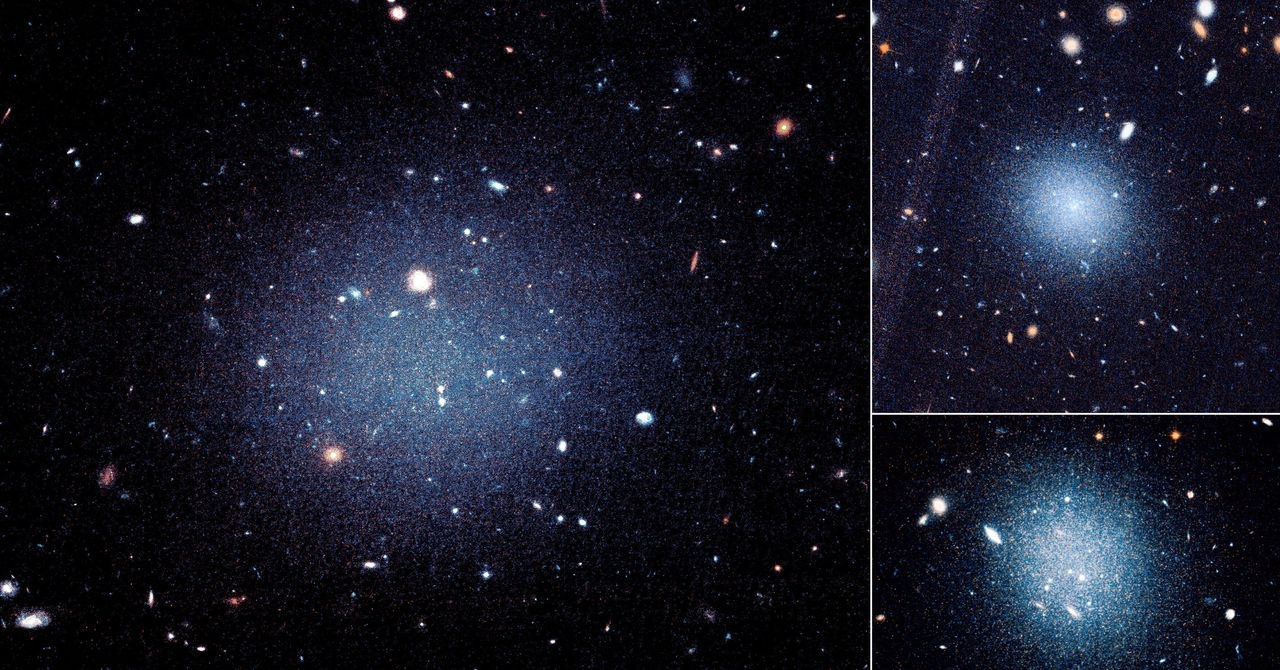
San Jose State University astronomer Aaron Romanowsky likened the event to two jousting knights colliding head-on, where the riders and lances fall into a heap while their horses keep running at full speed. That separation left behind DF2, DF4, and DF9 as orphaned systems of ordinary matter struggling to form stars. The resulting objects drifted along the path of the collision as sparse, dimly lit galactic remnants.
University of California, Irvine particle physicist Daniel Whiteson called the collision explanation very convincing. Because dark matter interacts only through gravity, it escaped the wreckage while normal matter remained trapped behind. The physical segregation explains why the three dwarf systems contain only a pittance of ordinary matter and almost no dark matter halo.
Advertisement
Tech Pulse Daily
Get tomorrow's pulse first
Join engineers who read Tech Pulse before stand-up. Free, weekday mornings.
03Physical matter candidates and the Bullet Cluster
Dark matter accounts for roughly 27 percent of the universe and 85 percent of all cosmic matter, acting as the invisible glue holding spinning galaxies together. Astronomer Fritz Zwicky formally proposed the substance in the 1930s, and Vera Rubin expanded the model during the 1970s. Suspected particle candidates include weakly interacting massive particles, stealthy neutrinos, and primordial black holes as old as the cosmos and small as individual atoms.
University College London physicist Chamkaur Ghag explained that galaxies cannot evolve without dark matter providing the gravitational pull necessary to condense gas and keep stars from flying into space. Dark matter also bends background light through gravitational lensing, confirming its presence across large structures. The stripped galaxies demonstrate that normal baryonic matter can exist independently when separated by catastrophic events.
The separation in the triplet mirrors the dynamics of the Bullet Cluster located 3.8 billion light-years from Earth. Recent observations from the James Webb Space Telescope revealed that an ancient cluster collision separated hot intracluster gas from dark matter mass. In both cases, the distinct physical displacement confirms that dark matter behaves as real matter rather than an illusion.
04Environmental stripping and missing debris debate
Not all researchers endorse the two-galaxy collision model as the definitive explanation for the trio. Theoretical astrophysicist Kinwah Wu of University College London noted that DF2, DF4, and DF9 do not exhibit the fluid, wispy tidal debris typical of major galactic wrecks. Wu suggested instead that the three systems lost their dark matter while traveling through an outsize group of massive galaxies that stripped their halos away.
Case Western Reserve University astronomer Stacy McGaugh, a longtime proponent of modified gravity, expressed skepticism regarding the proposed genesis. McGaugh noted that while an ancient collision is plausible, it represents an exceptional and unproven origin mechanism. Without definitive confirmation of how the galaxies formed, McGaugh cautioned that scientists cannot conclusively determine what these systems reveal about the underlying nature of dark matter.
05Modified Newtonian dynamics and gravitational tweaks
The discovery poses a major hurdle for modified Newtonian dynamics, or MOND, an alternative framework proposed in 1983 by physicist Mordehai Milgrom. MOND suggests that visible matter alone exists, but that gravity operates more strongly across extreme distances where gravitational pulls become exceptionally weak. That adjustment explains the rotational speeds of normal galaxies without requiring vast halos of undiscovered particles.
Under modified gravity theories, every galaxy containing a given quantity of stars should produce identical gravitational acceleration. Keim emphasized that DF2, DF4, and DF9 disprove this prediction because their slow stellar motions demonstrate that their gravity remains extraordinarily weak. If gravity were universally modified, these systems could not shed their gravitational strength while retaining ordinary matter.
Balaji noted the irony that the absence of dark matter in these three galaxies provides some of the most compelling evidence yet that dark matter exists as a physical entity. By showing that visible matter and dark matter can be physically partitioned, the findings validate foundational cosmological models. The ghostly systems confirm that invisible particles, rather than revised gravitational laws, govern galactic architecture.
These ‘Ghostly’ Galaxies Have Lost Their Dark FAQ
What are galaxies DF2, DF4, and DF9?
They are three diffuse galaxies located approximately 65 million light-years from Earth that lack normal amounts of dark matter. DF2 spans the size of the Milky Way with 200 times fewer stars, while DF9 contains the mass of roughly 100 million suns accounted for by ordinary matter alone.
How did DF2, DF4, and DF9 lose their dark matter?
A study in The Astrophysical Journal suggests two regular galaxies collided, causing ordinary gas to clump into new galaxies while frictionless dark matter passed straight through. An alternative theory suggests the trio lost its dark matter after flying through a massive group of surrounding galaxies.
Why do these galaxies challenge modified gravity theories like MOND?
Modified Newtonian dynamics asserts that gravity behaves differently at weak thresholds rather than requiring invisible matter. Because DF2, DF4, and DF9 lack the expected gravitational boost despite having visible stars, they prove that dark matter is a detachable physical substance rather than a universal property of gravity.
What are the primary candidates for dark matter particles?
Leading candidates proposed since the work of Fritz Zwicky and Vera Rubin include weakly interacting massive particles, stealthy neutrinos, and atomic-sized primordial black holes formed during the early universe.
Sources

Author
Dillip Chowdary
Writes Tech Bytes coverage of AI, engineering, and the tools that actually ship. Editor of Tech Pulse Daily.
Related on Tech Bytes
Advertisement