These Robotic Arms Are Powered by Algae. Watch How They Move
TU Delft researchers built soft robotic arms colonized by photosynthetic algae that flex when exposed to light, lifting small objects without batteries.
By Dillip Chowdary • Nov 09, 2026 • Source: Wired

Delft University of Technology researchers in the Netherlands have developed soft robotic bioactuators powered entirely by living algae, creating flexible artificial limbs that move without motors, wires, or batteries. As reported in Wired's report, the miniature arms measure about three-quarters of an inch long and are as thick as a credit card. Led by Marie-Eve Aubin-Tam at TU Delft, the engineering team layered photosynthetic microalgae onto responsive hydrogel sheets, allowing the living cells to convert light into mechanical motion and deliberate gripping actions.
This report examines how photosynthetic cellular metabolism drives hydrogel expansion, the physical dimensions and gripping dexterity of the prototypes, and operational trade-offs between chemical responsiveness and slow actuation speeds. Roboticists, biomaterials researchers, and automation engineers developing low-power environmental monitoring or delicate biological handling systems can examine how living bioactuators eliminate external wiring. The following sections detail chemical mechanisms from laboratory trials, compare localized reactions to fluid-immersion methods, evaluate multi-fingered grippers, and assess deployment requirements for self-sustaining machines in aquatic and agricultural settings.
These Robotic Arms Are Powered by Algae: what actually changed
Standard soft robotics systems rely on external energy sources like electricity, pneumatic air pressure, heat, or surrounding fluid baths to generate movement. The TU Delft bioactuator replaces external mechanical infrastructure by colonizing living microalgae directly across the surface of a flexible hydrogel strip. Rather than modifying the chemical properties of an entire surrounding fluid container to trigger movement, the Dutch team showed that surface microbes can alter their localized chemical boundary layer. The resulting composite acts as an autonomous mechanical arm powered purely by cellular photosynthesis.
Following an initial proof of concept, researchers built several gripping devices to test physical manipulation. One device was a four-fingered gripper that curled inward under light exposure, grasping and lifting a hollow metal sphere before releasing it when light was shut off. Another design featured a hook-shaped arm that picked up and deposited a rubber ring. Although both test objects weighed far less than a small paperclip, the experiments proved that passive cellular metabolism generates sufficient mechanical force to grasp objects with fine dexterity.
These Robotic Arms Are Powered by Algae: how it works
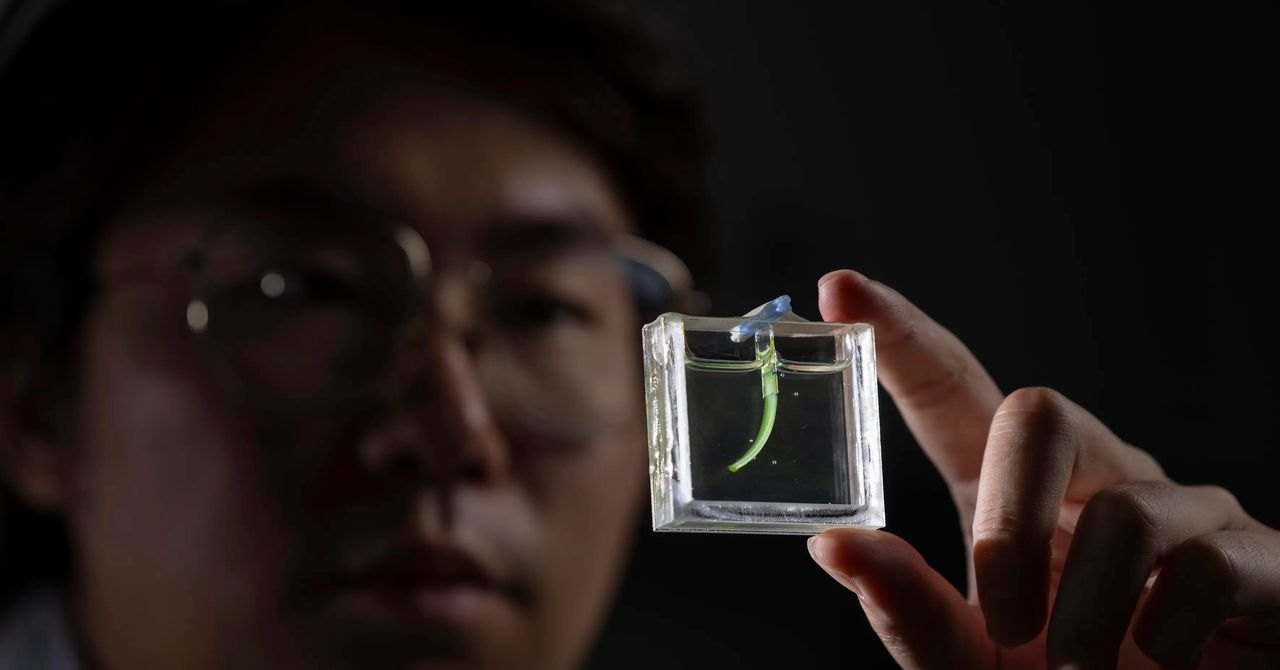
Motion relies on the biological activity of algae living across a bilayer hydrogel structure. One hydrogel layer swells or shrinks as acidity shifts, while the second layer remains stable. When illuminated, the algae photosynthesize, absorbing carbon dioxide and fixing nitrogen from their local surroundings. This metabolic process drives local pH toward basic conditions, causing the responsive hydrogel layer to expand. In acidic conditions between pH 3 and 7, this layer weighed approximately 37 percent of its original mass, but swelled to quadruple its original weight at pH 11.
When illumination ceases, the biological reaction reverses. In the dark, the microalgae stop photosynthesizing and switch to respiration, releasing carbon dioxide that lowers local pH back toward acidic levels. This acidification causes the responsive hydrogel to shrink, bending the arm in the opposite direction. While chemical shifts begin rapidly, starting twenty seconds after light appears and ten seconds after darkness falls, mechanical deformation is slow. It takes several hours for the hydrogel layer to bend the arm to its full mechanical reach.
Advertisement
Tech Pulse Daily
Get tomorrow's pulse first
Join engineers who read Tech Pulse before stand-up. Free, weekday mornings.
These Robotic Arms Are Powered by Algae: why it matters
Previous soft robotic systems that relied on pH variations required researchers to alter the chemical composition of the entire surrounding liquid bath. In contrast, the algae-driven actuator restricts chemical changes entirely to its immediate surface. Because metabolic activity alters pH only within the microscale boundary layer touching the hydrogel, the surrounding environment remains unaffected. This localized mechanism makes the technology suitable for delicate operational environments where changing ambient liquid chemistry would contaminate surrounding water, harm adjacent living organisms, or spoil chemical solutions being analyzed in microfluidic channels.
The bioactuator architecture also operates without external electricity or complex mechanical gears. As Aubin-Tam pointed out, microalgae are plantlike organisms that are largely self-sustaining, giving the actuator potential for long-term operation with minimal external input. Since the system requires only sunlight and ambient carbon dioxide to function, it consumes very little operating energy. Additionally, because the microalgae require no genetic modification, the robots eliminate the biosafety hazards often associated with synthetic biology, functioning as inherently eco-friendly machines that capture carbon dioxide while generating mechanical work.
These Robotic Arms Are Powered by Algae: who is affected
Engineers working on microfluidic platforms and lab-on-a-chip hardware can apply living bioactuators to regulate fluid flows without integrating motors, electronic switches, or external wiring. Because the actuators measure three-quarters of an inch in length and match credit-card thickness, they fit directly into compact analytical chambers. Medical instrument designers seeking soft handling tools for delicate tissues also benefit from actuators that grip without rigid mechanical pinch points. Similarly, researchers developing wearable technology or artificial muscles gain a functional blueprint for producing physical movement powered purely by biological cell reactions.
Agricultural equipment designers and marine robotics teams operating in open aquatic environments are also directly impacted. Autonomous equipment working in wet farm fields or waterways faces power limitations and risks leaking lubricants or battery acid into delicate soil. Because algal bioactuators require only light and natural moisture, they offer a pathway toward self-sustaining agricultural devices and aquatic sampling tools that operate autonomously across daylight cycles. By combining biodegradable hydrogels with wild-type microalgae, field teams can deploy mechanical sensors and flow regulators that operate over extended periods without leaving electronic waste behind.
These Robotic Arms Are Powered by Algae: what to watch
The primary engineering challenge facing the TU Delft actuators is operational speed. Even though chemical reactions initiate within ten seconds of darkness and twenty seconds of illumination, driving full mechanical deflection requires several hours of hydrogel swelling. Materials researchers will be tracking whether modified hydrogel compositions or denser algal cultures can accelerate liquid diffusion and shorten actuation times. Until response rates improve, practical applications remain focused on slow, cyclical tasks like opening day-and-night fluid valves, agricultural dosing, or passive underwater monitors that align with multi-hour solar cycles.
Researchers will also monitor payload capacity and long-term biological survival outside sterile laboratory settings. The experimental arms successfully manipulated rubber rings and hollow spheres weighing less than a paperclip, but practical field robots must exert greater force to manipulate heavier tools or sensors. Furthermore, scientists must confirm how long algae colonies remain viable across fluctuating outdoor temperatures, nutrient scarcity, and microbial competition. Demonstrating that living algae survive and generate motion over months in uncontrolled water bodies will determine whether bioactuators transition from academic prototypes into durable field hardware.
Developer Action Items
- ☐ Verify the claim on the official These Robotic Arms Powered page (or Wired), not from this recap alone.
- ☐ Name the surface that moved — API, policy, model, hardware, or commercial terms — before you Slack the thread.
- ☐ Assign one owner a day to read the primary material and decide: this-sprint, this-quarter, or noise.
- ☐ Do not change production on day-one coverage. Watch the vendor changelog and one independent write-up first.
These Robotic Arms Are Powered by Algae FAQ
How do the algae-powered robotic arms move?
The arms use a bilayer hydrogel seeded with microalgae that photosynthesize under light, absorbing carbon dioxide to raise local pH and cause the responsive hydrogel layer to swell and bend.
How quickly do the biological actuators respond to light?
Chemical shifts begin within twenty seconds of light exposure and ten seconds of darkness, but full mechanical bending of the hydrogel takes several hours.
What items were the experimental robotic grippers able to lift?
Prototype grippers picked up a hollow metal sphere and a rubber ring, successfully manipulating objects that weigh less than a standard small paperclip.
Do the algae require genetic modification or batteries?
No, the actuators use unmodified microalgae that harvest solar energy and ambient carbon dioxide, eliminating electrical wiring, battery packs, and biosafety risks.
Sources

Author
Dillip Chowdary
Writes Tech Bytes coverage of AI, engineering, and the tools that actually ship. Editor of Tech Pulse Daily.
Related on Tech Bytes
Advertisement