This AI Tamagotchi Turns Everyday Objects Into Needy Virtual Pets
Carnegie Mellon researcher Daehwa Kim built $20 E Ink micro-agent modules that use Google Gemini sprites to turn ordinary household items into virtual pets.
By Dillip Chowdary • Nov 15, 2026 • Source: Wired
Daehwa Kim, a doctoral researcher at Carnegie Mellon University, developed Object Agent Twins to give household items expressive digital personalities. Detailed in Wired's report, the project pairs physical objects with small electronic ink screens and environmental sensors. Kim presented the system at the ACM Symposium on User Interface Software and Technology in Detroit, earning two Honorable Mention awards.
This article examines the hardware architecture, sensor options, software setup, field deployments, and design limitations of the prototype system. It is written for engineers and product builders evaluating physical agent interfaces and ambient computing hardware. The analysis details exact component costs, runtime constraints, and behavioral patterns observed during user testing.
01Micro-Agent Twins on Electronic Ink Displays
The system adapts the virtual pet dynamics of nineties Tamagotchi toys to everyday household objects. Kim designed the micro-agent avatars to counter the endless smartphone screen gazing required by modern mobile artificial intelligence. Attaching visual agents directly to physical possessions shifts software interaction directly into real-world environments.
Consumer tech companies continue searching for alternatives to smartphones, including failed attempts like the Humane Ai Pin. Other efforts include an upcoming OpenAI device created with Jony Ive and Meta's pocket-sized Muse Charm gadget launching in December. Unlike those ventures, this research project relies on approachable visual cuteness to encourage adoption.
While observers have encouraged Kim to sell consumer kits online, she has not decided whether to commercialize the project. The prototype remains an academic exploration into whether emotional attachment to physical items can improve personal habits. The tiny electronic ink avatars provide immediate feedback without intrusive mobile notifications.
02Twenty Dollar Hardware and Gemini Generation
The primary module carries a hardware cost of roughly twenty dollars and pairs an electronic ink display with environmental sensors. Onboard and external sensors track physical moisture, temperature, humidity, light, motion, and human occupancy. These continuous physical readings enable the attached screen to monitor environmental conditions and user handling in real time.
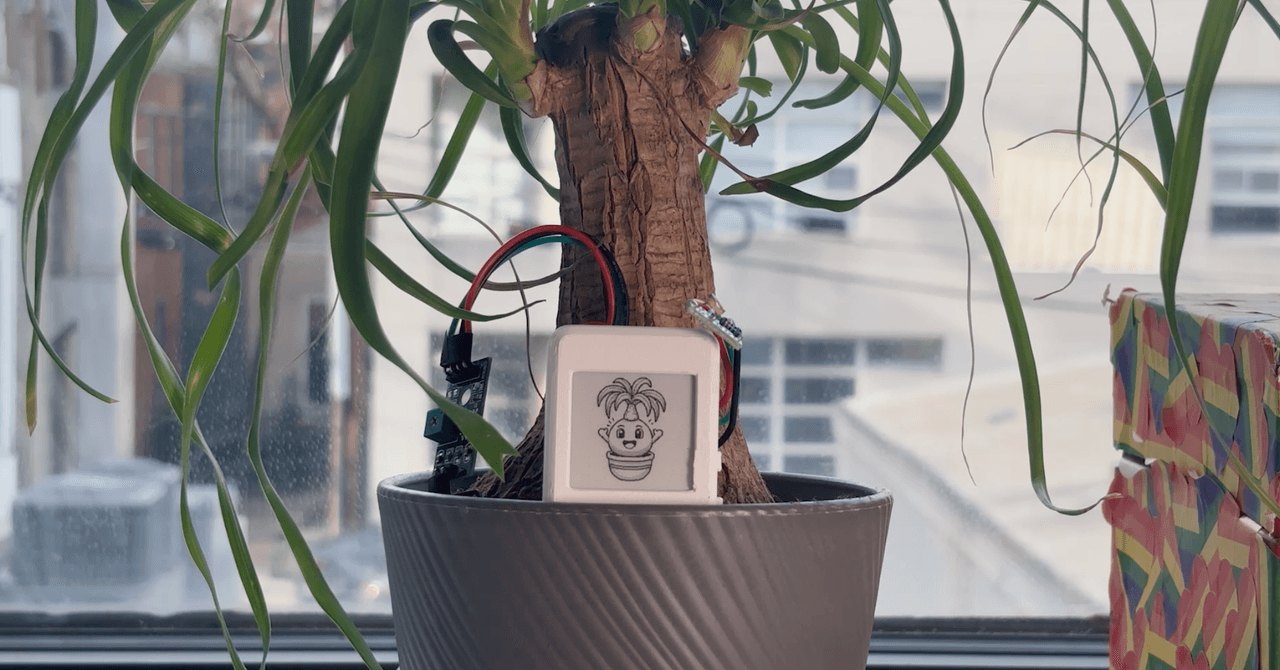
Visual avatar sprites are created through Google Gemini's Nano Banana image-generation service, producing distinct expressions for different sensor states. Users configure each module through a web portal where they name their agent and select sensors. The setup interface allows owners to customize behavioral reactions for specific household objects.
The web application generates positive and negative behaviors derived from the object's assigned name and description. For example, a houseplant module can interpret steady temperatures and low humidity as positive conditions for arid plants. Users can refine these automated rules to suit the exact requirements of their items.
Advertisement
Tech Pulse Daily
Get tomorrow's pulse first
Join engineers who read Tech Pulse before stand-up. Free, weekday mornings.
03Lithium Polymer Battery and Sensor Constraints
Power constraints represent the main technical hurdle of the current prototype, reinforcing its status as an experimental proof of concept. Each module houses an internal lithium-ion polymer battery charged through a standard USB-C port. While the electronic ink panel draws minimal current, ongoing sensor polling steadily depletes the compact cell.
Standard sensor setups achieve approximately three to four days of continuous runtime on a full charge. Connecting a sound level sensor reduces operating battery life down to a single day. This rapid drain highlights the trade-offs between continuous audio monitoring and battery life in small ambient devices.
The compact form factor requires regular charging to maintain habit-nudging prompts on household gear. If an attached skateboard detects no motion across multiple days, the avatar looks sad and lonely to prompt exercise. Once the user rides the board, the motion sensor registers movement and immediately displays happy expressions.
04Three Operational Modes Across Real Deployments
Across field deployments with study participants, Kim identified three primary usage models for the sensor-equipped screens. The first model indicates active operation, where appliances show excitement when running, such as a coffee machine grinding beans. The second model delivers safety warnings, such as mounting a module on a three-dimensional printer to signal toxic fumes during fabrication.
The third deployment pattern focuses on personal habit tracking through emotional accountability. One participant attached a unit to a dumbbell, logging strength workouts so the avatar stayed content rather than ignored. Tying workout frequency to an expressive virtual companion motivated regular exercise routines.
At the Detroit symposium, Kim hosted a design competition inviting attendees to propose novel object pairings. The project website hosts a gallery of community creations, featuring an animated conference badge and a panda avatar made for an Owala water bottle. These designs demonstrated how participants quickly adapted avatars to personal possessions.
05Anthropomorphic Boundaries and Behavioral Interface Ethics
The symposium demonstration provoked debate among interface researchers regarding the ethical consequences of anthropomorphizing artificial intelligence tools. Mainstream AI products frequently adopt human terminology, such as chatbot hallucinations or Anthropic's summer introduction of background memory cleanup described as dreaming. Critics warn that projecting human traits onto software can distort moral judgments and inflate user trust.
To prevent over-trust, Kim intentionally confined the modules to non-verbal emotional expressions shown on low-power screens. The hardware excludes voice assistants or interactive dialogue systems that might simulate conscious thought. The design deliberately isolates user interaction to simple visual cues driven entirely by objective sensor measurements.
Kim noted that while people frequently name their cars and bicycles, almost no one names their smartphone. The researcher argued that anthropomorphism can effectively motivate positive habit changes when applied carefully. However, future ambient interfaces must incorporate thoughtful boundaries to avoid exploiting emotional bonds between users and autonomous systems.
This AI Tamagotchi Turns Everyday Objects FAQ
What are Object Agent Twins?
Object Agent Twins, or OATs, are micro-agent artificial intelligence avatars shown on small electronic ink screens mounted to everyday physical items. Created by Carnegie Mellon doctoral researcher Daehwa Kim, the devices monitor onboard sensor data to express the state of an object using dynamic visual emotions.
How much does an OATs module cost and what sensors does it support?
The main hardware unit costs around twenty dollars and connects an electronic ink screen to a lithium-ion polymer battery. Supported sensors monitor environmental moisture, temperature, humidity, ambient light, motion, human occupancy, and sound levels.
What software generates the digital pet expressions?
The visual sprite states are generated with Google Gemini's Nano Banana image-generation tool. Owners map emotional states through a web setup dashboard that builds automated positive and negative triggers based on an object's name and description.
What is the battery runtime of the hardware?
Standard sensor configurations run for three to four days between charges over USB-C. Enabling continuous acoustic tracking with a sound level sensor drops operating battery life to approximately one day.
Sources

Author
Dillip Chowdary
Writes Tech Bytes coverage of AI, engineering, and the tools that actually ship. Editor of Tech Pulse Daily.
Related on Tech Bytes
Advertisement