This startup’s self-driving excavators help dig up $600 million in new
Bedrock Robotics raised $600 million at a $4.1 billion valuation to deploy autonomous excavator retrofit kits across commercial civil construction sites.
By Dillip Chowdary • Oct 26, 2026 • Source: TechCrunch
Bedrock Robotics secured $600 million in a Series C financing round that values the autonomous construction vehicle startup at $4.1 billion, as detailed in TechCrunch's report. The capital infusion arrives two months after the company moved its self-driving excavators beyond research pilots and into active commercial operations on active job sites. Founded in 2024 by autonomous vehicle veterans from Waymo, Anki, Segment, and Twilio, the two-year-old firm has now accumulated nearly $1 billion in total funding to address severe labor deficits across the heavy civil construction sector.
This coverage examines Bedrock Robotics' retrofit system architecture, commercial field footprints, operational benchmarks, and expanding contractor deployments for infrastructure builders. General contractors, civil engineers, and heavy equipment project directors will find operational requirements, retrofit specifications, workforce retirement statistics from the Associated Builders and Contractors, and deployment timelines across commercial earthwork, wastewater, and advanced industrial facilities.
What This startup’s self-driving excavators help shipped
Bedrock Robotics shipped an autonomous driving retrofit kit designed specifically for worksite excavators and heavy industrial machinery. The physical conversion package mounts directly onto existing commercial construction vehicles, turning conventional hydraulic excavators into machines capable of autonomous trenching, digging, and earth-moving without continuous manual cabin operation. The underlying software platform integrates directly with project civil blueprints and digital terrain models, allowing the automated machinery to execute earthwork maneuvers alongside existing human workers and established job site workflows.
Commercial deployments of the hardware-and-software kit are already operating across multiple active infrastructure sites across the United States. Active machines are digging at a municipal water treatment facility in Nevada, executing site preparation tasks for Champion Site Prep in Texas, and handling a 1.2 million-cubic-yard civil sitework contract with Zachry Construction Corporation. Co-founder and chief executive officer Boris Sofman confirmed that the company has transitioned from closed testing into verifiable job site production, delivering dependable machine cycles into active construction environments.
What changed for builders in This startup’s self-driving excavators help
For project developers and infrastructure contractors, the autonomous retrofits offer an immediate countermeasure to compounding labor shortages across the heavy equipment trades. Operating a heavy excavator requires five years or more of dedicated training to reach master-level proficiency. At the same time, data from the Associated Builders and Contractors indicates that over 40% of the active construction workforce will reach retirement age within the next five years, creating a structural shortage of qualified heavy machinery operators that traditional trade recruitment cannot balance.
| Metric | Prior Fleet State | Bedrock Autonomous Deployment |
|---|---|---|
| Site Operator Requirement | Dedicated in-cab master operator | Retrofitted autonomous vehicle system |
| Operator Training Horizon | 5+ years to achieve mastery | Direct software site integration |
| Industry Labor Gap | 40% workforce retiring in 5 years | Machine-level automated excavation |
| Deployment Footprint | Pilot testing and closed proving grounds | Active 1.2M cubic-yard civil projects |
| Total Capital Backing | Seed and early venture rounds | $600M Series C ($1B cumulative) |
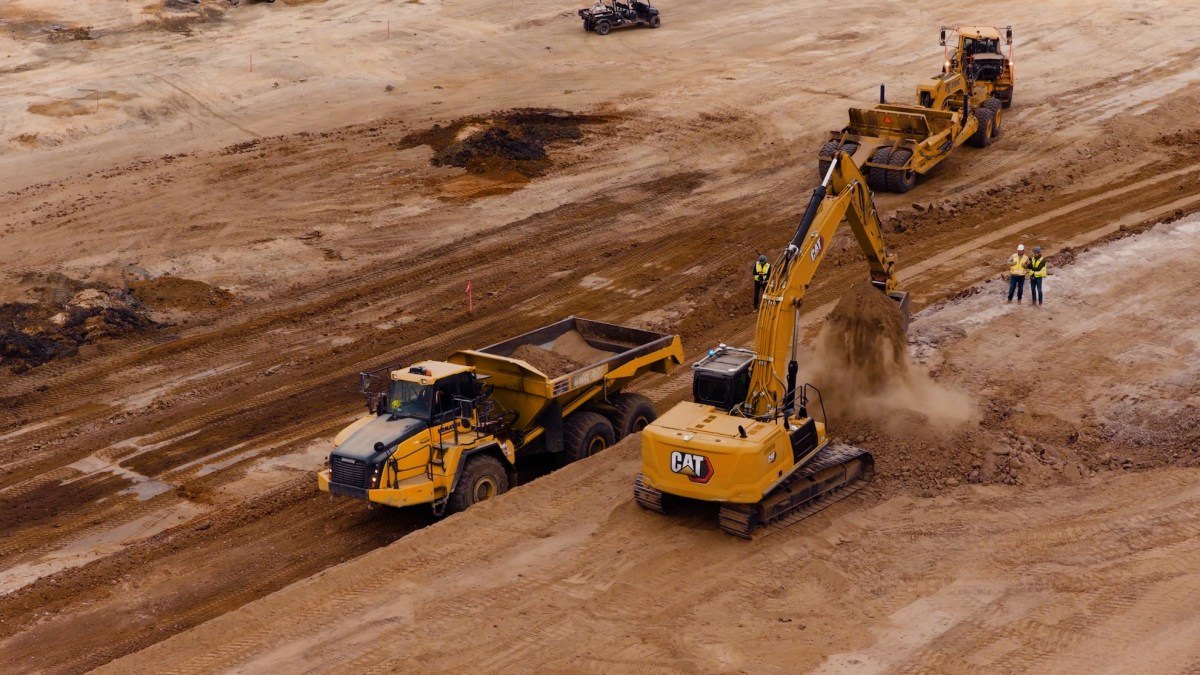
By implementing machine-level autonomy, contractors can maintain continuous operational uptime on massive civil earthmoving projects without halting machinery during workforce transitions. General contractor Haydon, the startup's newest commercial partner based in Arizona, is integrating the retrofitted machines across its core project portfolio. These operational rollouts encompass advanced semiconductor manufacturing facilities, water and wastewater treatment plants, hyperscale data centers, and regional healthcare construction facilities where strict schedule compliance remains paramount.
How to install or upgrade This startup’s self-driving excavators help
Advertisement
Tech Pulse Daily
Get tomorrow's pulse first
Join engineers who read Tech Pulse before stand-up. Free, weekday mornings.
Contractors onboard Bedrock systems by mounting the dedicated retrofit sensor and compute enclosure onto standard worksite machinery rather than purchasing proprietary vehicle chassis. Field integration engineers calibrate the kit’s sensor clusters, perception pipeline, and vehicle control actuation interfaces directly to the host machine's hydraulic manifolds. Fleet operators interface with the underlying dispatch platform through standardized operational terminal commands to commission kits, switch guidance models, and set persistent autonomy baselines across site networks:
bedrock-fleet update --channel commercial-stableTo configure specific operational parameters, load project grading profiles, or lock the automated excavator to a targeted civil site plan, job managers dispatch runtime commands through the fleet controller interface:
bedrock-fleet control --unit excavator-04 --set-profile civil-sitework-deepSite systems engineers running persistent dispatch operations can also launch local supervisor sessions pinned to specific firmware configurations or establish site-wide operational defaults:
bedrock-fleet run --profile mass-excavation --site-id zachry-nv-01 --supervisor local
bedrock-fleet config set-default --profile wastewater-treatment --pin-safety true
Gotchas and compatibility in This startup’s self-driving excavators help
Integrating autonomous excavators introduces precise operational boundaries that general contractors must accommodate before field commissioning. The technology relies on a retrofit kit applied to existing heavy equipment, requiring mechanical compatibility with the target machine's hydraulic interfaces and electrical subsystems. Site layouts must maintain structured coordination between autonomous machinery and manned support vehicles such as haul trucks, ensuring that automated digging zones conform strictly to the digital sitework models provided by project engineers.
Regulatory compliance and legal oversight also represent critical considerations as automated heavy equipment scales on active projects. To navigate worksite liability, regulatory structures, and operational safety standards, Bedrock hired Lando Juarez, former head of legal for Uber’s autonomous mobility and delivery business, as general counsel, alongside Amy Jones Satrom, a veteran of Amazon, Nuro, and Uber, as vice president of operations. Contractors must align their safety procedures with automated operational boundaries, ensuring ground personnel understand machine exclusion zones during active trenching cycles.
What to watch after This startup’s self-driving excavators help
Following the $600 million funding round, Bedrock Robotics plans to accelerate hardware deployments to contractors nationwide while scaling field engineering infrastructure to maintain equipment uptime on commercial sites. The Series C investment was co-led by CapitalG and Emergence Capital, with participation from new backers US Innovative Technology Fund, Bessemer Venture Partners, and Temasek. Existing investors 8VC, Georgian, Valor Equity Partners, Xora, Eclipse, Perry Creek Capital, and Nvidia also committed capital to support fleet expansion.
Industry observers should monitor the execution speed of the Haydon partnership as autonomous excavators deploy into high-complexity builds across Arizona, including advanced manufacturing plants and data centers. With leadership drawn from Waymo and consumer robotics pioneers, including chief technology officer Kevin Peterson, vice president of engineering and infrastructure Ajay Gummalla, and hardware vice president Tom Eliaz, Bedrock’s expansion will indicate whether retrofit autonomy can successfully offset retirement cliffs across North American civil construction.
Developer Action Items
- ☐ Map where startup self-driving excavators help sits in your stack (SDK, API key, billing, data-processing addendum).
- ☐ Hold the $600 million figure to the primary report; do not brief a number that is not on the record.
- ☐ Hold non-urgent migrations until the integration or use-of-proceeds roadmap is public — day-one coverage is not a ship signal.
- ☐ If you are mid-contract or mid-POC, ask the vendor what changes for existing customers this quarter.
- ☐ Write the single decision this forces: stay, dual-source, or exit.
This startup’s self-driving excavators help FAQ
How much capital did Bedrock Robotics raise in its Series C round?
Bedrock Robotics raised $600 million in a Series C round co-led by CapitalG and Emergence Capital, bringing its valuation to $4.1 billion and total funding to nearly $1 billion.
Which active construction projects are currently using Bedrock's self-driving excavators?
Bedrock's autonomous excavators operate commercially at a Nevada water treatment facility, an earthwork site for Champion Site Prep in Texas, and a 1.2 million-cubic-yard civil project with Zachry Construction Corporation.
Why is Bedrock Robotics prioritizing autonomous excavators over other vehicles?
Excavator operation requires over five years to master, and the Associated Builders and Contractors estimates that over 40% of the construction workforce will retire within five years, creating a critical operator deficit.
Who are the key executives and founders leading Bedrock Robotics?
The company was founded in 2024 by CEO Boris Sofman, CTO Kevin Peterson, VP of engineering Ajay Gummalla, and hardware VP Tom Eliaz, with recent executive hires including operations VP Amy Jones Satrom and general counsel Lando Juarez.
Sources

Author
Dillip Chowdary
Writes Tech Bytes coverage of AI, engineering, and the tools that actually ship. Editor of Tech Pulse Daily.
Related on Tech Bytes
Advertisement