Uber’s Legal AI Agent Cuts Contract Review Time by 20% with Rules and RAG
Uber deployed an AI legal redlining agent in Microsoft Word, cutting contract review time by over 20% with 91% accuracy using LangGraph and deterministic rules.
By Dillip Chowdary • Nov 16, 2026 • Source: InfoQ
At a glance
- Product
- Legal Redlining Agent
- Developer
- Uber
- Efficiency gain
- Review time reduced by more than 20%
- Decision accuracy
- 91% accuracy on AI recommendations
- Runtime stack
- LangGraph, OpenSearch, and Redis
- Deployment target
- Microsoft Word add-in
Uber has deployed an artificial intelligence assistant called the Legal Redlining Agent to help its corporate legal team review incoming contract revisions, as detailed in InfoQ's report. The software operates directly inside Microsoft Word to identify third-party modifications, assess transactional risks, and recommend responses aligned with corporate policy. The company reports that the integration has reduced average contract review time by more than 20% while sustaining a 91% accuracy rate for automated decisions.
This report examines the underlying engineering architecture, retrieval mechanics, and deterministic safety controls that govern Uber's contract review system. It is written for enterprise engineering leads, legal operations specialists, and software architects designing agentic document workflows. The analysis breaks down how Uber combined retrieval-augmented generation with historical attorney feedback and deterministic rules to assist enterprise lawyers without removing human supervision.
01Microsoft Word add-in for contract redlines
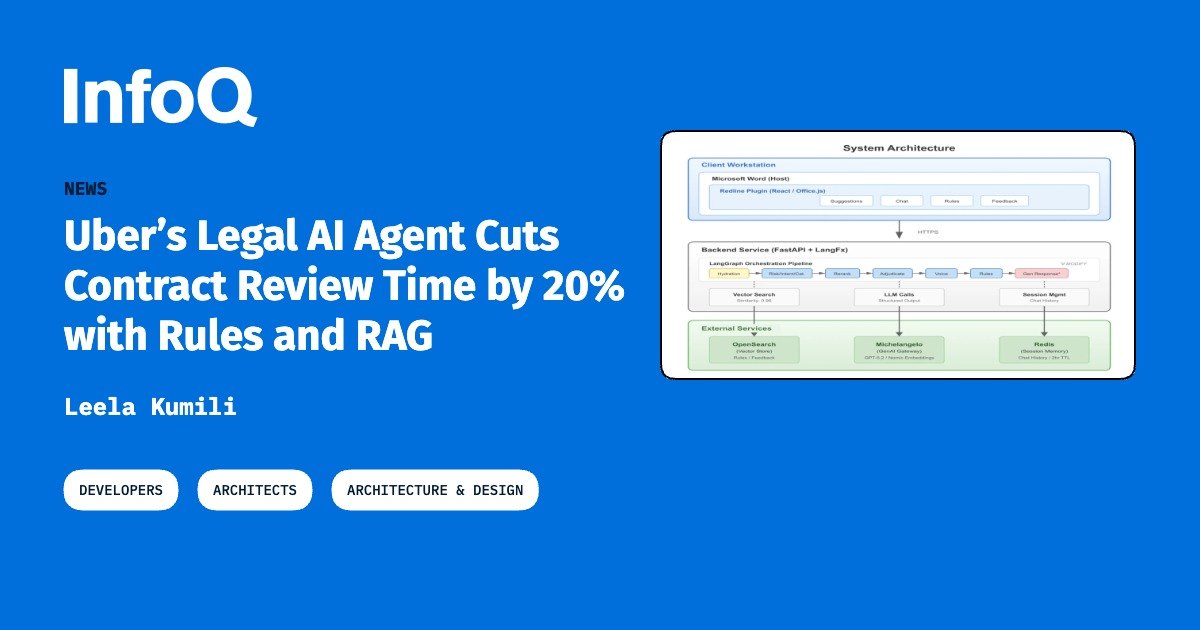
Uber integrated the Legal Redlining Agent directly into Microsoft Word to analyze edits submitted during commercial negotiations. Built as an add-in using React and TypeScript, the tool interprets counterparty intentions, flags contractual risks, and compares edits against corporate standards. It generates explanatory comments to clarify why specific language requires scrutiny while suggesting whether attorneys should accept, reject, or modify disputed terms.
The agent handles incoming contract changes through a structured sequence that moves from diff parsing to clause recommendations:
- Clause intent detection The system identifies redlines proposed by external parties and interprets the commercial intent behind each clause revision.
- Policy standard comparison Algorithms evaluate counterparty modifications against internal legal policies to isolate deviations requiring formal legal review.
- Response and comment generation The platform recommends whether to accept, reject, or modify text while generating contextual guidance for reviewers.
Uber initiated development of the first-generation system in early 2024 and piloted the software across its internal legal team in 2025. Company attorneys retain full responsibility for reviewing, validating, and approving every recommendation before contract language is accepted. This human-in-the-loop deployment ensures that legal counsel maintains oversight while benefiting from faster turnaround times during routine counterparty revisions.
02Playbook retrieval limits and lawyer feedback loops
Uber's initial prototype relied on standard retrieval-augmented generation to pull relevant sections from static legal department playbooks. That baseline configuration struggled to achieve semantic retrieval precision, failed to reproduce acceptable negotiation tones, and could not resolve contract scenarios that lacked explicit documentation. Corporate counsel found that static playbook passages provided insufficient context for nuanced language model evaluations during real negotiations.
To correct these shortcomings, the engineering team introduced a continuous feedback loop that logs lawyer decisions, legal rationales, and finalized clause modifications. Capturing how counsel handled similar contractual clauses replaced simpler metrics that merely recorded whether an automated recommendation was accepted or rejected. This operational data enables the retrieval system to reference real negotiation outcomes rather than abstract guidance.
This feedback design gives legal subject matter experts direct control over corporate negotiation style and drafting vocabulary. Attorneys calibrate the desired tone and legal boundaries, while software engineers maintain prompt templates and execution workflows. This clear separation of responsibilities allows lawyers to adjust model outputs without modifying backend orchestration code.
Advertisement
Tech Pulse Daily
Get tomorrow's pulse first
Join engineers who read Tech Pulse before stand-up. Free, weekday mornings.
03Similarity filtering and exponential decay weighting
The agent searches through thousands of logged legal interactions at runtime using a multi-stage filtering mechanism. An initial pass combines vector similarity matching and metadata filtering to narrow historical records down to approximately twenty candidate examples. A secondary language model then evaluates the relevance of those twenty candidates to ensure only contextually appropriate precedents inform the final response.
Uber incorporates an exponential decay weighting algorithm into the retrieval pipeline to prevent outdated legal decisions from skewing active reviews. The decay calculation currently uses a configurable half-life set to 365 days, giving higher priority to recent negotiations while preserving older examples. This dynamic balance ensures the system respects recent shifts in legal strategy without discarding historical institutional knowledge.
In a post on LinkedIn, Uber Engineering summarized the core architectural problem that guided this multi-stage retrieval design: "How can AI help streamline repetitive contract review while keeping lawyers in control?" Filtering precedents and weighting recent decisions directly addresses that objective by surfacing verified precedents that attorneys can inspect before accepting recommendations.
04LangGraph orchestration and deterministic rules engines
The backend architecture relies on Python services orchestrated with LangGraph to coordinate contract analysis across parallel workflow nodes. Dedicated nodes simultaneously execute intent detection, legal risk assessment, and policy lookup tasks. Vectorized legal rules and historical feedback records are stored in OpenSearch, while Redis caches session state to support multi-turn conversational follow-up questions from reviewing attorneys.
| Architectural layer | Functional scope | System precedence |
|---|---|---|
| Deterministic rules engine | Enforces non-negotiable legal requirements | Overrides model recommendations |
| Language models | Contextual interpretation and negotiation tone | Checked by final verification step |
A deterministic rules engine enforces mandatory legal standards and overrides generative model suggestions whenever an established company policy applies. Language models manage tasks requiring contextual interpretation, including clause recommendations and stylistic tone. A final verification step evaluates all generated responses against retrieved legal rules, ensuring that model outputs remain strictly within institutional boundaries.
05Agentic harness exploration and legal knowledge graphs
Uber is expanding its agentic automation strategy beyond document redlining by evaluating specialized developer harnesses, including Claude Code and OpenCode. The engineering team is pairing these harnesses with modular skills to structure and automate broader enterprise workflows. These initiatives aim to establish consistent execution patterns across autonomous systems operating throughout the company's technical infrastructure.
The engineering organization also plans to investigate legal ontologies and knowledge graphs to build structured semantic representations of contract principles. Mapping explicit relationships between legal terms and contractual clauses will establish a semantic foundation for machine interpretation. This structured knowledge graph approach aims to improve reasoning consistency across varied commercial agreements and minimize ambiguities during contract analysis.
Note: Lawyers retain ultimate authority over contract modifications, and the platform does not accept or apply clause changes autonomously. The system acts as a decision support mechanism, and deterministic policy rules override generative suggestions whenever mandatory compliance constraints are triggered. Uber initially developed the platform in early 2024 before piloting it with internal legal teams in 2025.
Frequently asked questions
What performance improvements does Uber's Legal Redlining Agent deliver?
The tool reduces average contract review time by more than 20% while achieving 91% accuracy in AI-generated decisions. Human attorneys review and approve all proposed changes before they are finalized.
How does the system handle non-negotiable legal policies?
A deterministic rules engine enforces mandatory compliance rules and automatically overrides language model recommendations whenever a matching policy applies. A final verification step also evaluates all generated text against retrieved rules.
What technologies power the Legal Redlining Agent backend?
The backend uses LangGraph to orchestrate parallel workflow nodes for intent detection, risk assessment, and policy lookup. OpenSearch stores vectorized rules and lawyer feedback, while Redis maintains session state.
How does Uber prioritize historical lawyer feedback?
Uber applies an exponential decay algorithm with a configurable half-life currently set to 365 days. This weights recent attorney decisions more heavily while retaining older negotiation precedents.
Sources

Author
Dillip Chowdary
Writes Tech Bytes coverage of AI, engineering, and the tools that actually ship. Editor of Tech Pulse Daily.
Related on Tech Bytes
Advertisement