Uncommon Thinkers: Alexis Harroun aims for space with a new engine —
Juno Propulsion secured NASA and NSF backing to test the first rotating detonation rocket engine in orbit aboard a Momentus spacecraft next year.
By Dillip Chowdary • Nov 14, 2026 • Source: GeekWire Startups

Juno Propulsion is preparing to test the first rotating detonation engine in orbit next year aboard a Momentus satellite under a mission named Project Iris. Founded by Alexis Harroun and CTO Ari Martinez in Tukwila, Washington, the startup is developing detonation-based propulsion systems that replace traditional continuous-flame combustion with supersonic shockwaves, as detailed in GeekWire Startups's report. By extracting significantly more energy from propellants, the engine provides what Harroun describes as a higher-mileage rocket system designed to break through performance limits that have constrained chemical rocketry since the 1930s.
This report examines Juno Propulsion's technical architecture, development trajectory, research partnerships, and market strategy for satellite operators and aerospace engineers. Harroun will be recognized on December 10 at the GeekWire Gala in partnership with Greater Seattle Partners as one of five regional Uncommon Thinkers. With contracts spanning NASA, the National Science Foundation, and private venture investors, the company aims to move rotating detonation engines from academic research benches into active commercial and national security space operations.
01Supersonic combustion waves in orbit
Conventional rocket propulsion burns propellant through a steady deflagration flame inside a combustion chamber. Juno Propulsion replaces this process with rotating detonation, which harnesses a continuous supersonic shockwave that compresses and ignites propellants at higher pressures. This physical mechanism releases more usable energy per unit of mass, effectively shrinking the fuel volume required for orbital missions.
The underlying physics of detonation engines has been researched in laboratory settings for decades without reaching sustained orbital flight. Juno Propulsion intends to bridge that operational gap through Project Iris next year. The mission will evaluate how detonation combustion behaves over repeated firings in the vacuum and microgravity of low Earth orbit.
Successful orbital execution would establish a new propulsion benchmark for satellite mobility. Modern spacecraft operators increasingly require active maneuverability to dodge debris and shift orbits, tasks often limited by heavy fuel requirements. Juno's architecture aims to grant satellites greater maneuverability while dramatically cutting down overall propellant mass.
02Laboratory roots from Washington to Purdue
Harroun grew up in Federal Way, Washington, as the daughter of a physician and a flight instructor, developing an interest in engineering late in high school. While completing her undergraduate studies at the University of Washington, she spent four years conducting research under professor Carl Knowlen at the Aeronautics and Astronautics Department's Detonation Engines Lab and led the propulsion division of the student rocketry team.
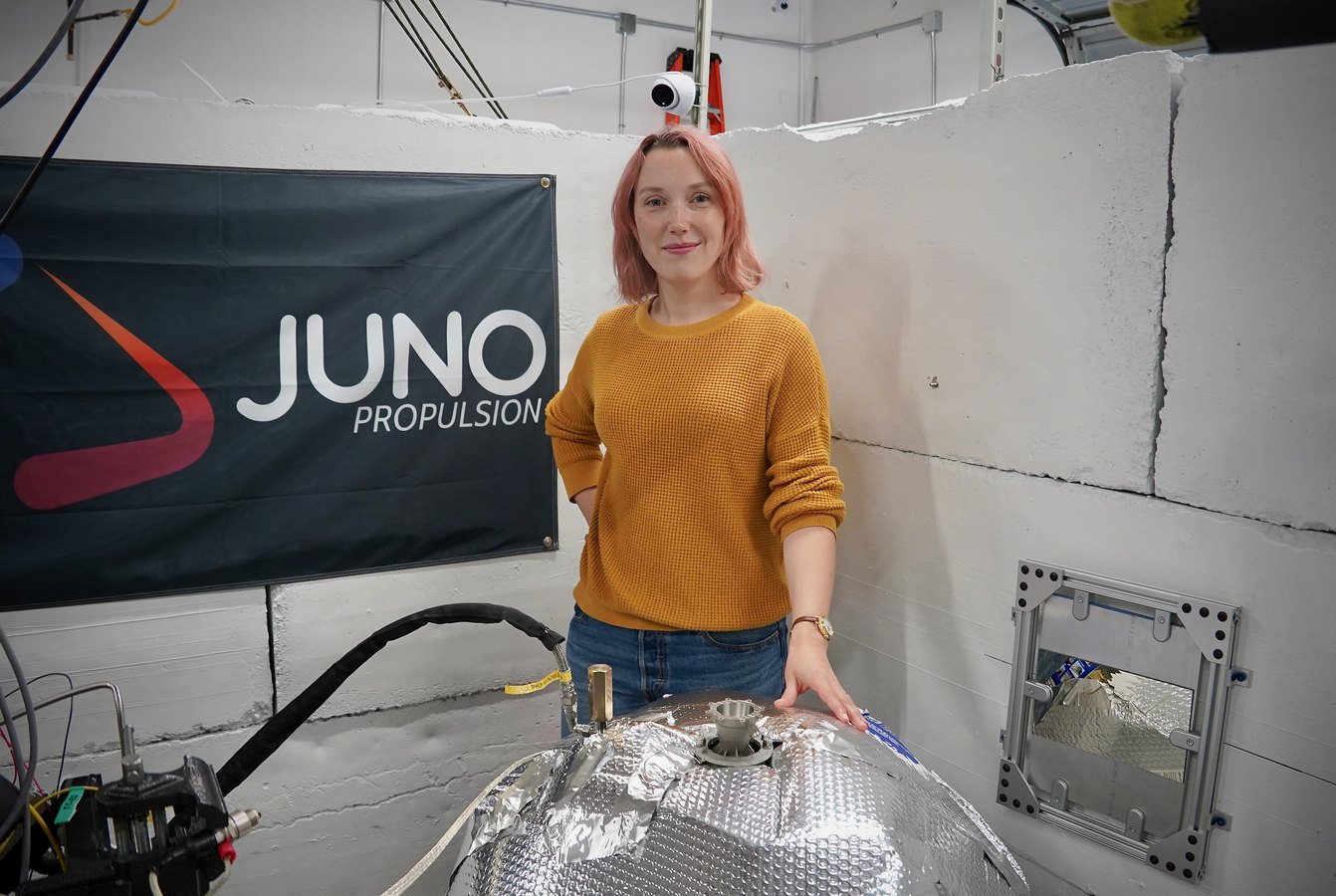
After interning at NASA, Boeing, and Blue Origin in 2016, Harroun moved to Purdue University to pursue graduate studies after noticing that top propulsion engineers shared degrees from the institution. Over six years in West Lafayette, Indiana, she earned a master's degree and a Ph.D. under advisor Stephen Heister, focusing her doctoral research on nozzle flows and complications tied directly to detonation engines.
During her time at Purdue, Harroun shared an office with Martinez, establishing the technical partnership that eventually became Juno Propulsion. Following her doctoral graduation in 2023, Harroun chose not to remain in academia, instead returning to the Seattle area to commercialize the propulsion concepts explored during her graduate research.
Advertisement
Tech Pulse Daily
Get tomorrow's pulse first
Join engineers who read Tech Pulse before stand-up. Free, weekday mornings.
03Capital backing and public research grants
When NASA contacted the startup in July 2025, Juno Propulsion operated out of a one-room office with just Harroun, Martinez, and a single summer intern. NASA awarded the startup roughly $500,000 through its TechLeap program to build the Project Iris payload, while also providing the Momentus spacecraft host and covering launch costs.
Beyond NASA flight support, the company secured a $1.2 million research grant from the National Science Foundation this past summer. That award funds a collaborative technical program alongside Knowlen's research group at the University of Washington, allowing Juno Propulsion to conduct advanced testing using university lab infrastructure.
To fund its transition from initial testing to commercial operations, Juno Propulsion raised a $1.4 million pre-seed venture financing round led by SOSV. Combining venture capital with non-dilutive government grants has enabled the team to mature its flight hardware without taking on early commercial payload delivery risk before Project Iris flies.
04Non-toxic propellants and satellite maneuvering
A core engineering advantage of Juno Propulsion's architecture is its compatibility with non-toxic fuels. Standard satellite propulsion systems frequently rely on toxic propellants such as hydrazine, which require specialized ground-handling procedures, dedicated breathing apparatuses, and strict safety clearances. Harroun noted that handling protocols can sometimes cost satellite operators more than the propulsion hardware itself.
Project Iris will test satellite-style orbital maneuvers using safe propellants aboard the Momentus spacecraft. While the demonstration flight carries no commercial payload, its flight profile is programmed to replicate real-world orbital repositioning and collision-avoidance maneuvers. Proving these capabilities in space provides commercial and defense fleets an alternative to toxic propellant architectures.
Orbital mobility represents a significant shift from historical satellite operational profiles, where spacecraft generally remained in whichever orbital slot their launch vehicles deployed them. By offering higher specific performance on benign propellants, Juno aims to give satellite operators the freedom to change inclinations, raise altitudes, or perform evasive maneuvers without carrying prohibitive propellant mass.
05Long-term manufacturing and engine scaling
Harroun positions Juno Propulsion to become a foundational domestic rocket engine supplier, drawing comparisons to Rocketdyne, the historic propulsion contractor that powered the Saturn V and the Space Shuttle before folding into L3Harris. Although Japan's space agency has previously flown rotating detonation engines on suborbital research sounding rockets, putting an operational engine into orbit presents far stricter thermal, structural, and endurance hurdles.
The startup plans to expand outward from small satellite thrusters into larger space mobility platforms. Following the Project Iris flight test, Juno intends to develop larger engines tailored for orbital transfer vehicles, rocket upper stages, and ultimately first-stage launch vehicle boosters capable of lifting payloads directly off the launch pad.
Returning to Washington state has allowed Juno Propulsion to recruit from a dense concentration of aerospace talent established by regional aerospace employers. By tapping local suppliers and collaborating directly with university research groups, the company is assembling the hardware and manufacturing pipeline required to scale detonation propulsion across commercial and defense aerospace markets.
Uncommon Thinkers FAQ
What is Juno Propulsion testing in orbit next year?
Juno Propulsion is flying a rotating detonation rocket engine aboard a Momentus satellite in a demonstration mission called Project Iris.
How does a rotating detonation engine differ from traditional rocket engines?
Instead of burning propellants in a continuous flame, it utilizes supersonic combustion detonation waves to generate higher pressure and extract more energy from the same mass of propellant.
How much funding has Juno Propulsion secured for its technology?
The company raised a $1.4 million pre-seed round led by SOSV, received approximately $500,000 from NASA's TechLeap program along with launch support, and won a $1.2 million grant from the National Science Foundation.
Who founded Juno Propulsion and where is the company based?
The company was founded in Tukwila, Washington, by CEO Alexis Harroun and CTO Ari Martinez, who both conducted advanced propulsion research at Purdue University.
Sources

Author
Dillip Chowdary
Writes Tech Bytes coverage of AI, engineering, and the tools that actually ship. Editor of Tech Pulse Daily.
Related on Tech Bytes
Advertisement