Understanding Positional Embeddings in Modern LLMs
Sebastian Raschka analyzed positional embeddings across 2026 open-weight LLMs, contrasting GPT-2 absolute vectors with MiniMax-M3 rotary attention mechanisms.
By Dillip Chowdary • Nov 15, 2026 • Source: magazine.sebastianraschka.com
Sebastian Raschka published a technical architectural breakdown dissecting how modern large language models represent token order across classic and contemporary transformer designs, according to magazine.sebastianraschka.com's report. The analysis traces the transition from learned absolute position tables to relative positional formulations like Rotary Position Embedding inside attention blocks, alongside methods that modify or omit explicit encodings altogether. Drawing on visual workflows, mathematical formulations, and PyTorch implementations, the study benchmarks positional strategies across 2026 open-weight model releases.
This report evaluates how token positions enter modern architectures, examining why autoregressive sequence modeling requires spatial coordinate signals beyond standard vocabulary lookups. It provides machine learning engineers and transformer practitioners with an architectural comparison between baseline systems like GPT-2 and recent models such as MiniMax-M3. Readers gain an operational breakdown of embedding additions, causal mask dynamics, absolute vector lookups, and attention-level positional transformations.
01Token embedding pathways and transformer blocks
Text processing in language models begins when a tokenizer maps input text into discrete integer token IDs. An input token embedding layer then transforms each ID into a dense vector of numerical feature entries. In baseline models like GPT-2, an absolute positional vector matches this feature dimension and merges directly into the token embedding before entering the first transformer block.
Modern architectures adjust this pipeline by deferring or distributing spatial computations across subsequent stages. In recent models such as MiniMax-M3, which features 60 feedforward layers with dense layers across its initial three stages, positional data is integrated within individual transformer blocks via Rotary Position Embedding. This design applies spatial modifications inside attention mechanisms rather than relying on a single static pre-attention addition.
02Token order mechanics and permutation limits
Positional signals resolve spatial ambiguity across identical tokens within varying syntactic configurations. For instance, swapping words between phrases like the red fox jumps over the gray fox alters which animal performs the action despite sharing identical vocabulary entries. Without explicit position signals or directional constraints, standard self-attention produces identical embeddings and pairwise attention scores regardless of word order.
In a vocabulary indexing words from position 0 through 7, duplicate tokens such as fox map to identical token IDs and identical base embeddings. An unconstrained self-attention block treats these vectors symmetrically, making permuted sequences mathematically indistinguishable. Explicit position layers ensure that token representations diverge based on their precise index in the sequence.
Advertisement
Tech Pulse Daily
Get tomorrow's pulse first
Join engineers who read Tech Pulse before stand-up. Free, weekday mornings.
03Causal attention masks and implicit ordering
Standard autoregressive large language models enforce sequence directionality through causal masking, which restricts each token to attending exclusively to itself and prior tokens. In the toy sentence example, this mechanism allows jumps to attend to red in the first phrasing and gray in the second. As a result, causal masking alone provides an implicit order signal that enables models to separate token sequences without explicit coordinate tags.
This implicit mechanism forms the foundation for architectures exploring NoPE, or No Positional Embeddings. However, standard causal masks cannot differentiate relative distances between tokens, treating an adjacent token identically to one separated by ten positions. Consequently, leading modern architectures maintain explicit positional techniques to provide attention heads with precise relative distance signals.
04Absolute learned tables in classic architectures
Classic architectures like GPT-2 incorporate explicit coordinate data by training a dedicated lookup table of learned position vectors. This table shares identical feature dimensions with the token embedding layer, allowing elementwise addition before passing the modified vector to the initial transformer block. The GPTModel implementation instantiates this structure directly using standard embedding modules for vocabulary size and context length.
This absolute approach assigns an independent trainable vector to every fixed sequence position from zero up to the maximum context window. While straightforward to implement and compute during forward passes, the mechanism binds sequence coordinates to fixed absolute index slots. This limits flexibility when scaling sequences beyond the predetermined context boundaries established during initial model training.
05Open model gallery implementations and trends
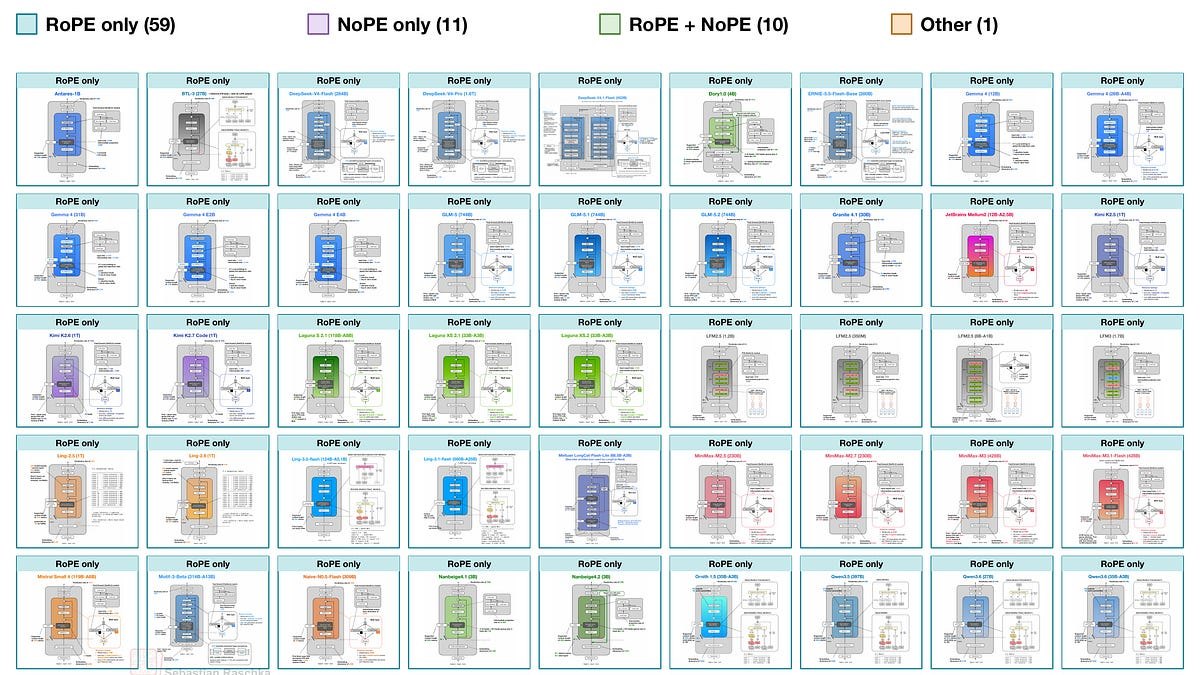
Recent 2026 open-weight language models reflect a clear architectural shift away from learned absolute lookup tables toward dynamic attention-level representations. The transition addresses context scaling constraints by embedding relative positional math directly into query and key projections across transformer layers. Modern model galleries categorize these choices to demonstrate how current releases balance sequence length extension against training stability.
Practitioners analyzing these systems observe that newer architectures favor rotary encodings over early static approaches. By computing positional relationships dynamically during attention operations, models maintain distance sensitivity across expansive context windows. This baseline survey establishes the technical foundation for ongoing evaluations of evolving open-weight LLM building blocks.
Understanding Positional Embeddings in Modern FAQ
Why do language models require positional information if causal masks already provide order?
Causal masks restrict attention to prior tokens and offer implicit directional sequence order, but they cannot distinguish specific spatial distances such as a separation of one token versus ten positions. Explicit positional embeddings supply these exact distance measurements to attention heads.
How does positional encoding differ between GPT-2 and MiniMax-M3?
GPT-2 adds a learned absolute position vector to the token embedding before the first transformer block, whereas MiniMax-M3 integrates positional information inside each transformer block using Rotary Position Embedding during attention operations.
Can a transformer architecture process sequential text without any explicit positional embeddings?
Yes, causal autoregressive masks inherently prevent future token lookahead and provide basic sequence distinction, enabling approaches known as NoPE that omit explicit positional encodings entirely.
Sources

Author
Dillip Chowdary
Writes Tech Bytes coverage of AI, engineering, and the tools that actually ship. Editor of Tech Pulse Daily.
Related on Tech Bytes
Advertisement