Wired linked 150 of Ikea’s $10 Speakers to Make a Wall of Sound
Ikea shipped 150 of its $10 Kallsup Bluetooth cubes to test multi-speaker pairing limits, forming a 447-watt wall of sound across 149 functional units.
By Dillip Chowdary • Oct 25, 2026 • Source: Wired
When Ikea launched its ten-dollar Kallsup Bluetooth speakers in April, the retailer claimed customers could chain up to one hundred of the 2.75-inch cubes together. After receiving an inquiry, Ikea headquarters in Älmhult supplied one hundred and fifty units to test whether the connection would hold. As detailed in Wired's report, the publication stacked the hardware inside its London office to build a massive physical sound wall powered from a single smartphone.
This article examines the multi-speaker pairing mechanism, acoustic output, and physical limits of mass-chaining ultra-cheap audio hardware. It is written for budget shoppers, audio enthusiasts, and hardware tinkerers evaluating whether grouping entry-level drivers can substitute for dedicated party speakers. The report details setup times, driver surface physics, comparative decibel output, and reliability across one hundred and forty-nine functional units.
Wired linked 150 of Ikea’s $10 Speakers: what actually changed
Ikea provided one hundred and fifty Kallsup speakers directly from its Älmhult headquarters to evaluate a scenario that the brand had never tested. Selling for ten dollars each in white, green, and pink, the 2.75-inch cubes represent the cheapest Bluetooth speakers available. One speaker arrived damaged with loose internal parts, failing to play despite lighting up. That left one hundred and forty-nine working units to build the wall, representing a total retail investment of one thousand four hundred and ninety dollars.
The team stacked the functional cubes on an office desk, constructing a physical monolith to verify whether the wireless link stayed active. Each speaker features its own three-watt amplifier, giving the complete 149-unit array a combined rated electrical output of 447 watts. Although the cubes lacked top indentations or interlocking grooves for stability, the entire structure remained upright throughout playback without toppling from acoustic vibrations. The build confirmed that Ikea's entry-level hardware could successfully maintain an unbroken audio connection across nearly one hundred and fifty chained units.
Wired linked 150 of Ikea’s $10 Speakers: how it works
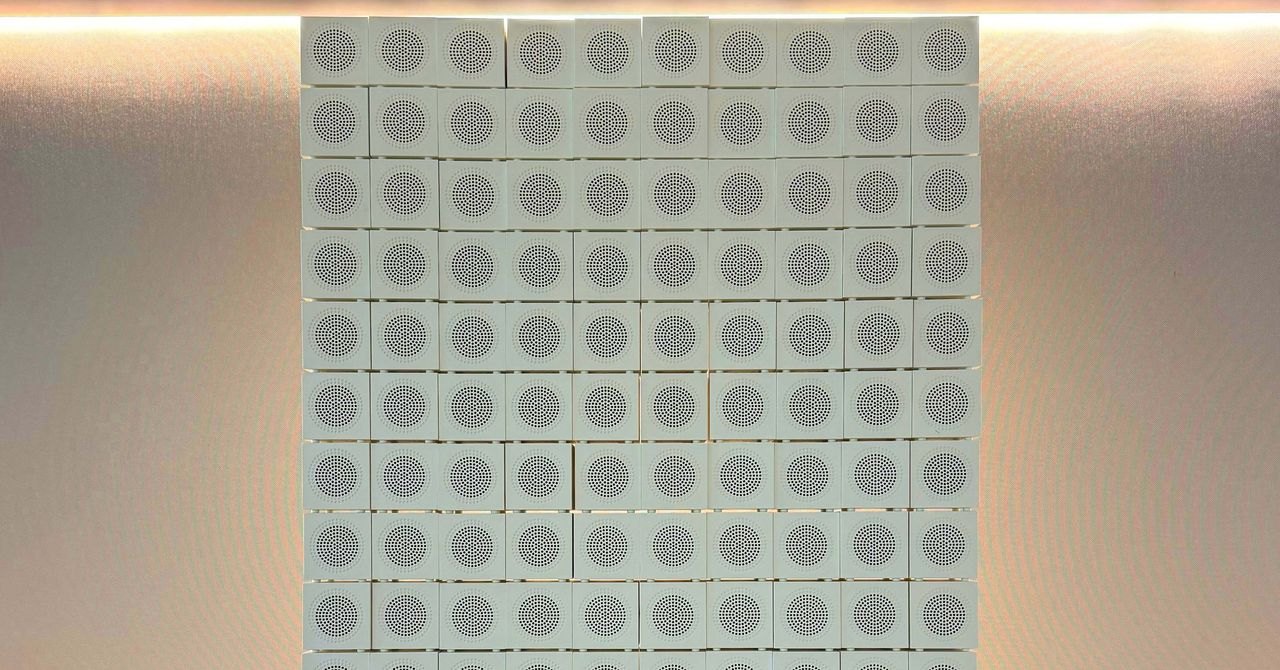
The chaining procedure relies on built-in multi-speaker wireless functionality enabled by Bluetooth 5.3. Linking began by pairing an initial Kallsup directly to an iPhone 16 Pro. Once that primary cube was actively streaming music, testers powered on an adjacent unit and held down its Play button until a chime indicated multi-speaker mode had activated. The secondary unit immediately mirrored the music playing on the master speaker. Repeating this straightforward process across all one hundred and forty-nine operational cubes required about thirty minutes, maintaining continuous playback throughout the entire installation.
A single 1.8-inch full-range driver handles all frequencies inside each Kallsup, omitting separate woofers and tweeters. Across one hundred and forty-nine cubes, the combined driver surface area equals roughly twenty-two inches, matching the cone size of a giant single transducer. Rather than acting like a dedicated 22-inch subwoofer, the wall operates as dozens of individual cones moving modest quantities of air. The collective acoustic output grows smoothly in scale at low volumes, though minor timing variations between individual Bluetooth receivers introduce slight dispersion that softens ultimate acoustic detail.
Advertisement
Tech Pulse Daily
Get tomorrow's pulse first
Join engineers who read Tech Pulse before stand-up. Free, weekday mornings.
Wired linked 150 of Ikea’s $10 Speakers: why it matters now
The installation highlights how much capability modern budget manufacturing squeezes into ten-dollar hardware. Building a standalone wireless speaker that functions reliably for less than the price of a craft beer requires sophisticated economies of scale. When played at low background volumes, the grouped cubes produced an unexpectedly pleasant soundstage, especially on acoustic tracks where the sound scaled evenly without individual drivers overpowering the room. The test proves that basic consumer hardware can support expansive wireless synchronization without requiring companion smartphone apps, external control hubs, or complicated network configuration.
At maximum volume, the setup shifted from pleasant background sound into overwhelming sonic pressure. Increasing the volume on Trans Lunar by Twin Dimensions and Richard Strauss' Also Sprach Zarathustra unleashed a brain-numbingly loud acoustic blast. The wall generated sound akin to an emergency fire alarm rather than high-fidelity music, causing internal organs to vibrate and preventing spoken communication across the room. While the 447-watt aggregate output succeeded in generating extreme decibel levels, pushing the small drivers past their comfort zone eliminated tonal fidelity and musical nuance completely.
Wired linked 150 of Ikea’s $10 Speakers: who is affected
For everyday shoppers, the test confirms that a standalone Kallsup offers solid utility for ten dollars. Operating individually, the speaker works well on a bedside table, an office desk, or packed inside travel luggage. While the single driver lacks low-end bass and exhibits a somewhat tinny profile when turned up, its performance remains acceptable given the rock-bottom price tag. Consumers purchasing two or three cubes can easily distribute synchronized background audio across adjacent living spaces by using the built-in pairing button without touching complex wireless menus.
Party organizers and audio purists receive a clear reminder that linking numerous budget drivers cannot replace proper acoustic engineering. Side-by-side listening alongside the 500-dollar LG Xboom Stage 501 showed that both reached uncomfortably loud sound levels. However, the LG speaker leveraged dual 5.25-inch woofers, dual 2.5-inch full-range drivers, and digital signal processing to deliver richer bass and musical refinement. Spending nearly one thousand five hundred dollars on an array of budget cubes proves impractical, as a single dedicated party speaker delivers substantially superior acoustic quality.
Wired linked 150 of Ikea’s $10 Speakers: what to watch
Hardware behavior revealed practical connection boundaries as the number of linked units reached triple digits. Chaining proceeded effortlessly through the initial one hundred units, but pairing resistance increased as the network expanded toward its maximum limit. Speakers added beyond the hundred-unit mark occasionally failed to link on their first attempt, requiring testers to cycle the pairing button. Despite that minor friction, no speaker failed more than twice before locking into the shared stream, demonstrating that the Bluetooth 5.3 firmware handled high-density broadcasting without catastrophic connection dropouts.
While synchronizing one hundred and forty-nine units is an impressive technical feat, it falls well short of the world record of 1,500 linked speakers set by Majority Audio in March 2026. Future revisions of modular mini-speakers could improve usability by incorporating top indentations or rubber alignment feet to prevent tall stacks from wobbling during heavy playback. For consumers, the conclusion remains straightforward: chaining budget cubes demonstrates impressive wireless scaling, but buyers seeking high-fidelity sound are still best served by investing in higher-end audio hardware.
Developer Action Items
- ☐ Verify the claim on the official Wired linked Ikea Speakers page (or Wired), not from this recap alone.
- ☐ Name the surface that moved — API, policy, model, hardware, or commercial terms — before you Slack the thread.
- ☐ Assign one owner a day to read the primary material and decide: this-sprint, this-quarter, or noise.
- ☐ Do not change production on day-one coverage. Watch the vendor changelog and one independent write-up first.
Wired linked 150 of Ikea’s $10 Speakers FAQ
How do you chain multiple Ikea Kallsup speakers together?
Pair the first Kallsup cube to a smartphone over Bluetooth, turn on another speaker, and hold down its Play button until a chime signals multi-speaker mode. The secondary unit will instantly synchronize and play the active audio stream.
What are the hardware specifications of the Ikea Kallsup speaker?
Each $10 Kallsup features a single 1.8-inch full-range driver, an integrated 3-watt amplifier, and Bluetooth 5.3 connectivity within a 2.75-inch cube enclosure.
Did all 150 Ikea Kallsup speakers successfully connect in the test?
One unit was damaged in shipping and could not play audio, but all 149 functional speakers successfully linked together from an iPhone 16 Pro.
What is the official world record for linked Bluetooth speakers?
The world record stands at 1,500 interconnected speakers, established by Majority Audio in March 2026.
Sources

Author
Dillip Chowdary
Writes Tech Bytes coverage of AI, engineering, and the tools that actually ship. Editor of Tech Pulse Daily.
Related on Tech Bytes
Advertisement