Webz.io launches self-service dark web APIs with free monthly credits
Webz.io launched five self-service dark web APIs with $5 in free monthly credits to help security teams track breached accounts and stolen session cookies.
By Dillip Chowdary • Nov 29, 2026 • Source: BleepingComputer
At a glance
- Product
- Webz.io Cyber APIs
- Pricing
- $5 monthly credit, pay-as-you-go
- Date
- November 29, 2026
- Authentication
- Domain verification required
- Protocols
- HTTPS and Model Context Protocol
Webz.io launched five self-service cybersecurity application programming interfaces to help security teams uncover breached accounts, stolen session cookies, exposed machine secrets, and underground discussions. According to BleepingComputer's report, the automated services provide structured threat intelligence gathered from infostealer logs, cybercrime forums, and illicit marketplaces. Registered accounts receive $5 in free monthly credits alongside pay-as-you-go pricing for expanded scanning.
This report details the capabilities, source collections, data structures, and operational boundaries of the five new endpoints. Security engineers, identity architects, and threat intelligence analysts can evaluate how these programmatic feeds integrate with existing incident response workflows. The catalog addresses credential compromise, authentication session theft, developer secret leaks, and dark web chatter through direct query mechanisms.
01Breach databases and credential combo lists
The Data Breach Monitoring API searches compromised databases, credential combo lists, and infostealer malware logs for records linked to verified company domains. Organizations can query by email domain, login domain, or both values depending on their operational focus. Results arrive as structured JSON delivering available login URLs, exposure classifications, breach timestamps, and underlying device context.
| Search Option | Target Scope | Operational Finding | | Email domain | Corporate email addresses | Identifies external service database compromises | | Login domain | Application login URLs | Detects credentials stolen while accessing company systems | | Dual query | Addresses and login portals | Isolates internal system breaches from third-party exposures |
Querying login domains isolates credentials captured while employees accessed internal corporate infrastructure from credentials leaked in third-party database breaches. Analysts examine exposure timestamps and device parameters to determine which accounts require immediate remediation. A matching corporate email address alone indicates an external exposure rather than confirming an intrusion into company systems.
02Stolen browser sessions and authentication cookies
The MFA Bypass Monitoring API tracks stolen browser sessions and authentication cookies harvested by infostealer malware operating on employee devices. Reusable stolen cookies can allow attackers to access authenticated sessions without triggering a multifactor authentication challenge. Returned records identify the targeted service host, browser software, cookie classification, expiration timestamp, and infected machine context.
Note: Recorded expiration dates do not confirm that a session remains active. The primary investigative value lies in identifying exposed authentication material and equipping defenders with forensic evidence. Any session revocation or fresh sign-in requirement must run through the customer's identity provider or internal application controls.
Advertisement
Tech Pulse Daily
Get tomorrow's pulse first
Join engineers who read Tech Pulse before stand-up. Free, weekday mornings.
03Exposed machine credentials and developer secrets
The Non-Human Identity API discovers exposed machine credentials across supported cloud platforms, development toolchains, and artificial intelligence environments. Infostealer malware frequently extracts API tokens stored in local configuration files on developer machines even when keys are never committed to source repositories. The service catalogs API keys, OAuth tokens, personal access tokens, refresh tokens, cloud access keys, session tokens, and private keys.
Note: Secret values remain masked by default in query responses to prevent accidental exposure of sensitive keys. Accessing unmasked credentials or surrounding raw log extracts requires explicit account permissions. In addition, detailed source file locations and point-in-time verification indicators depend on the specific customer subscription tier.
04Underground forum mentions and leak sites
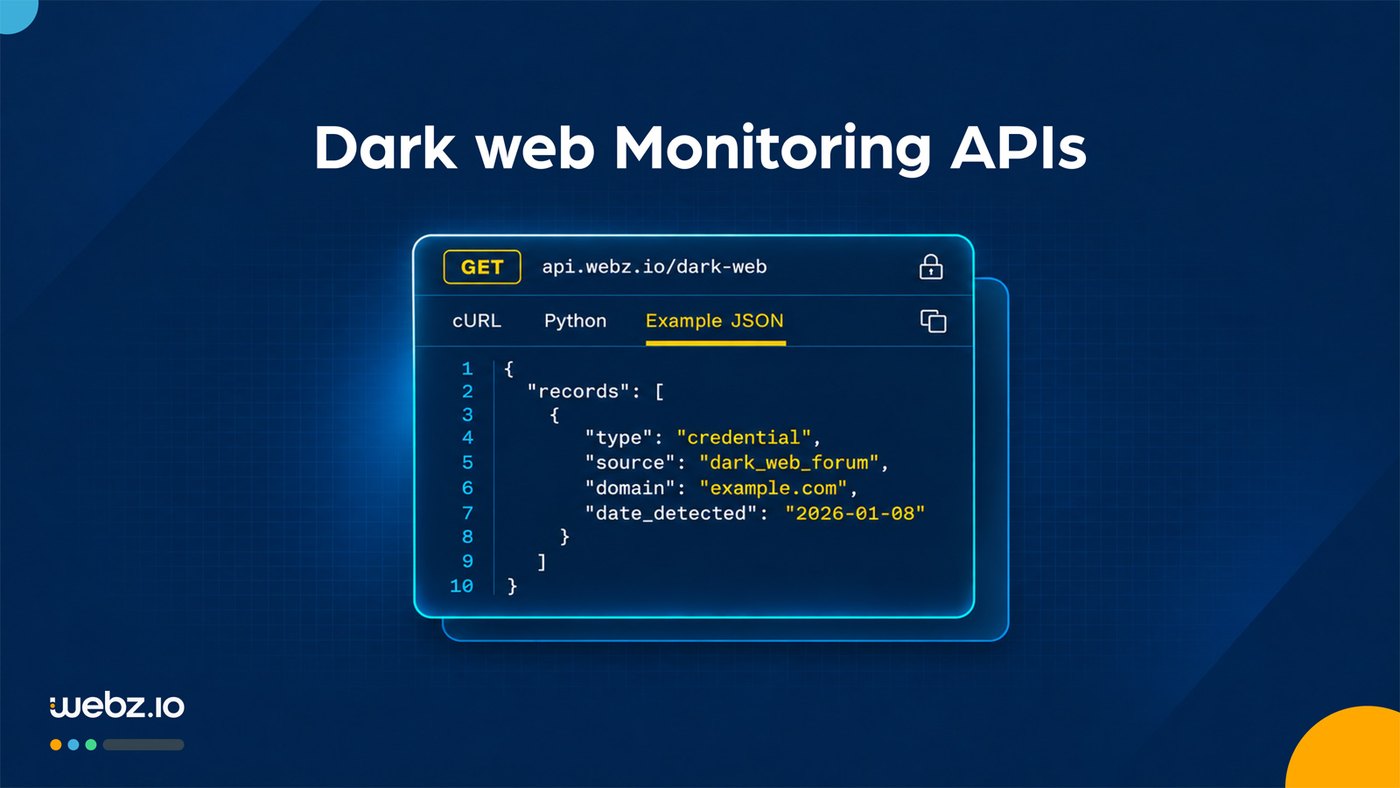
The Dark Web Monitoring API captures posts referencing verified company domains across collected hacking forums, underground marketplaces, ransomware leak portals, and Telegram channels. The feed flags instances where threat actors advertise unauthorized network access, market stolen databases, or discuss company operations. Responses deliver full post content alongside origin thread details, publication timestamps, author handles, and extracted entity data.
Developers execute queries over standard HTTPS connections without operating Tor proxy networks, managing headless browsers, or maintaining custom web scraping infrastructure. The structured output routes directly into security information and event management platforms or enterprise case management systems. Access permissions and query scopes depend on the specific data collection feeds enabled for each registered organization.
05Natural language queries and cited evidence
The Dark Web Answers API processes plain English questions and generates structured reports containing direct citations to supporting dark web messages. Users explore emerging threat topics without constructing specialized search queries or possessing prior cyber threat intelligence analysis experience. The service integrates with conversational assistants and autonomous agents through the Model Context Protocol, allowing security teams to conduct interactive investigations.
Security teams integrate these endpoints by verifying domain ownership before configuring automated requests that route breach alerts into incident queues. Where infostealer infections involve multiple compromises, shared machine identifiers link stolen secrets with associated cookies and account credentials. Connecting related artifacts from the same infected endpoint enables analysts to investigate multi-vector compromise events in a single coordinated response.
Note: Self-service pay-as-you-go accounts receive guarded threat answers with sensitive information censored during retrieval. Cybersecurity companies requiring unrestricted access to complete raw evidence can contact Webz.io directly to arrange expanded data tier permissions. The access tier alters how sensitive records are handled rather than changing the length of the delivered answer.
Frequently asked questions
Which endpoints are included in the new Webz.io cyber API release?
The release includes the Data Breach Monitoring API, MFA Bypass Monitoring API, Non-Human Identity API, Dark Web Monitoring API, and Dark Web Answers API.
How are the self-service Webz.io cyber APIs priced?
Accounts register without a credit card and receive $5 in monthly credits, with additional queries billed under pay-as-you-go pricing.
How does the MFA Bypass Monitoring API assist security teams?
It analyzes stolen session cookies from infostealers, providing expiration timestamps and device context to uncover session hijacking risks.
Sources

Author
Dillip Chowdary
Writes Tech Bytes coverage of AI, engineering, and the tools that actually ship. Editor of Tech Pulse Daily.
Related on Tech Bytes
Advertisement