What I found in 39,535 Claude.md and AGENTS.md files
An analysis of 39,535 repositories reveals AGENTS.md has overtaken CLAUDE.md with 1,196,366 files while typical setups consume 1,379 tokens every session.
By Dillip Chowdary • Nov 18, 2026 • Source: internals.laxmena.com
At a glance
- Publication date
- November 17, 2026
- Sampled files
- 39,535 files across 33,762 repositories
- Generator version
- Claude Code 2.1.326
- Median cost
- 1,379 tokens per CLAUDE.md session
- Index total
- 1,196,366 AGENTS.md and 876,678 CLAUDE.md
- Query limit
- 9 queries per minute on GitHub code search
Independent researcher Lax Meiyappan published an extensive empirical study on November 17, 2026, analyzing how software teams configure autonomous programming tools across GitHub. The investigation, released through internals.laxmena.com's report, examined 39,535 configuration files across 33,762 public repositories to quantify token consumption, file proliferation, and developer instructions. The data reveals that vendor-neutral configuration standards are rapidly overtaking proprietary formats while automated boilerplates silently inflate recurring session costs.
This report breaks down the measurement methodology, token billing dynamics, boilerplate distributions, and repository guardrail practices uncovered across the sampled projects. It provides software engineers, engineering managers, and tool maintainers with concrete operational metrics to optimize local instruction files and eliminate wasted context before their agents process project code.
01Random sampling across thirty-three thousand repositories
Lax Meiyappan released a large-scale empirical analysis measuring 39,535 agent instruction files across 33,762 public GitHub repositories on November 17, 2026. The study collected repository data through automated index queries using a custom tool named neri, which means guideline in Tamil. GitHub limits code searches to 1,000 results per query at roughly nine queries each minute, requiring targeted slices across both small hobby projects and prominent codebases.
The measurement pipeline extracted raw token counts, architectural sections, and execution settings directly from code. Three independent artificial intelligence models evaluated text samples requiring subjective classification, with conflicting labels resolved through manual verification. Weighting the sample back to the wider public repository population enabled the dataset to accurately reflect broader developer habits without skewing toward over-represented popular repositories.
Note: The underlying measurement captures only public, committed instruction files found on GitHub. Private codebases, personal global instruction paths, and uncommitted local workspace configurations remain completely invisible to the search index and were excluded from the final tallies.
02Harness neutral adoption across one million files
Harness-neutral agent instructions have outpaced vendor-specific formats across the public GitHub index. The search index currently contains 1,196,366 AGENTS.md files compared to 876,678 CLAUDE.md files. Two out of every three scanned repositories maintain an AGENTS.md file, while slightly more than half include a CLAUDE.md file, showing widespread developer migration toward cross-tool configuration standards.
A random spot-check of 40 repositories confirmed that 39 files named AGENTS.md functioned specifically as operational instructions for automated programming assistants. Anthropic adapted to this ecosystem shift in September by updating Claude Code to read AGENTS.md when no local CLAUDE.md is present. That engine change resolved a community request on GitHub that had accumulated more than 5,000 upvotes over twelve months.
Advertisement
Tech Pulse Daily
Get tomorrow's pulse first
Join engineers who read Tech Pulse before stand-up. Free, weekday mornings.
03Fixed session overhead and token consumption bills
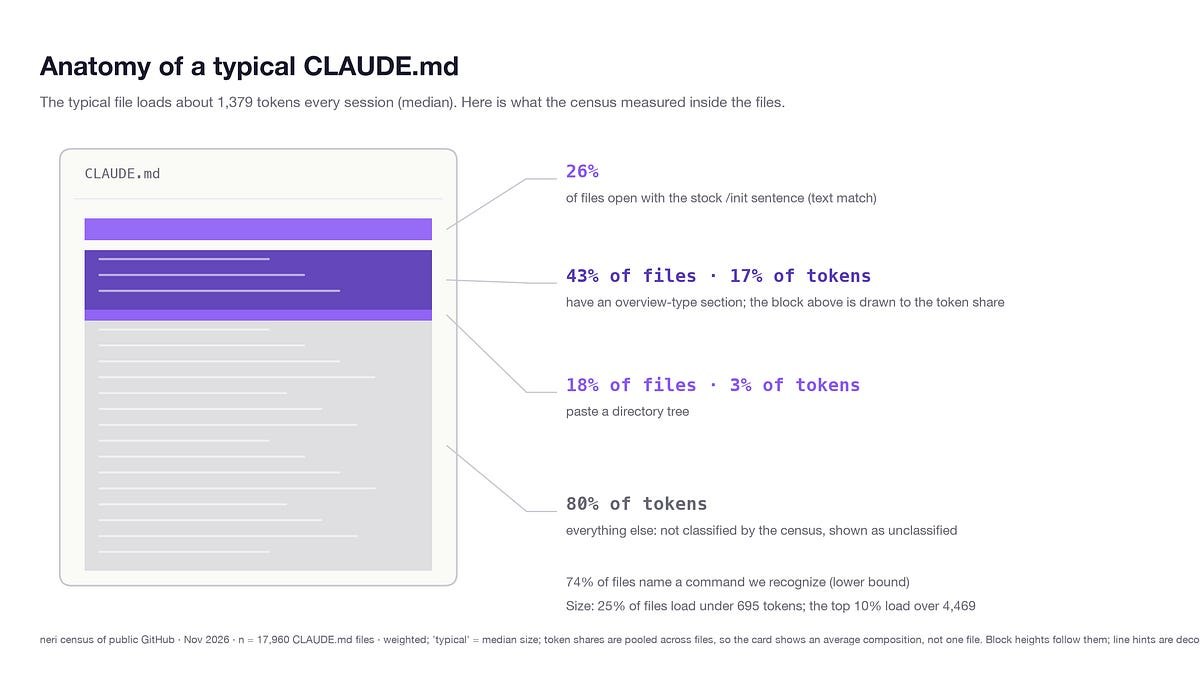
Every interactive coding session imposes an upfront context toll before the agent reads project source code. The typical CLAUDE.md file consumes 1,379 tokens across approximately 86 lines, while the top ten percent of files exceed 4,469 tokens per session. By contrast, AGENTS.md files average 1,009 tokens, reflecting tighter instruction footprints across smaller repositories.
Popular repositories average 1,550 tokens while smaller hobby projects average 1,361 tokens, demonstrating that teams write similarly sized instruction documents regardless of project maturity. Root instruction files load during every session start, whereas subfolder configurations load on demand only when an agent navigates into specific directories.
| Metric | CLAUDE.md files | AGENTS.md files |
|---|---|---|
| Total indexed count | 876,678 | 1,196,366 |
| Typical token footprint | 1,379 tokens | 1,009 tokens |
| Top decile token size | 4,469 tokens | Not reported |
| Average line length | 86 lines | Not reported |
04Generated overview sections and benchmark cost inflation
Repository overviews appear in 43 percent of CLAUDE.md files and consume roughly 17 percent of all instruction tokens. Developers frequently include broad architecture summaries, technology stack listings, and directory tree layouts, which account for 18 percent of files. However, research from ETH Zurich demonstrated that general repository overviews fail to improve agent navigation while inflating session token costs by more than 20 percent.
Much of this token inflation stems from automated generators rather than intentional developer drafting. Approximately 26 percent of all CLAUDE.md files retain the verbatim opening line generated by Claude Code version 2.1.326 via the init command. Files keeping this default text contain overview sections 87 percent of the time, with overviews absorbing 41 percent of their total tokens compared to just seven percent in custom files.
05Symlinked instruction files and committed guardrail hooks
Most repository setups avoid modular complexity, with 83 percent storing instructions in a single root file. Only 1.0 percent of repositories utilize file imports, and just 16 percent place scoped configuration files in subdirectories. When projects maintain both file types, 58 percent link them through symlinks or direct references, while 12 percent maintain duplicate files by hand, creating long-term synchronization risks.
Only ten percent of examined repositories commit Claude Code configuration settings, but those that do prioritize enforcement over loose guidance. Among configured projects, 41 percent implement hooks to inspect inputs before tool execution or format code after edits, whereas only two percent grant blanket pre-approval for arbitrary shell commands. One engineering team even deployed a hook that automatically updates instruction documents after every repository edit.
Frequently asked questions
How many tokens does a standard CLAUDE.md file consume per session?
A typical CLAUDE.md file consumes approximately 1,379 tokens across 86 lines, while the top ten percent of files require over 4,469 tokens. By comparison, AGENTS.md files average 1,009 tokens per session.
Has AGENTS.md surpassed CLAUDE.md in repository adoption?
Yes, GitHub's public index holds 1,196,366 AGENTS.md files compared to 876,678 CLAUDE.md files. Two out of three examined repositories contain an AGENTS.md file, and Claude Code added native support for reading it in September.
Why do repository overviews inflate coding agent costs?
An ETH Zurich benchmark found that broad architectural overviews and directory trees do not improve code retrieval but increase token costs by more than 20 percent on average. Overviews represent 17 percent of all CLAUDE.md tokens and appear in 87 percent of files generated by default setup commands.
How often do developers commit automated hooks and execution permissions?
About ten percent of repositories commit Claude Code configuration settings. Among those projects, 41 percent configure automated hooks to guard operations or format edits, while only two percent grant blanket pre-approval for shell execution.
Sources

Author
Dillip Chowdary
Writes Tech Bytes coverage of AI, engineering, and the tools that actually ship. Editor of Tech Pulse Daily.
Related on Tech Bytes
Advertisement