What is Pathways? Single-controller training for large models
Google released Pathways on Google Cloud to coordinate large JAX models on TPUs, replacing SPMD lockstep barriers with single-client graph execution.
By Dillip Chowdary • Nov 09, 2026 • Source: Google Developers Blog
Google announced the General Availability of Pathways on Google Cloud Platform on Nov. 9, 2026, releasing the distributed training system it built to train internal frontier models like Gemini. According to Google Developers Blog's report, Pathways replaces rigid multi-controller architectures with a single client that coordinates large-scale training jobs as global computation graphs across hardware accelerator clusters.
This report details the architectural changes introduced by Pathways, comparing single-controller execution with standard distributed training methods like DDP and FSDP. The system is designed for machine learning researchers, infrastructure engineers, and systems developers scaling non-uniform workloads across accelerator clusters.
Is Pathways? Single-controller training: what actually changed
Most large model training runs use the Single Program, Multiple Data execution model, implemented in PyTorch through Distributed Data Parallel and Fully Sharded Data Parallel. Under SPMD, every accelerator runs identical code in lockstep, synchronizing via collective operations like AllReduce. While collectives are fast within tightly connected groups over local interconnects, crossing datacenter networks causes severe bottlenecks. On TPU v5p chips, bidirectional interconnect bandwidth reaches 1,200 GB/s within a group, but drops to 50 Gb/s, roughly 6 GB/s, across datacenter networks, delaying steps.
Pathways replaces decentralized multi-controller execution with a single client running on an ordinary CPU machine, defining the complete training workload as a unified dataflow graph. In this graph representation, computational blocks serve as nodes, and moving tensors act as edges connecting them. Instead of every process managing its own hardware, a centralized distributed runtime schedules tasks, routes tensors, and resolves execution dependencies. This decouples program logic from physical chips, allowing users to write models against virtual devices that a central resource manager maps onto physical accelerators.
Is Pathways? Single-controller training: how it works
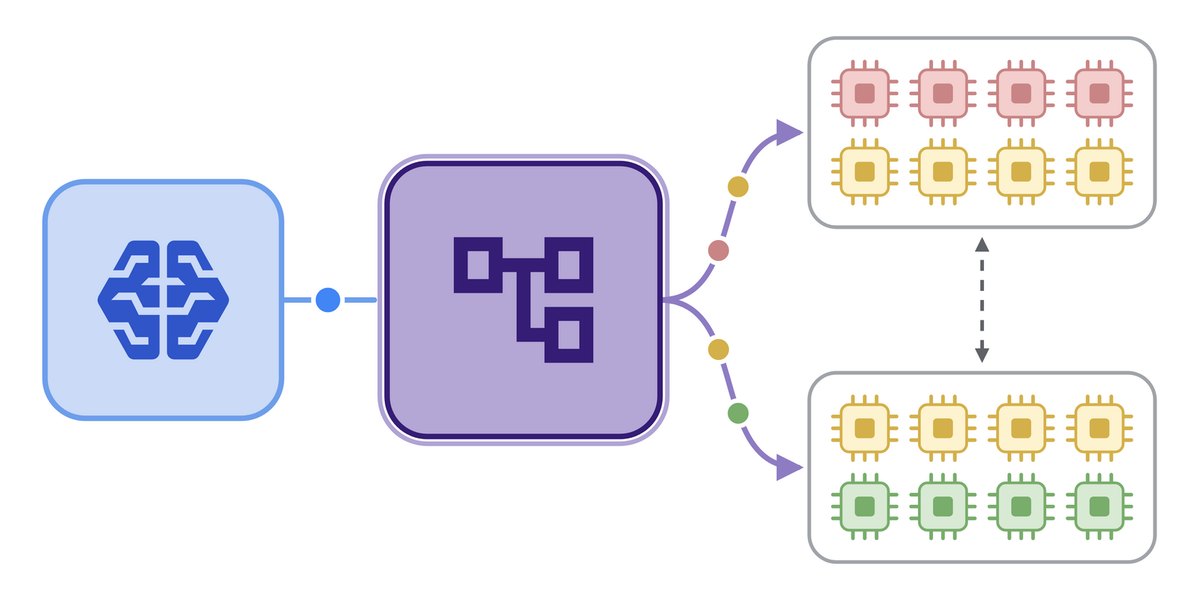
Developers write JAX programs that execute on TPUs, specifying computation from a single Python client without authoring low-level distributed communication routines. The client generates an end-to-end computation graph referencing virtual devices, leaving hardware assignments to a distributed resource manager. This manager maps virtual devices onto physical accelerator chips across the cluster and provisions worker processes on host machines to execute compiled sub-programs. Because code targets virtual abstractions, the runtime dynamically dispatches compiled binaries, reorders operations, and stages tensor buffers asynchronously across hosts before computations begin.
The system manages non-uniform workloads by overlapping disparate tasks across hardware devices. In complex reinforcement learning loops, training requires coordinating three distinct programs: a sampler generating rollouts, a reward model scoring candidates, and a trainer updating policy weights. Traditional SPMD forces these programs to run sequentially, leaving samplers idle during updates and trainers idle during generation. Pathways schedules these distinct programs concurrently across virtual devices. The runtime automatically transfers weights from trainers to samplers and routes rollout tensors to reward models, preventing stalls without custom inter-process orchestration.
Advertisement
Tech Pulse Daily
Get tomorrow's pulse first
Join engineers who read Tech Pulse before stand-up. Free, weekday mornings.
Is Pathways? Single-controller training: why it matters
Hardware utilization drops under SPMD when workloads cannot fill all devices uniformly. In pipeline parallelism, models are split into sequential blocks across devices processing smaller micro-batches. Activations advance forward while activation gradients flow backward, creating pipeline bubbles where downstream devices sit idle waiting for upstream computations. Under SPMD, each process holds its accelerators for the entire run, forcing organizations to pay for idle chips that cannot be reassigned. Pathways mitigates these bubbles by orchestrating task graphs centrally, allowing independent computational steps to fill idle slots across virtual devices and maximizing hardware efficiency.
Cluster resilience is equally critical during large-scale pre-training. Hardware failures interrupted Gemini 2.5 training multiple times per hour, exposing a fatal flaw in SPMD execution. Because SPMD processes run in lockstep, losing a single machine stops collective operations, halts the entire run, and forces all workers to roll back to the last checkpoint. Furthermore, SPMD prevents adding or returning devices mid-run. Pathways overcomes this vulnerability through dynamic device remapping. When a physical host fails, the resource manager remaps the affected virtual devices to healthy chips, enabling the training run to continue without restarting.
Is Pathways? Single-controller training: who is affected
Teams engineering frontier models and multi-stage post-training pipelines are directly affected by this platform release. Developers implementing reinforcement learning workflows previously had to construct bespoke orchestration layers or tolerate severe hardware idle time while samplers, reward models, and trainers exchanged parameters sequentially. With Pathways now generally available on Google Cloud Platform, engineering teams running JAX models on TPU clusters can define these multi-program pipelines inside a single script. The runtime manages data dependencies and tensor placement automatically, eliminating manual communication harnesses and enabling research organizations to run complex training architectures without custom distributed plumbing.
Software developers and cluster administrators also experience immediate improvements in debugging workflows and resource sharing. On multi-host SPMD clusters, launching jobs requires pushing scripts to every individual host, making debugging difficult when workers hang indefinitely at collective barriers without a central inspection point. With Pathways, developers run their script from a single client on an ordinary CPU machine, setting standard Python breakpoints and inspecting execution state directly. Meanwhile, cluster administrators avoid rigid static partitioning, since capacity can be reassigned between stages dynamically rather than remaining locked to dedicated allocations throughout a job.
Is Pathways? Single-controller training: what to watch
Industry adoption will depend on how engineering organizations evaluate framework trade-offs between PyTorch-based SPMD tools and JAX-based graph execution. While Pathways powers Google's flagship models including Gemini, the system currently runs JAX programs on TPU hardware. Development teams maintaining extensive PyTorch codebases using DDP or FSDP must evaluate migration overhead against the utilization gains provided by centralized coordination. Infrastructure teams will monitor whether Google introduces broader framework bridges, or whether the wider open-source ecosystem attempts to replicate single-controller dataflow architectures on alternative accelerator fabrics to support multi-program training workflows outside Google Cloud.
Long-term performance benchmarks will also reveal how effectively the runtime manages fault tolerance and resource reclamation across production cloud deployments. Authored by Google engineers including Sujeeth Jinesh, Shaurya Gupta, Luke Baumann, Monica Song, Ivan Nardini, Akanksha Gupta, Anthony Owusu, Jing Yang, Sadi Kneipp, and Yu Li, Pathways demonstrated resilience during Gemini 2.5 runs that experienced multiple hardware dropouts per hour. Practitioners will observe how third-party enterprise clusters handle automated virtual device remapping during machine failures, and whether dynamic capacity sharing delivers promised cost reductions over static GPU and TPU allocations in shared cloud environments.
Developer Action Items
- ☐ Verify the claim on the official Gemini / Google / Python page (or Google Developers Blog), not from this recap alone.
- ☐ Name the surface that moved — API, policy, model, hardware, or commercial terms — before you Slack the thread.
- ☐ Assign one owner a day to read the primary material and decide: this-sprint, this-quarter, or noise.
- ☐ Do not change production on day-one coverage. Watch the vendor changelog and one independent write-up first.
Is Pathways? Single-controller training FAQ
What is Pathways on Google Cloud?
Pathways is a centralized distributed execution system developed by Google to train large machine learning models, including Gemini, by orchestrating computation as a global dataflow graph across TPU accelerator clusters.
How does Pathways handle hardware failures during model training?
Pathways decouples user programs from physical hardware by compiling against virtual devices, allowing a central resource manager to dynamically remap failed physical hosts to healthy chips without restarting the run from a checkpoint.
Why do traditional SPMD models like DDP and FSDP struggle when scaling?
SPMD models force every accelerator to run in lockstep and synchronize via collective operations like AllReduce, which causes severe step delays when crossing slower datacenter networks and leaves accelerators idle during non-uniform pipeline stages.
What programming framework and hardware does Pathways support?
Pathways runs JAX programs on Google Cloud Tensor Processing Units, allowing developers to author and manage distributed training jobs from a single Python client running on an ordinary CPU machine.
Sources

Author
Dillip Chowdary
Writes Tech Bytes coverage of AI, engineering, and the tools that actually ship. Editor of Tech Pulse Daily.
Related on Tech Bytes
Advertisement