What's Next for Nvidia?: Comments news update
These transitions altered distribution channels, client bases, and core revenue models rather than merely iterating on existing hardware designs.
By Dillip Chowdary • Nov 16, 2026 • Source: steveblank.com
At a glance
- Company
- Nvidia
- Outgoing executive
- Jensen Huang
- Executive tenure
- 33 years
- Direct reports
- ~60 executives
- Ecosystem investments
- ~$50 billion in AI labs
- Successor status
- Unnamed
Nvidia’s board of directors announced that co-founder Jensen Huang resigned from his post after thirty-three years leading the company, according to steveblank.com's report. The sudden departure strips the semiconductor giant of its singular product architect at the height of the artificial intelligence boom. Huang left both the chief executive office and his board seat on the same day without naming a designated successor.
This analysis examines the operational and strategic dilemmas confronting Nvidia’s leadership following Huang’s resignation, specifically detailing historical succession patterns across Silicon Valley computing giants. It is intended for technology executives, semiconductor analysts, enterprise software architects, and institutional investors evaluating market stability across the artificial intelligence hardware supply chain.
01Three business model shifts over three decades
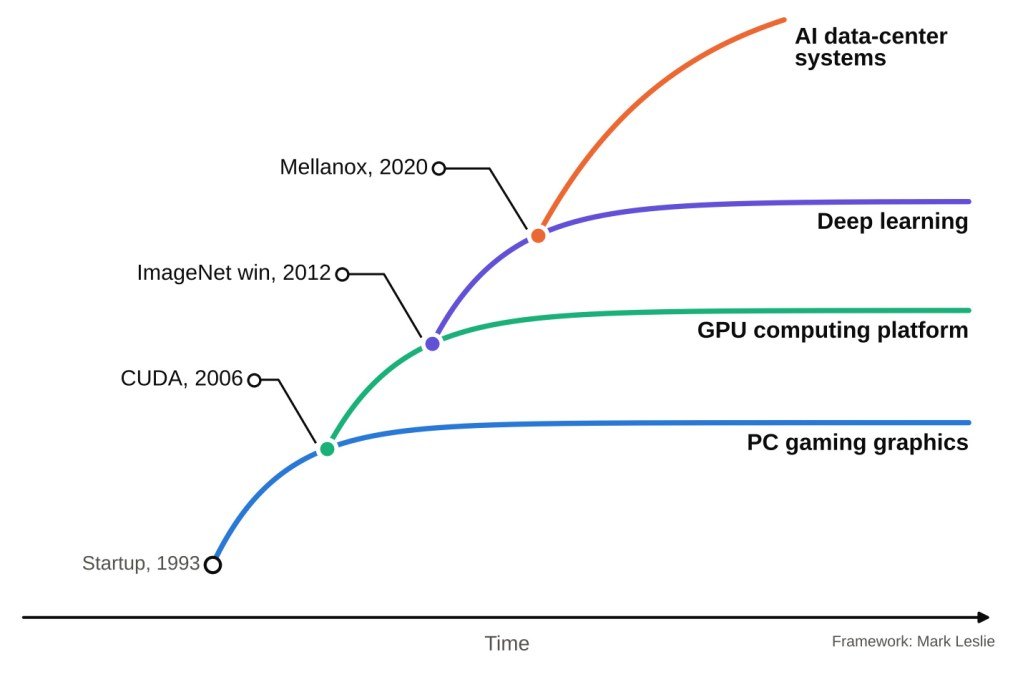
Jensen Huang reshaped Nvidia three distinct times by committing capital to nascent technologies long before commercial returns appeared. In 2006, he launched the CUDA software platform, converting specialized PC graphics processors into general-purpose computing platforms through years of unmonetized development. Six years later, when artificial intelligence researchers used Nvidia hardware to win the 2012 ImageNet contest, Huang directed corporate engineering directly toward deep learning frameworks.
The company completed its third transformation in 2020 through the acquisition of network hardware provider Mellanox. That purchase expanded Nvidia from a merchant vendor of standalone accelerator boards into an integrated datacenter systems builder selling complete computing racks. These transitions altered distribution channels, client bases, and core revenue models rather than merely iterating on existing hardware designs.
Note: Hardware shipments and production timelines for current accelerator generations remain under the authority of existing operating executives while the board conducts its leadership search.
02Executive transitions at Microsoft and Apple
Silicon Valley history illustrates that operational replacements for visionary founders often excel at financial stewardship while missing adjacent technology shifts. When Bill Gates stepped down in January 2000 after twenty-five years, Steve Ballmer focused corporate resources on legacy Windows and Office franchises. While Ballmer grew sales to $78 billion and profits from $9 billion to $22 billion over fourteen years, Microsoft missed search, smartphones, mobile operating systems, media streaming, and cloud infrastructure.
Apple followed a comparable trajectory when Tim Cook succeeded Steve Jobs, growing enterprise valuation from $350 billion to roughly $4 trillion and revenues from $108 billion to $416 billion over fifteen years. Cook introduced Apple silicon across existing product lines but struggled with novel computing form factors like the Apple Vision Pro and failed to develop competitive generative models. In September 2026, Cook transferred leadership of Apple to John Ternus after turning to Google earlier that year to repair Siri.
| Executive | Company | Tenure | Initial Revenue | Final Revenue | Major Strategic Result |
|---|---|---|---|---|---|
| Steve Ballmer | Microsoft | 2000–2014 | $25 billion | $78 billion | Missed search, mobile, and cloud transitions |
| Tim Cook | Apple | 2011–2026 | $108 billion | $416 billion | Scaled hardware revenue but faltered on artificial intelligence |
| Satya Nadella | Microsoft | 2014–Present | $78 billion | $4 trillion valuation | Unified cloud infrastructure and enterprise software |
Advertisement
Tech Pulse Daily
Get tomorrow's pulse first
Join engineers who read Tech Pulse before stand-up. Free, weekday mornings.
03Sixty direct reports without management layers
Huang enforced an unusual organizational design at Nvidia that eliminated traditional executive buffers and long-term planning committees. He managed approximately sixty direct reports simultaneously and actively discouraged one-on-one executive check-ins. Like Steve Jobs, Huang served as the single clearinghouse where engineering, design, pricing, and business strategy converged.
Incoming leadership will face immediate structural pressure to dismantle this flat organizational model and introduce conventional tiers of management. Execution-oriented leaders naturally institute repeatable corporate review processes, standardized operational reporting, and layered management structures to manage enterprise communication. This shift toward predictability frequently triggers departures among senior technical contributors who prefer rapid product iteration over bureaucratic sign-offs.
Amazon managed a founder departure differently because Andy Jassy built Amazon Web Services from scratch before succeeding Jeff Bezos. In contrast, Huang explicitly disbelieved in formal succession planning and groomed no internal product visionary to take over his responsibilities. Without an appointed successor, Nvidia’s remaining operating leaders must now reorganize reporting structures without disrupting active manufacturing programs.
04Custom silicon from internal hyperscaler customers
Nvidia faces an urgent competitive threat because its largest cloud datacenter customers are developing bespoke silicon accelerators to replace merchant graphics processors. Hyperscalers including Google, Amazon, Microsoft, Meta, OpenAI, and Tesla have each engineered proprietary internal chips to process training and inference workloads. These internal silicon efforts aim directly at reducing capital expenditures paid to third-party accelerator suppliers.
Huang countered this customer defection by accelerating production to release fresh processor generations every year while funding approximately $50 billion into partner labs. He coupled that rapid silicon cadence with the proprietary CUDA software stack to make migration to rival chips costly. An execution-focused successor attempting to optimize corporate margins would likely target these capital-intensive ecosystem investments first.
Defending merchant accelerator margins requires continuous technical gambles across packaging, memory architecture, and supply-chain logistics. A defensive posture that preserves current gross margins instead of attacking new product categories exposes semiconductor suppliers to rapid displacement. The loss of product-level technical insight at the top executive tier increases the probability of conceding critical inflection points to hyperscaler silicon teams.
05Four strategic dilemmas confronting the board
Nvidia’s board of directors must decide whether the company remains a risk-tolerant innovator or pivots toward harvesting returns from its established datacenter monopoly. The departure occurred abruptly, leaving decisions to a board operating under its first independent chairperson without Huang’s participation. Governing bodies facing sudden operational vacuums historically prioritize organizational stability, which systematically favors operations executives over unconventional product thinkers.
- Evaluate leadership profiles Determine whether to recruit an external product pioneer, promote an internal operating executor, or elevate engineering leaders from lower operational tiers.
- Preserve development speed Retain rapid annual silicon deployment schedules without centralizing all architectural decisions into a single executive bottleneck.
- Restructure executive authority Distribute organizational oversight across functional vice presidents without suffocating technical experimentation under administrative procedures.
- Defend software moats Maintain capital commitments to developer ecosystems and research laboratories despite rising customer competition.
Frequently asked questions
Why did Jensen Huang leave Nvidia?
Nvidia announced that Jensen Huang resigned after leading the company for thirty-three years, stepping down from both his chief executive role and the board of directors on the same day.
Who is running Nvidia following the resignation?
Nvidia has not named a successor to Huang, leaving the board of directors and its first independent chair to manage the search for new leadership.
What major challenges face Nvidia’s next chief executive?
The next executive must confront custom chip competition from major customers like Google, Microsoft, and Meta while restructuring an organization where sixty direct reports previously answered to one founder.
Sources

Author
Dillip Chowdary
Writes Tech Bytes coverage of AI, engineering, and the tools that actually ship. Editor of Tech Pulse Daily.
Related on Tech Bytes
Advertisement