WhatsApp is testing Zaps to send instant photos and videos
WhatsApp is testing Zaps in Android beta 2.26.46.2, allowing users to send encrypted view-once photos and videos launched from a new lightning bolt button.
By Dillip Chowdary • Nov 14, 2026 • Source: WABetaInfo

WhatsApp is actively developing an ephemeral camera capability called Zaps that allows people to capture and distribute fleeting visual messages directly inside chat conversations. The functionality, originally introduced under the name Instants, draws inspiration from the quick media sharing mechanics available on Instagram, according to WABetaInfo's report. Although currently undergoing internal engineering on Android, the system aims to give users a streamlined way to record spontaneous moments that disappear after a single viewing.
This technical breakdown details the architecture, design changes, and privacy controls behind the upcoming media feature for Android users. Readers will learn how the interface functions, where files are stored, and which chat interactions Meta is implementing across personal conversations and broadcast channels. It serves messaging enthusiasts, regular contacts, and group administrators monitoring upcoming communication tools.
01Ephemeral camera origins in earlier beta builds
The early foundation for ephemeral capture surfaced in the WhatsApp beta for Android 2.26.45.13 update. Engineering teams constructed an instant camera system designed to replicate the quick visual sharing found on Instagram. The tool lets people snap a photograph or record a video directly from a shortcut placed conveniently on the main application dashboard.
Users access the creation interface by tapping a dedicated lightning bolt button located at the top of the Chats tab. Once launched, the camera allows rapid capture of immediate visual content without navigating through standard attachment menus. This placement guarantees immediate access for individuals seeking to share unpolished, real-time visual updates.
Security parameters mirror standard messaging protections through mandatory end-to-end encryption across all transmissions. Only the sender and the recipient hold cryptographic keys capable of viewing the media files. Furthermore, each visual item disappears automatically after the recipient views it once, strictly preventing repeated playbacks or extended viewing sessions.
02Lightning bolt launcher and name rebranding
WhatsApp transitioned the feature toward a new identity within the WhatsApp beta for Android 2.26.46.2 update distributed through the Google Play Store. The application officially renamed the underlying Instants system to Zaps. Consequently, every individual photo or video recorded through this camera mechanism is now formally designated as a Zap.
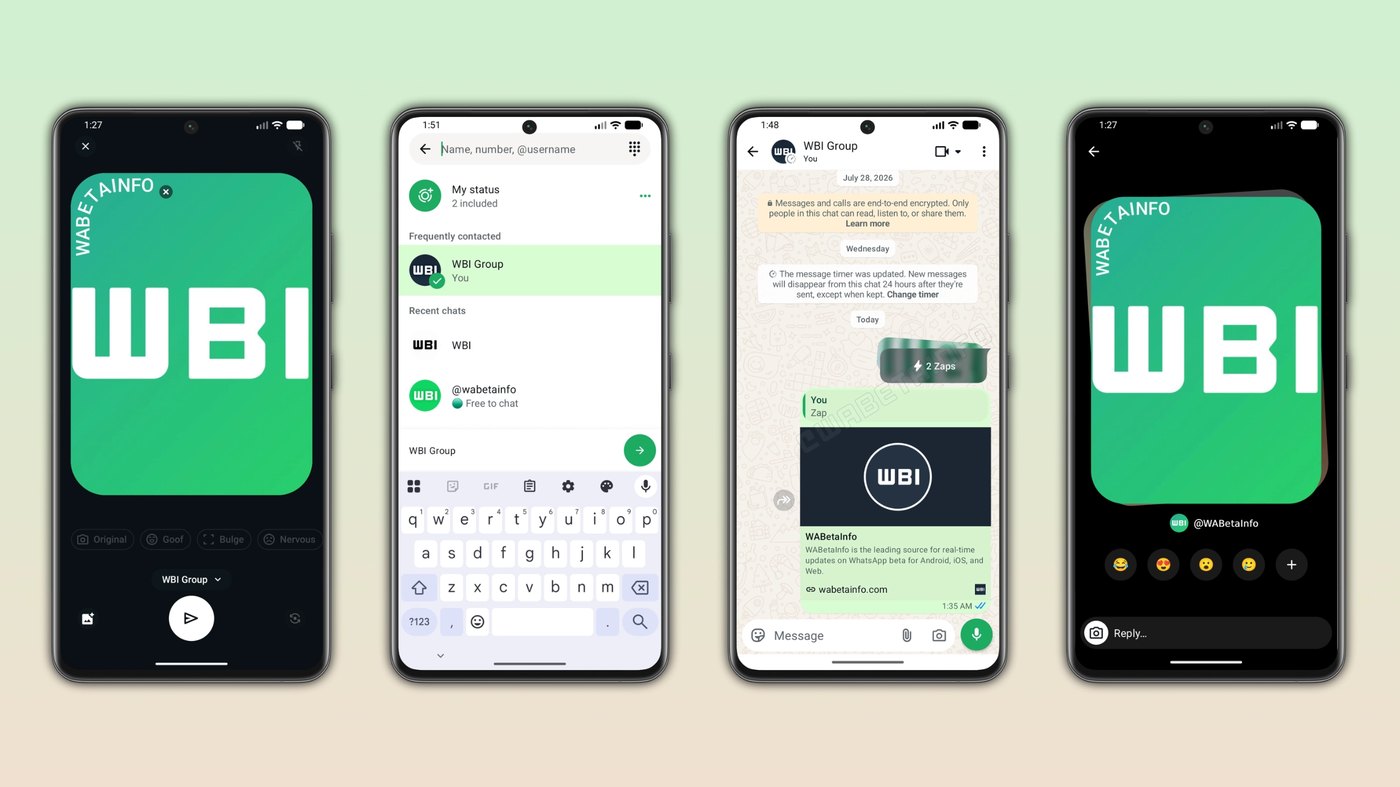
The revised branding reflects the immediate and spontaneous spirit intended for short-lived messaging exchanges. Developers selected the term because a zap conveys speed, directness, and playful urgency during everyday mobile conversations. The existing lightning bolt launcher icon at the top of the interface visually reinforces this energetic naming convention.
The nomenclature simplifies how people track and describe media inside active message logs. Senders deliver a Zap, while recipients open a Zap inside their incoming feed. Whenever someone distributes several consecutive visual clips, the conversation screen adapts by presenting the incoming content as an organized bundle of Zaps.
Advertisement
Tech Pulse Daily
Get tomorrow's pulse first
Join engineers who read Tech Pulse before stand-up. Free, weekday mornings.
03Recipient expansion across groups and channels
Earlier iterations of the instant camera restricted delivery parameters strictly to established mutual contacts. That initial constraint prevented users from sending ephemeral items to unknown numbers or newly initiated conversations. The latest engineering updates remove that barrier, broadening distribution capabilities across the entire WhatsApp user network.
Under the expanded rules, participants can dispatch Zaps to any contact entry as well as multi-member group chats. Group distribution enables communal viewing where members can experience single-view visual clips simultaneously. This modification transforms Zaps from an isolated one-on-one direct messaging feature into an active group communication medium.
Meta is also evaluating distribution avenues that reach broadcast channels. Although internal plans indicate potential channel support, documentation does not confirm whether broadcast compatibility will launch simultaneously with standard chat rollout. Extending ephemeral media to public or subscriber channels would permit administrators to share time-sensitive announcements with broad audiences.
04Inline conversation grouping and message counters
Shared Zaps appear directly inside standard chat feeds instead of being segregated into isolated viewing galleries or dedicated status trays. Recipients encounter incoming ephemeral files alongside regular textual messages and media attachments. This placement ensures that spontaneous clips integrate seamlessly into ongoing dialogue without interrupting conversational flow.
To prevent multiple consecutive uploads from cluttering the screen, WhatsApp groups several files into a unified graphical unit. When an individual transmits multiple Zaps in a single conversation, the software combines them under a single bubble. The container displays an aggregated counter, showing labels like "2 Zaps" directly on the chat timeline.
This consolidation maintains readability across busy conversations by eliminating repetitive message bubbles. Friends exchanging rapid sequences of visual moments do not overwhelm the chat history. The consolidated interface allows participants to navigate back and forth between regular text messages while still seeing clearly how many pending ephemeral files await inspection.
05Dedicated viewing screen and interaction tools
Tapping an incoming Zap opens a full-screen dedicated playback environment tailored for focused media consumption. The recipient sees the sender's account name clearly displayed at the bottom edge of the display. This layout highlights the incoming photo or video while providing distinct interface tools for quick viewer responses.
Recipients can interact directly with the opened media by sending emoji reactions using the full emoji catalog. In addition, an integrated reply bar permits viewers to type and send written feedback immediately. While the media file vanishes for the recipient after viewing, senders retain permanent visual records in their chat history.
Zaps do not appear in the media section of the chat info screen, preserving privacy and keeping media galleries uncluttered. The feature remains under active development on Android and has not rolled out to public beta testers. Meta has not announced an official public release date for the final deployment.
WhatsApp is testing Zaps to send instant FAQ
What are WhatsApp Zaps?
Zaps are ephemeral photos and videos captured through an instant camera feature in WhatsApp that disappear after the recipient views them once. The tool was previously referred to as Instants in earlier testing builds.
How do users open the Zaps camera on WhatsApp?
Users open the camera by tapping the lightning bolt button positioned at the top of the Chats tab on Android. From this screen, they can instantly capture a photo or record a video.
Can Zaps be sent to groups and unsaved numbers?
Yes, WhatsApp is expanding the feature to allow sending Zaps to any contact, unsaved numbers, and group chats. Meta may also introduce channel distribution in the future.
Where are viewed Zaps stored on the recipient's phone?
Zaps disappear from the recipient's view immediately after they are opened and are never saved to the chat info media gallery. Senders, however, retain permanent copies within their chat logs.
Sources

Author
Dillip Chowdary
Writes Tech Bytes coverage of AI, engineering, and the tools that actually ship. Editor of Tech Pulse Daily.
Related on Tech Bytes
Advertisement