WhatsApp launches three new account security updates
WhatsApp released three new account security updates including complex passwords, unknown caller context, and passkeys used by over one billion accounts.
By Dillip Chowdary • Oct 10, 2026 • Source: WABetaInfo
At a glance
- Two-step verification
- Six-digit PIN replaced by account password
- Unknown calls
- Shows other country and mutual group count
- Passkeys
- Over one billion users have activated one
- Chat backups
- Passkeys replace 64-digit recovery keys
- Rollout
- Gradual, phased, on iOS and Android
- User base
- Over three billion active users
WhatsApp launched a trio of account security updates designed to strengthen user account protection and streamline account recovery options across mobile operating systems. In WABetaInfo's report, the messaging service detailed changes to its two-step verification mechanism, expanded contextual data for unknown calls on Android, and broader passkey integration for multi-device environments. With a user base exceeding three billion accounts globally, the Meta-owned platform is adding these secondary protection layers to complement its core end-to-end encryption architecture.
This breakdown details the technical changes behind the release, examining how individual account protections function and who benefits from the updated authentication options. It outlines the specific capabilities rolled out to Android and iOS users, steps required to access the security additions, and broader metrics around passkey adoption across the user base.
01The announcement
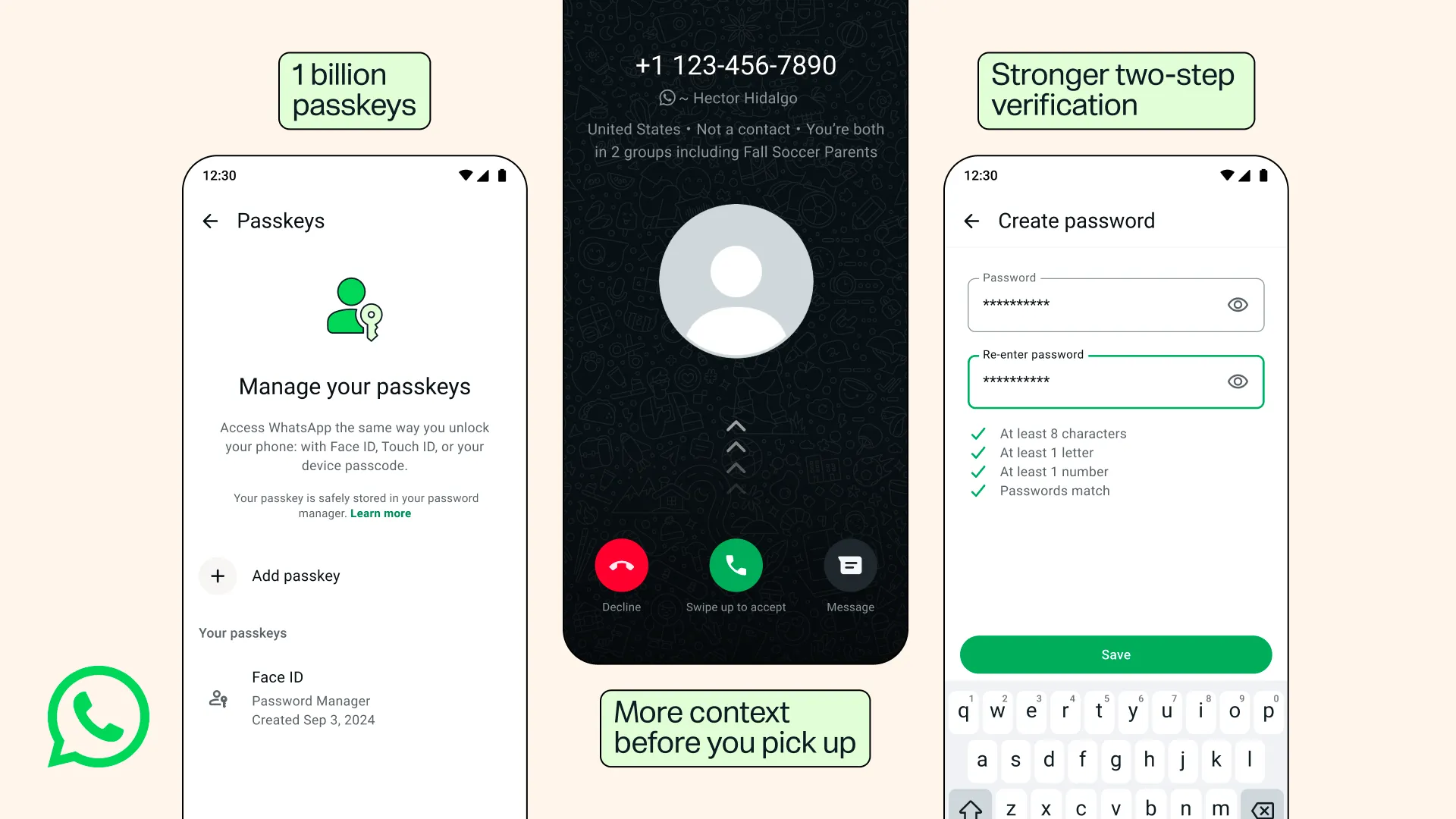
Meta announced three focused account security updates for WhatsApp to prevent unauthorized account access while simplifying recovery procedures. First, the service upgraded its existing two-step verification mechanism by replacing numerical PINs with full account passwords.
Second, Android users gained additional contextual metrics when receiving incoming calls from unfamiliar phone numbers. Third, WhatsApp expanded its passkey infrastructure to support users operating across multiple devices and platforms, while revealing that more than one billion users have already activated a passkey on their accounts.
The security rollout arrives as WhatsApp manages security for over three billion active users. While end-to-end encryption remains the baseline for securing message contents, account-level authentication controls entry points to prevent account takeovers. By expanding verification parameters beyond traditional numerical entry codes, WhatsApp aims to increase defense against automated guessing tools while offering unified authentication alternatives across smartphone hardware.
02What actually changed
The primary authentication change replaces the legacy six-digit PIN for two-step verification with an account password, a feature previously tested in WhatsApp beta for Android 2.26.29.4. Unlike standard numerical PINs, the updated password system supports letters, numbers, and special characters, offering users more complex combinations that increase resistance to brute-force guessing attacks.
For Android users, incoming calls from unknown numbers now display additional screening details directly on the call screen. The interface indicates whether an incoming call originates from a different country and displays the count of mutual groups shared between the recipient and the caller.
Furthermore, the passkey system now supports adding multiple passkeys to a single account, allowing users switching between Android and iOS hardware to maintain biometric authentication on both devices. Passkeys can also secure chat backups with end-to-end encryption, replacing legacy 64-digit recovery keys or custom passcodes with fingerprint, facial recognition, or screen lock verification.
Advertisement
Tech Pulse Daily
Get tomorrow's pulse first
Join engineers who read Tech Pulse before stand-up. Free, weekday mornings.
03Who should care
These security enhancements directly target users navigating high-exposure environments, including individuals managing sensitive personal data or receiving frequent communications from unrecognized callers. The unknown caller context features specifically assist Android users targeted by international spam calls or phishing attempts, providing immediate visual signals when a caller shares no common groups and calls from an external country code.
Multi-device users who transition between iOS and Android hardware benefit from the updated passkey structure, which eliminates platform-locking for biometric credentials. Additionally, users who previously found 64-digit encryption keys for chat backups difficult to manage can now utilize biometrics, such as fingerprint or face lock, to secure their backed-up chat history across devices without relying on stored numerical strings.
04How to try it
WhatsApp is gradually rolling out the new security features to users on both iOS and Android platforms. Users looking to access the upgraded two-step verification password, unknown caller context tools, or expanded passkeys should update WhatsApp to the latest version available in the Google Play Store or Apple App Store.
Because the rollout is phased, features may not immediately appear for every user upon updating the app. Users can inspect their account security settings periodically within the app menu under Settings, Account, and Security to verify when password upgrades and multi-device passkey options become enabled for their specific profile.
05What to watch next
Following the confirmation that over one billion users have registered a passkey, adoption metrics for secondary authentication mechanisms remain a key area of observation. As passkey usage expands to chat backup encryption, the reliance on traditional SMS verification codes and numerical PINs is expected to decline across the user base.
Security researchers and users will monitor how effectively the unknown caller context data reduces spam interactions on Android devices over time. Additionally, as WhatsApp continues deploying these features globally across iOS and Android, future app builds may integrate deeper cross-platform synchronization for biometric credentials and backup management.
Frequently asked questions
What is changing with WhatsApp two-step verification?
WhatsApp is replacing the six-digit numerical PIN for two-step verification with a full account password that supports letters, numbers, and special characters to resist guessing attempts.
How do the new unknown call features work on Android?
Android users receiving calls from unknown numbers will see whether the call originates from another country and how many mutual groups they share with the caller.
How many users have added a passkey to WhatsApp?
WhatsApp confirmed that more than one billion users have added a passkey to their account.
Can passkeys be used for WhatsApp chat backups?
Yes, passkeys can now be used to enable end-to-end encryption on chat backups using biometric authentication like fingerprint, face recognition, or screen lock instead of a 64-digit code.
Sources

Author
Dillip Chowdary
Writes Tech Bytes coverage of AI, engineering, and the tools that actually ship. Editor of Tech Pulse Daily.
Related on Tech Bytes
Fitbit founders launch Luffu Link, an LTE health and safety band
Read →
Pi vs. the official DeepSeek Harness on the same local model (Qwen3.8-27B)
Read →
We open-sourced Myli: a harness for AI design agents
Read →
Now introducing Gemini Enterprise for Legal
Read →
Today's Tech Pulse briefing
Full briefing →
Advertisement